
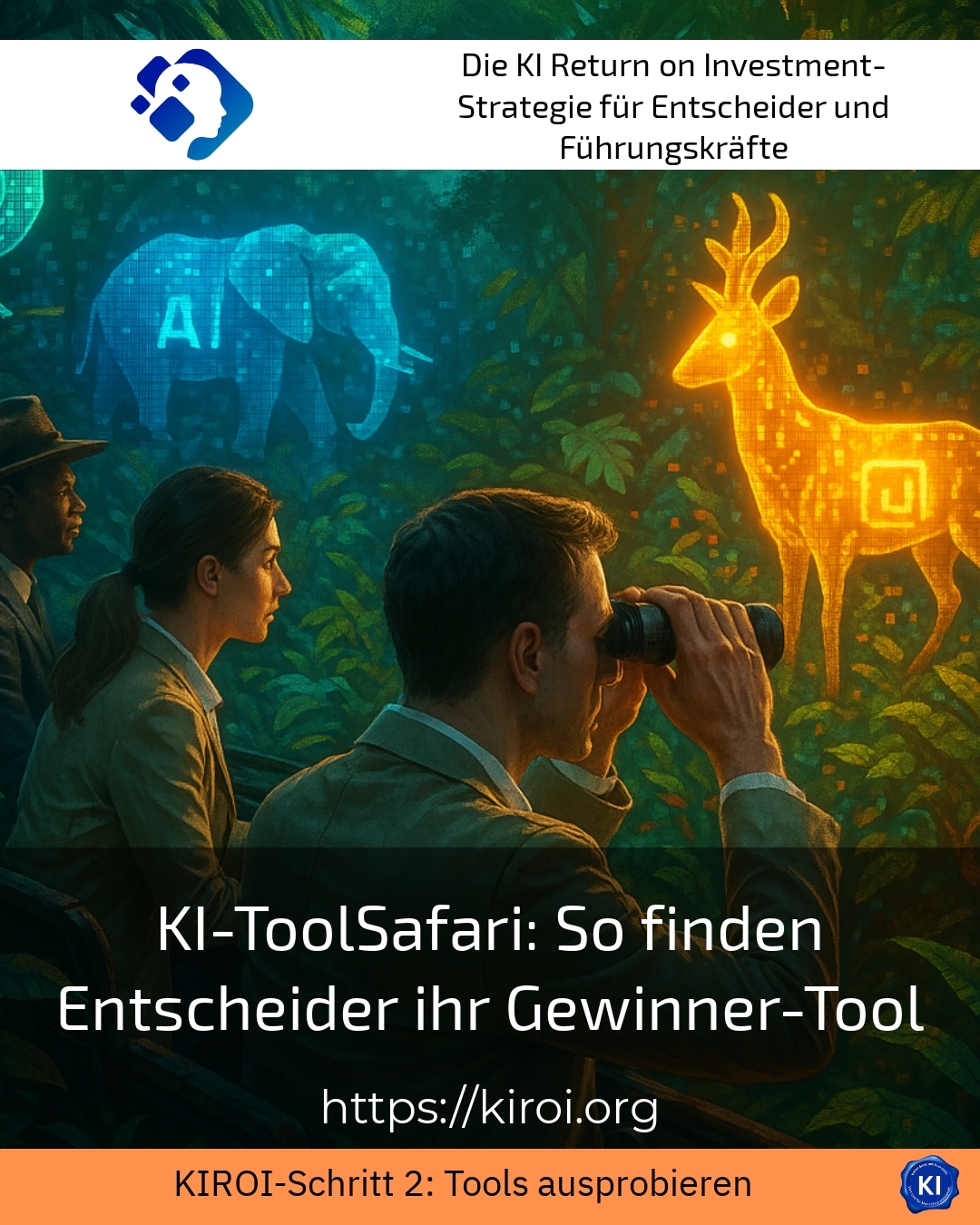
Imagine you find yourself in the middle of an impenetrable jungle, where behind every tree a new digital tool awaits, promising to revolutionise your business processes, and you don't know which path to take. This is precisely the situation faced daily by leaders in manufacturing companies, service providers and medium-sized organisations, who are embarking on a veritable AI Tool Safari must undertake to identify the one tool that meets their specific requirements from the overwhelming abundance of offerings. The selection is akin to an expedition through unknown terrain, where every wrong turn can cost time, resources, and valuable employee trust. This post will guide you through this complex selection process and show you how to proceed systematically so that, in the end, you don't just accept any compromise, but actually find your personal winning tool.
Why the AI Tool Safari is unavoidable for decision-makers today
The landscape of digital tools has changed dramatically in recent years, leaving even experienced leaders facing an overwhelming array of choices. Where only a few providers used to dominate the market, today hundreds of solutions jostle for attention, all promising to optimise work processes and enable increases in efficiency. This diversity brings enormous opportunities on the one hand, as there is a suitable solution for almost every specific requirement, but on the other hand, it leads to decision-making overload.
In the manufacturing industry, for example, production managers are looking for predictive maintenance systems for their machinery. At the same time, marketing departments need tools for automated text generation for campaigns. The HR department, in turn, is interested in solutions that can support the application process. Each of these requirements demands a different approach and a different tool.
In the realm of logistics, we observe companies seeking intelligent route planning systems. Retailers, on the other hand, are focusing on recommendation systems for their online shops. Financial service providers, in turn, require analytical tools for risk assessment. This diversity shows how individual the requirements are.
Best practice with a KIROI customer
A medium-sized mechanical engineering company from southern Germany faced the challenge of selecting the right analytical tool for quality control from over thirty different options. The company initially attempted to make this decision without external support, which led to months of internal discussions with various departments having different preferred choices. With the support of transruptions coaching, a structured evaluation process was established that involved all relevant stakeholders. Together, we developed a catalogue of criteria that considered both technical and organisational aspects. The result was a well-founded decision for a system that is now successfully employed in production. Employees frequently report that they felt more involved due to the structured process. The acceptance of the new tool was significantly higher than the management's expectations.
The five phases of a successful AI tool safari
Successful expeditions into unknown territory never begin without thorough preparation. Decision-makers who embark on the search for the optimal digital tool ideally go through five clearly defined phases, each with its own challenges and success factors.
Phase 1: Taking stock of your own needs
Before you embark on your search, you need to understand what you are looking for in the first place. In the automotive supply industry, this often means analysing existing quality inspection processes. In healthcare, it's about understanding documentation workflows and identifying areas for optimisation. In the insurance sector, on the other hand, the focus is on claims processing procedures, where manual activities are to be reduced.
During this stocktake, managers often approach us with issues such as time pressure, a lack of resources, and unclear requirements [1]. They report situations where different departments have differing ideas. Communication between IT and specialist departments is often difficult. External support can provide valuable impetus here.
Phase 2: Mapping the Tool Jungle
Once individual needs are clear, the systematic recording of available options begins. This often reveals that the market is far more diverse than originally assumed. In the pharmaceutical industry, specialised solutions for drug development exist that fundamentally differ from general analysis tools. In the e-commerce sector, in turn, highly specialised systems for shopping cart optimisation can be found, which have different strengths to generic personalisation solutions [2].
For instance, the telecommunications sector uses network optimisation tools. Energy providers rely on load forecasting systems. Transport companies are interested in intelligent fleet management solutions. This specialisation makes the selection more demanding.
Navigating the AI Tool Safari Successfully: Criteria for Selection
When navigating the jungle of tools, decision-makers need a reliable compass in the form of clear evaluation criteria that go beyond superficial marketing promises and can assess actual suitability for the specific application.
In the banking sector, for instance, compliance with regulatory requirements plays a central role in tool selection. For media companies, however, scalability in the face of high content volumes is paramount. Production companies, in turn, pay particular attention to integration with existing machine control systems.
Best practice with a KIROI customer
A retail company with several hundred branches was looking for a demand forecasting system to optimise stock levels while simultaneously increasing customer satisfaction. The initial shortlist comprised seven different providers, all of whom had delivered promising presentations. As part of our support, we jointly developed a practical testing process whereby the tools had to work with real company data. It quickly became apparent that while some solutions delivered impressive demonstrations, they struggled with the company's specific data structures. Other providers, conversely, impressed with their flexibility and adaptability. The transruptions coaching helped in asking the right questions and objectively evaluating the results. Ultimately, the decision was made for a solution that was not initially among the favourites but proved to be superior in the practical test. The implementation proceeded successfully, and branch managers today report significantly improved processes.
Technical criteria versus organisational requirements
Decision-making processes often focus too heavily on technical specifications, while neglecting organisational aspects, even though these are at least as crucial for long-term success. A technically superior tool can fail if employees do not accept it. Conversely, a less powerful solution can be successful if it is well integrated into workflows [3].
In the chemical industry, we observe that laboratory assistants are often sceptical of new digital tools. In publishing, on the other hand, editors frequently show reservations about automated text processing systems. In the catering industry, however, intelligent ordering systems are often accepted more quickly than expected.
The human factor in AI tool safaris
The best technical solution remains ineffective if it is not adopted by the people who are supposed to work with it. Therefore, the early involvement of employees is a critical success factor for any tool implementation.
In the tourism industry, we see travel agents initially viewing new booking systems with skepticism. Architects in planning offices show similar reactions to new design tools. Office workers in government agencies report anxieties regarding their job security. Taking these concerns seriously is part of a successful implementation strategy.
Supporting these transformation processes requires sensitivity and experience. Management often approaches us with the desire to overcome employee resistance. Together, we then develop approaches that focus on involvement rather than persuasion. Experience shows that employees who are involved early on can later become the strongest proponents.
Best practice with a KIROI customer
A service company in the consulting sector wanted to introduce a new project documentation tool, but encountered significant resistance from experienced consultants who did not want to abandon their established working methods. Instead of enforcing the introduction from the top down, we developed a participatory process together, in which the consultants themselves were involved in the final selection. We organised workshops where the various options were presented and discussed. The consultants were able to voice their concerns and formulate their own requirements. Although this process took longer than originally planned, it led to significantly higher acceptance. Today, almost all consultants regularly use the selected tool. Management reports improved project documentation and faster onboarding processes for new employees. The initial extra effort has more than paid off.
Minimising risks through structured pilot projects
A proven method for risk mitigation is to conduct structured pilot projects where the selected tool is first tested in a limited area before company-wide implementation.
In food production, pilot projects can start, for example, on a single production line. In the education sector, individual courses or degree programmes are suitable as a test environment. Medical facilities often start with a department before expanding to the entire hospital [4].
My KIROI Analysis
The AI Tool Safari Decision-makers face complex challenges that go far beyond the purely technical evaluation of tools, encompassing profound organisational, cultural, and strategic dimensions. In my experience supporting numerous companies through these decision-making processes, it repeatedly becomes clear that success depends less on choosing the perfect tool and more on the quality of the selection process itself.
Decision-makers who take sufficient time for needs analysis make better decisions. Companies that involve their employees early on experience less resistance during implementation. Organisations that start with pilot projects can better control risks. These insights may sound self-evident, but they are surprisingly often ignored in practice.
Guidance through transruptive coaching can provide valuable impetus by creating a structured framework for the decision-making process while also taking into account the specific circumstances of each company. The aim is not to make the decision for the company, but to enable the internal decision-makers to make a well-founded and sustainable choice.
Ultimately, every AI Tool Safari a learning journey where the company not only finds a new tool but also gains valuable insights into its own processes, structures, and cultures. These insights are often at least as valuable as the tool itself, because they form the basis for future decisions and strengthen the organisation's maturity.
Further links from the text above:
[1] Gartner – Artificial Intelligence Insights
[2] McKinsey – The State of AI
[3] Harvard Business Review – Artificial Intelligence
[4] Bitkom – Artificial Intelligence
For more information and if you have any questions, please contact Contact us or read more blog posts on the topic Artificial intelligence here.











 Deutsch
  English (UK)