
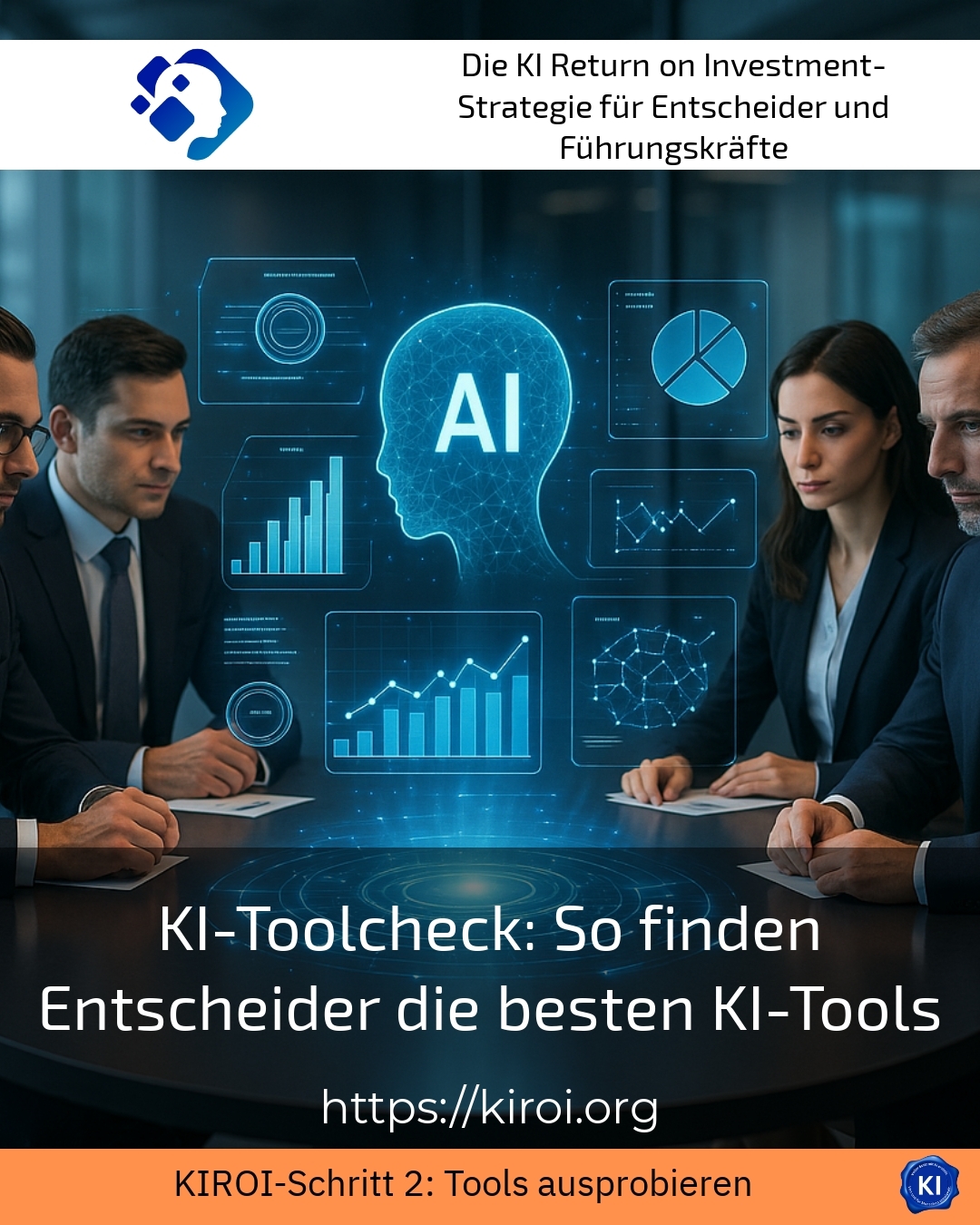
Imagine standing before a vast toolbox filled with hundreds of gleaming instruments, each one promising groundbreaking results for your business. However, choosing the right tool determines whether your projects succeed or end in costly missteps. This is precisely the situation countless leaders in intelligent automation and data-driven decision-making are currently facing. A structured AI Toolcheck This provides the necessary guidance to select, from the multitude of available solutions, those that actually fit your own business model. But how do you proceed methodically when technological complexity meets economic necessities?
Why a systematic AI tool check has become indispensable
The landscape of intelligent software solutions has changed dramatically in recent years. Previously, it was sufficient to compare a few established providers. Today, hundreds of providers compete for the attention of decision-makers. This diversity holds both opportunities and considerable risks for companies of all sizes.
Let's first consider the area of text generation and communication automation. Companies use such tools for customer service, marketing texts, and internal documentation. The quality differences between various providers are significant and only become apparent during practical application. For example, a retail company implemented a solution for automated product descriptions but found that the generated texts did not match the brand image. An insurance company tested several chatbot solutions in parallel and discovered massive differences in the depth of understanding for complex customer inquiries. A logistics service provider, on the other hand, benefited enormously from a solution for automatic document creation because it was precisely tailored to industry-specific requirements.
Such examples illustrate why superficial comparisons are not sufficient. Investing in a comprehensive evaluation pays off in the long term, because poor decisions in this area have costly consequences and because switching to another provider ties up significant resources.
Criteria for an effective AI tool check in practice
When evaluating intelligent tools, several dimensions play a crucial role. Technical performance forms only the foundation. Furthermore, decision-makers must consider integration into existing systems, scalability, and long-term further development.
A medium-sized manufacturing company evaluated various solutions for quality control using image analysis. The technically superior solution failed due to a lack of integration into the existing production control system. A financial service provider examined fraud detection tools and found that regulatory requirements were not equally met by all providers [1]. A retail chain, in turn, required a demand forecasting solution, where accuracy during seasonal fluctuations made the decisive difference.
These examples show that the context is a key factor in the selection process. What works optimally for one company may be entirely unsuitable for another. Therefore, a structured approach that focuses on individual requirements is recommended.
Best practice with a AIROI customer An internationally operating mechanical engineering company faced the challenge of optimising its service processes through intelligent automation while simultaneously maintaining the industry's high quality standards. As part of transruption coaching, we accompanied the company over several months in the systematic evaluation of various providers for predictive maintenance and automated service ticket processing. Initially, we jointly developed a detailed requirements catalogue, which encompassed both technical and organisational aspects, integrating the perspectives of different departments. Subsequently, we defined clear evaluation criteria and weighted them according to the company's strategic priorities. The testing phase involved three shortlisted providers, each of whom conducted a proof of concept using real company data. The result surprised management because the winner was not the best-known provider, but a specialised solution tailored precisely to the requirements of the manufacturing sector. The implemented solution now significantly reduces unplanned machine downtime and considerably speeds up the processing of service requests.
The human factor in AI tool checks
Technical excellence alone does not guarantee success when implementing intelligent tools. Employee acceptance is a decisive factor for practical benefit. Therefore, a comprehensive selection process must also consider user-friendliness and training requirements.
A healthcare provider introduced a documentation support solution for medical staff. Initial resistance from the workforce initially prevented the expected efficiency gains. A telecommunications company, on the other hand, invested heavily in change management measures, thereby achieving a high adoption rate among its sales staff [2]. An auditing firm involved its professionals early in the selection process and benefited from their practical assessments of the solutions tested.
Involving the end-users in the evaluation process not only increases the quality of the decision. It also creates acceptance and trust, because people are more likely to support changes if they were involved.
Methodical Approach to Sustainable Decisions
Ideally, a structured selection process is divided into several phases. The first phase involves the precise definition of requirements and objectives. Insights from transruption coaching are helpful here, as they shift the focus beyond operational details to strategic contexts.
In the second phase, market research is carried out to systematically map out the supplier market. One energy provider used specialised analyst reports and trade publications. A hotel chain relied on recommendations from industry networks and testimonials from partner companies. A pharmaceutical company engaged external consultants who possessed in-depth market knowledge in the regulated environment [3].
The third phase involves the practical testing of the most promising candidates. This is where the actual strengths and weaknesses of the different solutions become apparent. An automotive supplier tested three providers in parallel over an eight-week period. A bank conducted a structured proof of concept with clearly defined success metrics. A media company allowed its editors to test various content creation tools in their day-to-day work.
Pitfalls and how to avoid them when checking AI tools
Clients often report challenges that only became apparent after implementation. These experiences highlight the importance of thorough preliminary investigation. Typical problem areas include hidden costs, insufficient data protection compliance, and a lack of customisation options.
An e-commerce company underestimated the ongoing costs of computing capacity and interface maintenance. A recruitment agency encountered problems with GDPR-compliant processing of applicant data. An authority could not adapt the chosen solution to its specific processes because the provider did not offer sufficient configuration options [4].
The support of experienced partners helps to identify such stumbling blocks early on. As part of transruption coaching, we develop checklists and evaluation grids specifically tailored to your situation together with you.
Best practice with a AIROI customer A large insurance group wanted to accelerate its claims processing through intelligent automation while simultaneously improving customer satisfaction. The challenge was to select the right solution from over twenty providers that would harmonise with legacy systems and meet strict compliance requirements. We supported the project team in creating a weighted decision matrix that considered technical, economic, and organisational criteria equally. The involvement of the specialist departments was particularly important, as their expertise was essential in evaluating the accuracy of damage claim recognition. The multi-stage selection process initially involved a preliminary selection based on publicly available information and references. This was followed by structured provider presentations and, finally, an extensive pilot test with real, anonymised damage claims. The company ultimately opted for a provider that not only impressed technically but also offered a long-term partnership for continuous further development. The solution is now a key component of the company's digital transformation.
Long-term perspectives and strategic considerations
Choosing a tool is not a one-off decision, but the beginning of a long-term relationship. Decision-makers should therefore include the future viability of suppliers and their development roadmap in their considerations.
A technology group deliberately chose a smaller, specialised provider because its development focus perfectly matched their own strategy. In contrast, a retail chain preferred an established platform provider that guaranteed stability and broad functionality. A startup opted for an open-source solution that offered maximum flexibility for customisation [5].
These different approaches illustrate that there is no universally correct choice. The optimal decision depends on numerous factors that must be carefully weighed against each other. Guidance from experienced coaches can provide valuable impetus and uncover blind spots.
Integration into the company strategy
Intelligent tools only realise their full benefit when they are embedded in the overarching corporate strategy. Isolated, siloed solutions often lead to inefficiencies and user frustration.
A chemical company first developed a comprehensive digitalisation strategy before beginning to evaluate individual tools. A construction company closely linked its tool selection to the goals of its sustainability initiative. A media house consistently aligned its decisions with its content strategy, which led to coherent results.
My AIROI Analysis
The systematic evaluation of intelligent tools has established itself as a critical success factor for companies across all industries. Experience gained from numerous accompanying projects clearly shows that structured approaches and clear criteria make the difference between successful implementations and costly wrong decisions. This is not only about technical aspects but about a holistic understanding of business requirements.
It is particularly striking that many decision-makers underestimate the time required for a thorough evaluation. The temptation to make a quick decision and begin implementation often leads to suboptimal results. At the same time, we observe that companies that invest in a structured AI Toolcheck invest, are more successful in the long term and achieve higher user satisfaction ratings.
The role of external support is becoming increasingly important, as internal teams often lack the necessary market overview and methodological expertise. Transruption coaching offers a valuable framework here, providing structure and direction without restricting entrepreneurial freedom of decision. The combination of specialist expertise and a neutral external perspective creates optimal conditions for well-founded decisions that will also hold up in the long term.
Further links from the text above:
[1] BaFin – Artificial Intelligence in Financial Supervision
[2] McKinsey – The State of AI
[3] Gartner – Artificial Intelligence Insights
[4] Bitkom – Artificial Intelligence
[5] Fraunhofer – Research Field Artificial Intelligence
For more information and if you have any questions, please contact Contact us or read more blog posts on the topic Artificial intelligence here.









 Deutsch
  English (UK)