
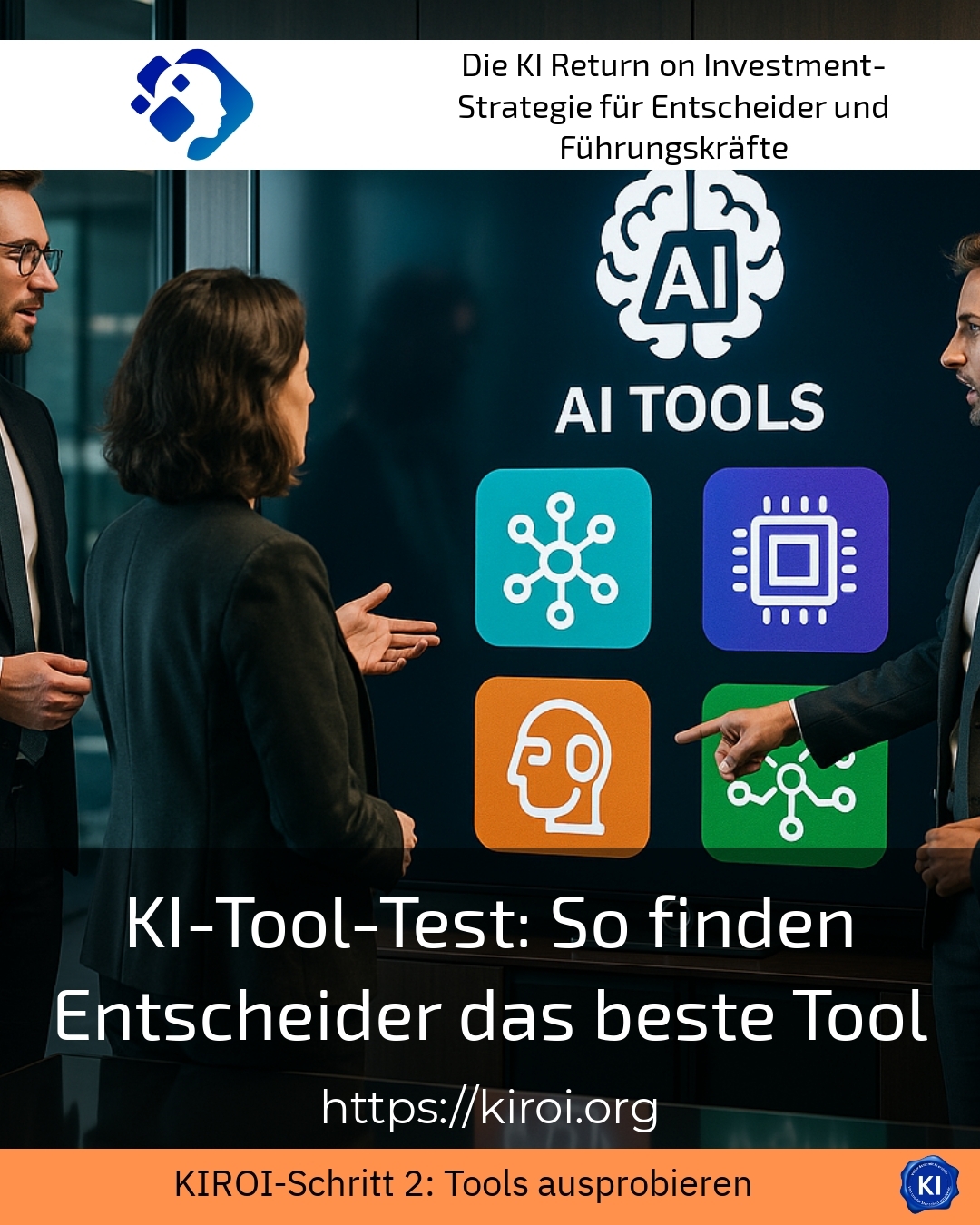
Digital transformation presents leaders with one of the most significant challenges of our time, because the selection of the right technological tools decisively determines the future success of a company. While the market is literally flooded with solutions that all promise revolutionary results, many decision-makers lack the systematic approach to separate the wheat from the chaff. A well-thought-out AI Tool Test This forms the foundation for informed investment decisions. This is where a structured approach goes beyond superficial product comparisons. This article will guide you through the complex process of tool selection and provide you with practical insights for your own evaluation.
The strategic dimension of the AI tool testing for modern companies
Decision-makers often report a veritable overload in the face of the sheer volume of available solutions on the market. For example, in the financial sector, there are hundreds of specialized applications available, ranging from automated fraud detection to intelligent portfolio analyses to customer communication. Banks and insurance companies are already using systems that evaluate credit applications within seconds, taking into account thousands of data points. Another example can be found in asset managers that implement algorithmic trading strategies and rely on machine learning to anticipate market movements early [1].
The challenge lies in the fact that not every highly praised tool actually fits the specific context of a company. Transruptions coaching supports organizations precisely at this critical phase of orientation and decision-making. It is not about general recommendations, but about an individual analysis of the specific requirements. Many executives face questions regarding integration into existing IT environments or acceptance among employees. These issues deserve thorough consideration before even comparing technical specifications.
Best practice with a AIROI customer
A medium-sized financial services company faced the challenge of supporting its customer advisory services through intelligent assistance systems while fully meeting the regulatory requirements of BaFin. The management had already contacted several providers and was uncertain about the compliance issues. As part of the AIROI mentoring process, we jointly developed a structured criteria catalog that took into account both technical and legal aspects. The evaluation included intensive testing phases with three selected solutions under realistic conditions. The involvement of the compliance department from the outset proved particularly valuable, as potential conflict areas were identified early on. After a three-month process, the company decided on a solution that did not offer the most extensive features, but was optimally suited to the existing infrastructure. The employees took the system positively because they had been actively involved in the selection process. Clients often report that this participatory approach is what makes the crucial difference for later acceptance.
Systematic criteria for a meaningful AI tool test
The development of a robust evaluation framework forms the core of any professional tool selection. In the logistics industry, for example, leading freight forwarders rely on route optimization systems that process traffic data, weather conditions, and delivery windows in real time. Through such systems, DHL and other major logistics service providers have significantly increased their efficiency [2]. Another field of application is warehouse management, where intelligent systems generate demand forecasts and automatically trigger orders. Predictive models are also increasingly being used in the area of shipment tracking, which predict delays and proactively suggest alternatives.
A thoughtful AI Tool Test It takes into account multiple dimensions simultaneously and avoids a one-sided focus on individual aspects. The functional level encompasses the concrete capabilities of the tool and their alignment with business requirements. In addition, technical integration plays a central role because even the most powerful system remains worthless if it does not communicate smoothly with existing applications. The organizational dimension considers training costs, change management requirements, and cultural fit with the company. Finally, economic aspects such as total operating costs, scalability, and amortization periods deserve thorough analysis.
The AI tool test in practical implementation
The practical implementation of an evaluation project requires a clear structure and defined responsibilities. In healthcare, this is particularly evident when clinics want to introduce diagnostic support systems. Radiology departments are already frequently using applications that support the detection of abnormalities in imaging procedures. For example, Charité in Berlin has conducted pilot projects to test various solutions under clinical conditions [3]. Innovative approaches can also be found in pathology, where tissue samples are analyzed automatically. Pharmaceutical companies, in turn, rely on intelligent systems to accelerate drug development.
Transruptions coaching helps decision-makers define a realistic test framework that yields meaningful results. Clients often report that they underestimated the complexity at the beginning of a project. A step-by-step approach with clearly defined milestones has proven particularly effective. The first step typically involves a review of the current processes and a prioritization of the pain points to be addressed. This is followed by a market research that goes beyond the usual suspects and also considers specialized niche providers. The actual testing phase should take place under conditions that are as realistic as possible and cover various scenarios.
Best practice with a AIROI customer
A manufacturing company in the mechanical engineering sector was looking for ways to optimize its quality control through image-based analysis systems and significantly reduce the rejection rate. The production involved highly precise components where even minimal deviations could lead to malfunctions. Together with the AIROI team, a two-stage evaluation process was developed, which initially made a preliminary selection based on documented reference projects. Five suppliers were invited to present their solutions, where we deliberately asked critical questions regarding error tolerance and threshold values. Three systems were shortlisted and installed in parallel on a test production line. The quality assurance staff systematically documented all anomalies and alarm messages over a period of six weeks. The comparison of the systems was particularly revealing in difficult-to-evaluate boundary cases where significant differences in reliability were evident. The final decision was in favor of a solution that required slightly longer analysis time but produced significantly fewer false alarms. This finding would not have been possible without the parallel practical test.
Typical pitfalls in tool selection and how to avoid them
The experience from numerous accompaniment projects reveals recurring patterns that can endanger decision-making processes. In retail, for example, some companies have invested substantial sums in personalization systems without previously verifying the quality of their customer data. Fashion chains such as Zalando or H&M use sophisticated recommendation algorithms, which however only work if sufficient actionable data is available [4]. Food retailers rely on intelligent demand forecasts to reduce waste and optimally dispose of fresh products. In the area of price optimization, numerous applications are also found that enable dynamic price adjustments based on demand and competition.
A common mistake is placing excessive emphasis on product demonstrations that naturally present idealized conditions. Sales presentations are designed to make the tool appear in the best possible light, and rarely take into account the specific challenges of the potential customer. Instead, decision-makers should insist on reference visits where they can speak with actual users. These conversations often provide valuable insights into implementation challenges and hidden costs. Soliciting independent expert opinions can also help distinguish marketing promises from realistic performance metrics.
The human component in the evaluation process
Technical excellence alone does not guarantee project success, because the acceptance by employees plays an equally important role. In the media industry, this is particularly evident in the introduction of automated content creation systems. News agencies such as Reuters are already using algorithmic text generation for standardized reports on financial results or sporting events. Publishers are experimenting with tools that support editorial workflows and assist in research. Advertising agencies are also increasingly relying on creative assistance systems that generate design drafts or suggest campaign ideas.
Involving later users in the evaluation phase has proven to be a crucial success factor. Employees who were allowed to participate in the selection process show a significantly higher willingness to adapt their working methods. Transruptions coaching helps teams to openly articulate concerns and to contribute constructively to the decision-making process. Many people approach such conversations with fears of losing their jobs or concerns about increasing surveillance. These concerns deserve serious consideration, because ignored resistance can later lead to sabotage or passive refusal.
Long-term perspectives and sustainable decisions
The rapid pace of the technology market requires decisions that will still be viable even in a few years. In the automotive industry, manufacturers are investing heavily in systems for autonomous driving, predictive maintenance, and personalized driver experiences. BMW and Mercedes-Benz have established their own competence centers to advance the integration of intelligent systems [5]. Suppliers are using machine learning to optimize production processes and predict machine breakdowns. Intelligent battery management systems are also playing an increasingly important role in the field of electric mobility.
A future-oriented AI Tool Test Therefore, it takes into account not only the current functionality but also the provider’s development strategy. The financial stability of the company, the size of the developer community for open source solutions, and the roadmap for upcoming versions deserve attention. Open interfaces and standardized data formats increase flexibility for future adjustments or a change of provider. The question of data ownership and the portability of one’s own information also gains importance, because dependencies on individual providers pose strategic risks.
Best practice with a AIROI customer
An energy provider planned the implementation of intelligent load forecasting and network optimization systems, taking into account the volatile feed-in from renewable sources. The particular challenge was integrating heterogeneous data sources from wind farms, solar installations, and conventional power plants. AIROI The team assisted in defining a comprehensive requirements catalog that explicitly considered scenarios for the energy transition of the coming decade. In the vendor evaluation, we placed particular emphasis on the systems’ ability to handle increasingly decentralized structures. The testing phase included both historical data and simulated extreme scenarios that had not occurred in the previous operational history. One vendor withdrew because its system did not cope with certain load peaks, although the initial standard tests seemed promising. The final solution convinced with a modular architecture that enabled successive expansions without fundamental system changes. The customer particularly appreciated the honest advice regarding the limits of current technologies and the realistic expectations.
My AIROI Analysis
Coaching numerous organizations in selecting tools has shown me that technical brilliance alone is rarely the deciding factor for project success. Rather, what is crucial is the fit between the solution and the company’s context, the careful preparation of organizational change, and a realistic assessment of one’s own data base and process maturity. Many decision-makers significantly underestimate the effort involved in integration, training, and continuous optimization, because vendor promises often paint an overly optimistic picture.
My recommendation is therefore to use the AI Tool Test Not to be viewed as an isolated technical exercise, but as a strategic project with far-reaching implications. The investment in thorough preparation pays off many times over, because misjudgments in this area can have costly consequences. Transruptions coaching provides valuable support that goes beyond mere product comparisons and adequately considers the organizational dimension. The best results are achieved when technical expertise, industry knowledge, and change management expertise work together.
Often, clients report after completed projects that the process itself was at least as valuable as the final result. The intensive discussion of one’s own requirements leads to insights that go far beyond the original question posed. I therefore encourage decision-makers not to go down this path alone but to seek competent guidance that asks critical questions and reveals blind spots. The market is evolving rapidly, and informed decisions today lay the foundation for tomorrow’s success.
Further links from the text above:
[1] McKinsey: Artificial Intelligence in the Banking Sector
[2] DHL Innovation and Technology
[3] Charité Berlin: Current research projects
[4] Zalando Technology and Innovation
[5] BMW Group Innovation
For more information and if you have any questions, please contact Contact us or read more blog posts on the topic Artificial intelligence here.











 Deutsch
  English (UK)