
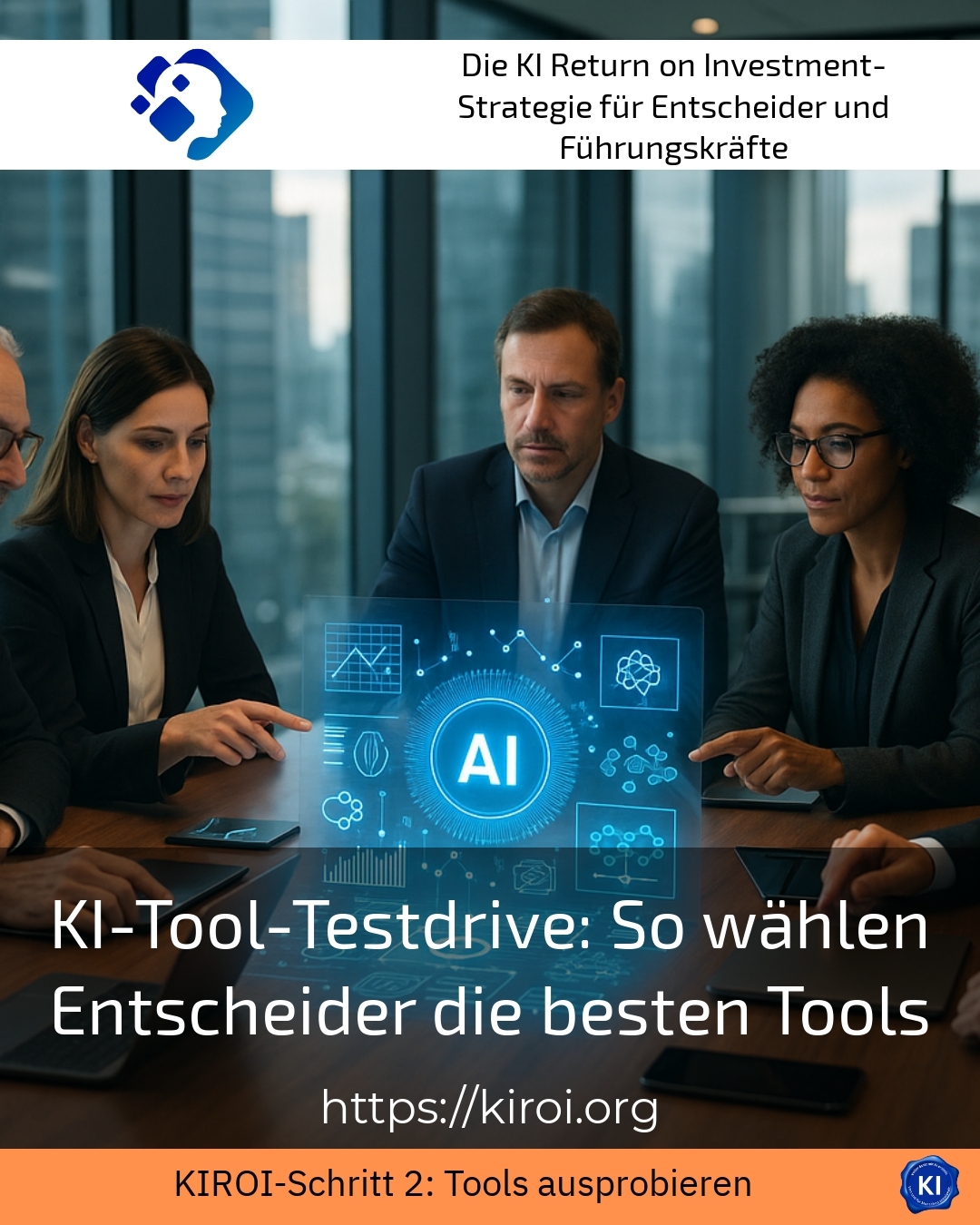
Digital transformation presents leaders with a central challenge: which intelligent tools are truly suitable for their own company? The AI Tool Test Drive: How decision-makers choose the best tools This becomes a strategic necessity, as the selection of the right solution is of paramount importance for business success. While the market tempts with hundreds of providers, many decision-makers lack a structured approach to evaluation. This article demonstrates in a practical way what smart evaluation processes can look like and which criteria can help in the decision-making process.
Why a structured selection process is indispensable
Decision-makers today face a paradoxical situation which, on the one hand, offers many opportunities, but on the other hand also carries significant risks. The variety of available solutions is growing continuously. At the same time, the pressure to act quickly and not lose ground to competitors is increasing. Many companies are investing considerable sums in technologies that later fail to deliver the expected benefits [1].
A systematic evaluation approach helps to avoid costly wrong decisions. It allows different solutions to be compared objectively. Furthermore, it creates transparency for all stakeholders within a company. Small and medium-sized enterprises in particular often lack dedicated resources for extensive market analyses.
Experience shows that successful implementations are usually based on careful preparation. Companies that clearly define their requirements achieve better results. They avoid the typical pitfalls that occur with rushed rollouts. This creates a solid foundation for sustainable digital transformation.
Best practice with a KIROI customer
A medium-sized mechanical engineering company faced the challenge of optimising its production planning while evaluating various intelligent systems. Initially, the company tested three different providers without a structured approach, leading to confusion and conflicting assessments from various departments. As part of the KIROI support, we collaboratively developed a standardised evaluation catalogue with weighted criteria. This included technical aspects such as integration capability and scalability, as well as organisational factors like training effort and change management requirements. The specialist departments received clear evaluation sheets that enabled objective comparability. Following a structured test run of four weeks per solution, the company was able to make an informed decision. The chosen solution was successfully implemented within three months and is now actively used by all relevant employees. The early involvement of the future users in the selection process was particularly valuable, as this significantly increased acceptance.
AI Tool Test Drive: The Key Evaluation Criteria
When evaluating intelligent tools, various dimensions play a crucial role that should be systematically considered by decision-makers. Firstly, functional suitability is paramount, as the solution must be able to meet the specific requirements of the company. This not only concerns current needs but also future development potential [2].
Technical integration represents another critical factor. Modern solutions must be able to work seamlessly with existing systems. Interfaces to ERP systems, CRM platforms, and other applications are essential. Isolated solutions that do not communicate create more problems than they solve.
Furthermore, user-friendliness deserves special attention. Even the most powerful technology remains ineffective if employees do not accept it. Intuitive interfaces and well-thought-out workflows significantly promote adoption. Complicated operating concepts, on the other hand, lead to frustration and rejection.
So, how do managers design an effective test drive?
A successful evaluation process begins with the precise definition of test scenarios that reflect real-world working life. Abstract demonstrations by vendors often convey an overly positive picture. Only practical use with real data and actual tasks reveals strengths and weaknesses. Therefore, it is advisable to define concrete use cases.
The involvement of various stakeholders significantly enhances the validity of the tests. IT professionals assess technical aspects, while business users evaluate practical usability. Management considers strategic dimensions and business benefits. This creates a comprehensive picture from different perspectives.
The timeframe for test phases should be set realistically. Evaluations that are too short provide superficial impressions. Phases that are too long unnecessarily delay important decisions. A period of four to eight weeks has proven to be sensible in practice.
Best practice with a KIROI customer
A logistics company with multiple sites wished to use intelligent systems to support its route planning and warehouse management and approached KIROI Coaching for a guided evaluation. Together, we identified five critical business processes to serve as test scenarios, including daily route planning and inventory optimisation. For each process, we defined measurable success criteria such as time savings, error reduction, and employee satisfaction. Three different providers were given the opportunity to demonstrate their solutions in a controlled environment. Dispatchers conducted the tests and documented their experiences in standardised protocols. The comparison of the planning results with the routes actually taken was particularly insightful. One solution impressed with significantly better suggestions and was ultimately selected. transruptions Coaching then supported the implementation and change management, ensuring a smooth introduction and rapid acceptance of the new technology by the employees.
Avoiding common mistakes when choosing tools
Many companies make typical mistakes during evaluations, which can be avoided through conscious action [3]. A common misconception is to be blinded by impressive presentations. Sales representatives naturally highlight their products' strengths. Critical weaknesses are rarely mentioned.
The neglect of hidden costs represents another common error. Licensing fees often only reflect a portion of the total costs. Implementation, training, maintenance, and later adjustments cause additional expenses. A realistic total cost consideration protects against unpleasant surprises.
The lack of consideration for organisational aspects also frequently leads to problems. Technology alone does not solve business problems. Adapting processes and qualifying employees are equally important. Successful transformations combine technical with organisational measures.
The role of references and testimonials in tool test drives
Exchanging ideas with other users provides valuable insights that go beyond glossy brochures. Companies that already use a solution can report authentically on the pros and cons. They can answer specific questions about practical use. Such conversations often reveal aspects that are missing from official materials.
Industry-specific references are particularly valuable. A system that works in retail is not automatically suitable for production. The requirements of different industries differ significantly. Therefore, reference customers should come from your own business sector.
Online reviews and analyst reports usefully supplement direct conversations. They offer a broader overview of market assessments. However, such sources should be viewed critically. Not every review is written independently and objectively.
Strategic aspects of tool selection
As well as operational criteria, strategic considerations play an important role in decision-making. The long-term development of the provider influences the future security of the investment. Established companies tend to offer more stability. Start-ups, on the other hand, often bring innovative approaches, but also higher risks.
The flexibility of the solution also deserves attention. Business requirements are constantly changing. A rigid system can become an obstacle. Modular architectures and open interfaces allow for customisation [4].
Data protection and compliance are increasingly important. Solutions must meet regulatory requirements. The processing of sensitive data requires appropriate security measures. European providers often offer advantages in terms of data storage.
Best practice with a KIROI customer
A financial services provider with strict regulatory requirements was seeking a solution for automated document processing and approached the KIROI network for support in selecting one that was compliant. The particular challenges lay in the high demands for data protection and traceability, which is why we jointly developed an expanded catalogue of criteria. This included not only functional aspects but also certifications, auditing capabilities, and data retention options as central evaluation points. Of the eight providers initially considered, only three met the minimum regulatory requirements at all, highlighting the importance of early compliance checks. These three candidates were then compared in a detailed testing process, involving the legal department actively. The ultimately chosen solution impressed with transparent processing and seamless logging of all operations. The transruption coaching supported the creation of the necessary documentation for the supervisory authority, which significantly accelerated the entire process.
My KIROI Analysis
The selection of suitable intelligent tools presents decision-makers with complex challenges that require a systematic approach. The AI Tool Test Drive: How decision-makers choose the best tools is not a one-off event, but a continuous process of evaluation and adaptation. Successful companies establish structured evaluation procedures that integrate various perspectives and enable objective comparisons.
Experience shows that technical excellence alone is not decisive for success. Rather, the interplay of technology, processes, and people is crucial. Solutions that are technically superior can fail if they do not fit the company culture. Conversely, simpler tools can have a great impact if they are introduced well.
Guidance from experienced partners like KIROI Coaching helps companies avoid typical pitfalls. External expertise complements internal knowledge and brings in experience from other projects. This leads to better decisions and smoother implementations. Investing in careful selection pays off in the long term.
In the future, it is expected that the diversity of solutions will continue to increase. At the same time, the tools will become more powerful and specialised. Decision-makers must therefore continuously develop their evaluation skills. Those who lay the right foundations today will be better equipped for future challenges.
Further links from the text above:
[1] McKinsey Digital – The Top Trends in Tech
[2] Gartner – Artificial Intelligence Glossary
[3] Harvard Business Review – Technology Topics
[4] Bitkom – Digital Transformation
For more information and if you have any questions, please contact Contact us or read more blog posts on the topic Artificial intelligence here.











 Deutsch
  English (UK)