
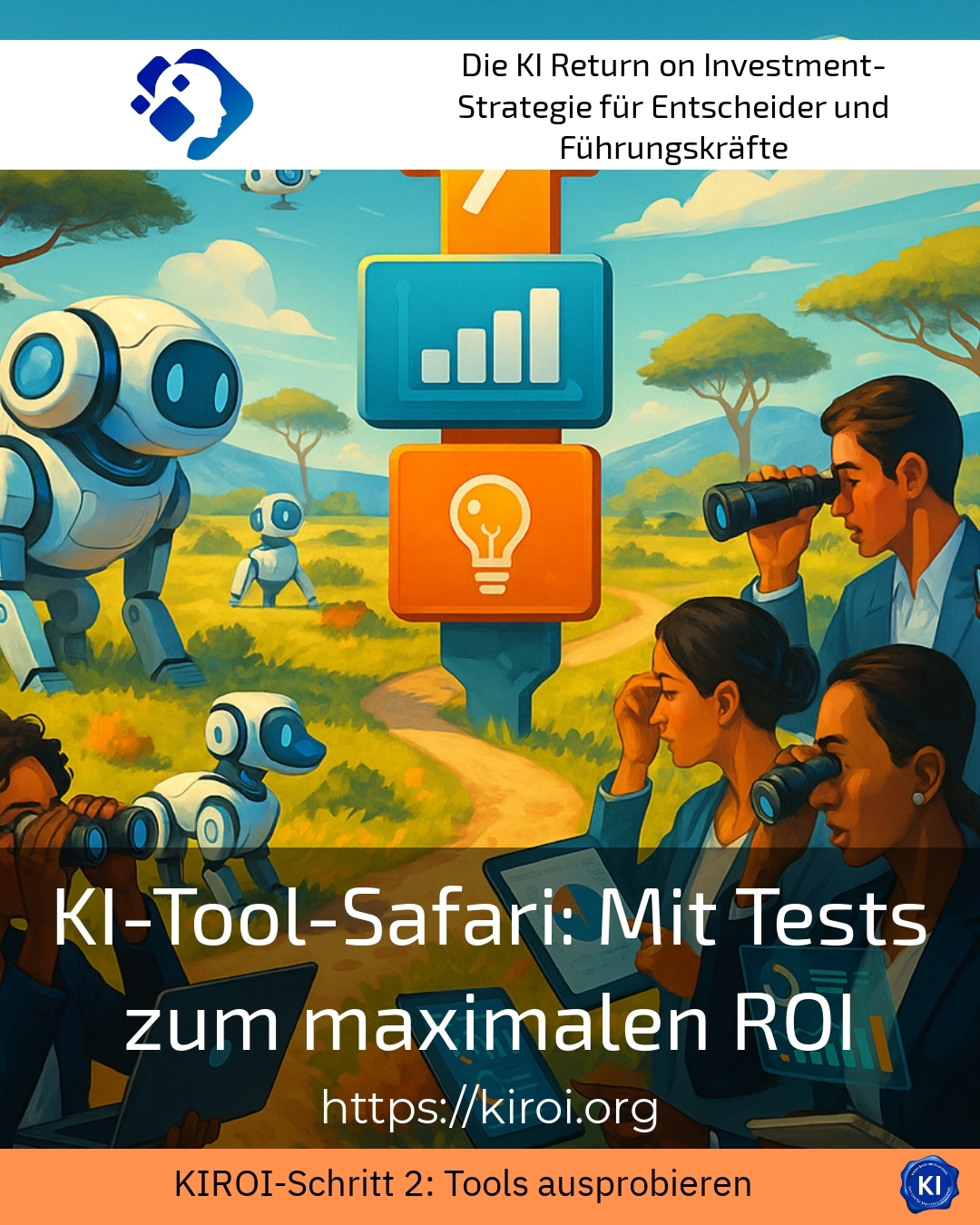
Imagine stepping into a digital jungle rife with fascinating possibilities, but also hidden pitfalls that can devour your budget without you ever experiencing the promised value. The AI Tool Safari: With Tests for Maximum ROI This expedition through the confusing landscape of automated solutions, where a systematic approach determines success or failure. Many decision-makers invest considerable sums in promising technologies, yet without structured evaluation, the hoped-for returns often fail to materialise because the chosen tools do not fit the specific corporate reality or are simply oversized, while simpler alternatives would serve the same purpose.
The expedition begins: Why systematic evaluation is essential
The market for intelligent automation solutions is growing rapidly. Every month, new applications with impressive promises emerge. However, not every shiny tool is suitable for every organisation. Therefore, companies need a clear evaluation process for their AI Tool Safari: With Tests for Maximum ROI, before they enter into long-term commitments.
For example, a medium-sized mechanical engineering company invested in a highly praised predictive maintenance solution [1]. The software analysed sensor data and predicted failures. However, it turned out that the company's specific machine types were not adequately considered. The prediction accuracy was significantly below expectations. A structured test run would have revealed this discrepancy early on.
A logistics company experienced something similar with route optimisation software. The solution worked excellently for standardised supply chains. However, it failed for complex multi-stop routes with time-critical refrigerated goods. The incompatibility was only recognised after six months of costly use.
A third example concerns a recruitment agency that introduced an applicant tracking system with automated pre-selection. The artificial intelligence assessed CVs according to set criteria. However, the system inadvertently filtered out qualified candidates because their career paths deviated from the norm. Transruption coaching would have helped to identify these stumbling blocks in advance and to professionally support the company during implementation.
Best practice with a AIROI customer
An internationally operating automotive supplier faced the challenge of automating its quality control because manual component inspection was becoming increasingly inefficient, and the error rate was unacceptably high with increasing production volume. The company approached us to undergo a structured evaluation process before making significant investments in imaging analysis systems. Together, we developed a three-stage testing framework, which first documented the specific requirements of the various production lines and then evaluated five different suppliers in pilot projects. The findings were surprising, as the most expensive supplier performed significantly worse in practice than a mid-priced alternative specifically developed for the automotive industry. This systematic approach not only saved the company significant acquisition costs but also achieved a reduction in the scrap rate by twenty-three percent within the first six months of implementation. The support provided by transruptions coaching enabled the internal team to build competence in handling such evaluations and to make future technology decisions more independently.
The Compass for your AI Tool Safari: Navigating to Maximum ROI with Testing
Successful expeditions require reliable aids for orientation. In the context of intelligent automation, this means defining clear evaluation criteria before the search begins. Only then can we compare apples with apples and make informed decisions.
A retail company with multiple branches was looking for a solution for inventory optimisation. The first candidate promised revolutionary algorithms. The second relied on tried-and-tested statistical methods. The third combined both approaches. Without structured comparison criteria, the decision would have become a gamble.
A further example can be found in healthcare. A clinic group evaluated scheduling systems. Some solutions primarily optimised doctor utilisation. Others focused on patient satisfaction. Still others attempted to balance both objectives. The correct choice depended on strategic priorities.
In the insurance sector, a company was testing various claims assessment systems. The requirements included accuracy, speed, and traceability. Not all solutions were able to impress in all three dimensions. A weighted scoring model helped with objective evaluation.
Develop criteria for tool assessment
Developing appropriate evaluation criteria requires a deft touch and industry expertise. Clients often report that they were initially overwhelmed by the technical possibilities and lost sight of the business requirements. A methodical approach creates clarity and prevents costly wrong decisions.
In the banking sector, an institution evaluated various fraud detection solutions. The criteria included detection rate, false positive rate, and integrability. Additionally, regulatory requirements played a central role. Without this structured approach, the selection would have been considerably more difficult.
A telecommunications company was looking for chatbot solutions for customer service. The evaluation considered voice recognition, escalation options, and learning capabilities. Data protection aspects were also taken into account in the decision. The result was surprising because the market leader was not the best choice.
In the energy sector, a utility company tested electricity consumption forecasting systems. The criteria included accuracy across different time horizons. Weather data integration and scalability were also assessed. The tests revealed significant differences between suppliers.
Test Methodology: How to Achieve Reliable Results
The quality of the tests determines the significance of the results. A AI Tool Safari: With Tests for Maximum ROI requires thoughtful experiment designs that simulate real-world conditions and uncover hidden weaknesses before they can become problems in practice.
A pharmaceutical company tested analysis tools for clinical trials. The test data comprised various scenarios and edge cases. Some solutions failed completely with incomplete datasets. Others produced inconsistent results on repeated runs. Only thorough testing revealed these deficiencies.
In the retail sector, a chain evaluated recommendation systems for its online shop. The tests used historical purchase data and simulated customer profiles. The results varied significantly across different product categories. This insight led to the selection of a specialised solution.
A manufacturing company tested production planning systems. The test scenarios included normal operating conditions and incidents. Some solutions reacted flexibly to changes. Others required manual intervention for unforeseen events. The differences were considerable.
Best practice with a AIROI customer
A major hotel chain approached us for support in selecting a revenue management system that would enable dynamic pricing based on demand forecasts, while also taking into account the complexity of group bookings and seasonal fluctuations. The challenge was that existing processes had evolved over many years, and different properties had varying requirements, making a uniform solution seem utopian at first. As part of the transruptions coaching support, we jointly developed a pilot project involving three hotels with different characteristics, selecting a city hotel, a conference resort, and a holiday destination on the coast to cover the breadth of requirements. The tests ran for a period of four months in parallel with the existing systems, allowing for direct comparisons and enabling staff to gradually familiarise themselves with the new tools. The results showed that one of the tested solutions was particularly adept at handling the volatility of the holiday business, while simultaneously accurately reflecting the stable booking patterns of the conference hotel. This methodical approach enabled the hotel chain to make an informed decision and ultimately implement a solution that, within the first year, led to a measurable increase in the average room rate without negatively impacting occupancy.
Setting up pilot projects correctly
Pilot projects form the core of any successful technology evaluation. They enable realistic insights without company-wide risks. The art lies in the correct sizing and objective setting.
A media company tested automated content analysis in one department. The learnings from this limited scope informed the company-wide strategy. Errors and adjustments remained manageable. The phased rollout significantly minimised risks.
In the transport sector, a freight forwarder initially trialled dispatch software in one region. The tests revealed integration problems with existing systems, which were resolved before widespread rollout. The controlled approach paid off.
An insurance company piloted claims processing with intelligent support within a team. Staff provided valuable feedback on usability. This was incorporated into the configuration before widespread deployment. This resulted in practical solutions.
Measuring ROI: From Metrics to Insights
The return on a technology investment cannot always be easily quantified. Qualitative improvements and strategic advantages complement quantitative metrics. A holistic view prevents errors and supports sustainable decisions.
A chemical company implemented laboratory software with an intelligent analysis function [3]. The direct cost savings were limited. However, the development of new formulations accelerated significantly. This strategic advantage fully justified the investment.
In construction, a project developer used planning tools with optimisation functions. The time saving per project averaged twelve percent. Additionally, planning quality improved measurably. The combination of both effects increased profitability sustainably.
A law firm introduced machine learning research tools. Billable hours per mandate changed little. However, the quality of legal work increased significantly. Client satisfaction and repeat business grew.
My AIROI Analysis
The systematic evaluation of intelligent tools is becoming a core competence of future-proof organisations, as the speed of technological developments is continuously increasing and the differences between seemingly similar solutions can have significant impacts on business success. From my consulting experience, clients regularly report that they initially underestimated the complexity and only gained the necessary clarity to make informed decisions through structured support. AI Tool Safari: With Tests for Maximum ROI is not a one-off expedition, but a continuous process that should be embedded in the corporate culture.
Particularly important to me is the realisation that technological excellence alone does not guarantee success. Integration into existing processes, acceptance by employees, and alignment with corporate strategy are equally crucial. Transruption coaching can provide valuable impetus here and support organisations in navigating these complex challenges.
The examples presented from various industries demonstrate that each organisation must find its own path. Standard solutions do not exist. What works perfectly for one company can be completely unsuitable for another. This individuality requires tailor-made evaluation approaches. Investing in structured tests regularly pays off through avoided misinvestments and optimised implementations. Those who master this methodology gain a sustainable competitive advantage.
Further links from the text above:
[1] McKinsey: The AI-Powered Organisation
[2] Gartner: Artificial Intelligence Glossary
[3] Deloitte: AI Institute Research
For more information and if you have any questions, please contact Contact us or read more blog posts on the topic Artificial intelligence here.











 Deutsch
  English (UK)