
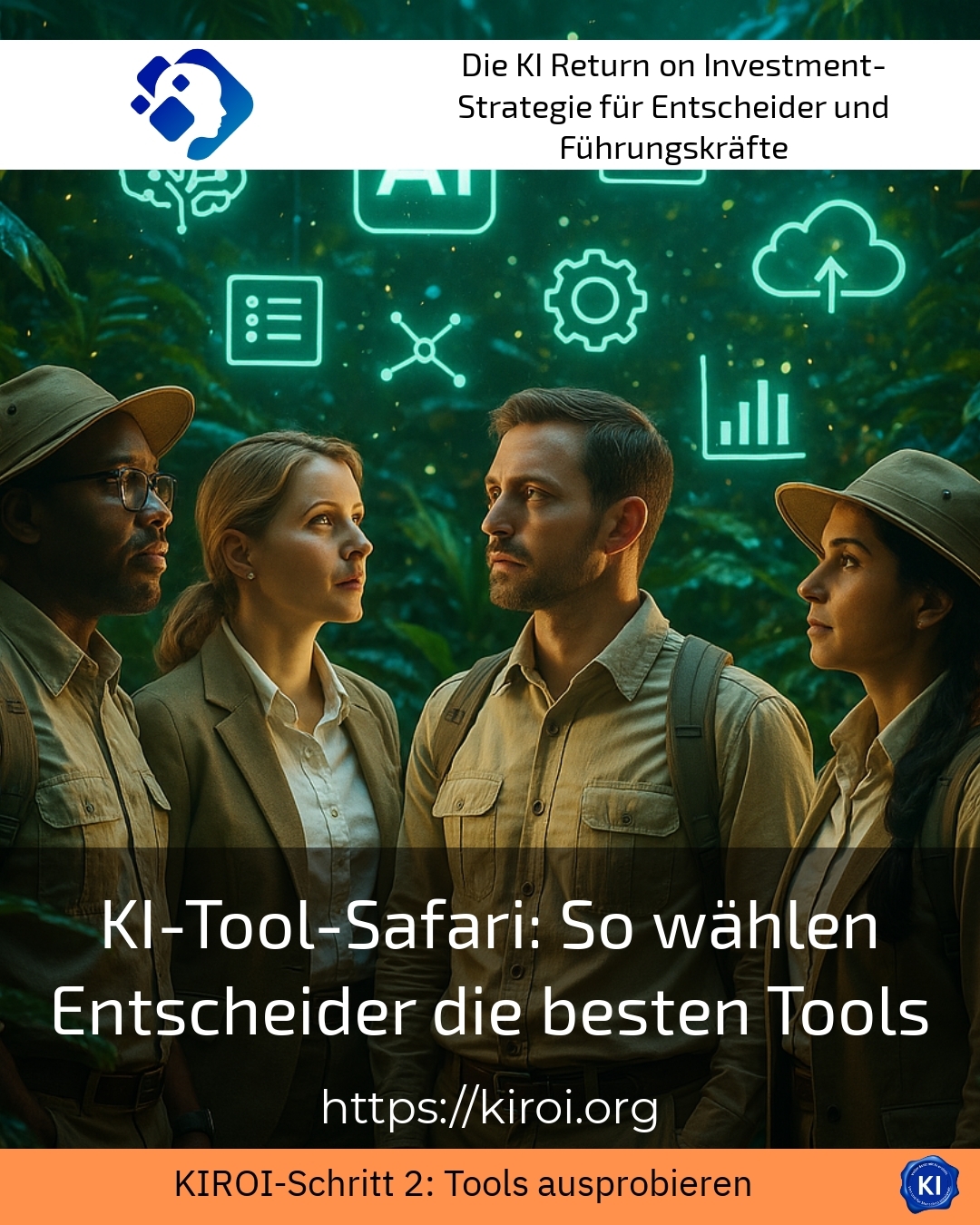
Imagine you're standing in the thick of the digital transformation jungle, with enticing technologies flashing all around you, each claiming to be exactly what your business needs. The AI Tool Safari It begins precisely here, at this point of overwhelm and simultaneous fascination, where leaders face the monumental task of filtering out, from thousands of available solutions, those that will actually create measurable added value. But how does one successfully navigate this technological jungle without getting entangled in the vines of false promises?
The Challenge of the AI Tool Safari in the Modern Business Environment
Today, business decision-makers are faced with an unprecedented flood of technological possibilities. The number of available solutions is growing exponentially. In the field of intelligent automation alone, there are now several thousand providers [1]. This diversity presents both opportunities and significant risks. Many managers report feeling overwhelmed by the selection process. They don't know where to begin. The complexity of decision-making is constantly increasing.
This phenomenon is particularly evident in the logistics sector. Companies such as DHL are already using intelligent route optimisation. Amazon employs advanced warehouse management systems with machine learning. Medium-sized freight forwarders are also experimenting with predictive maintenance for their fleets. Each of these use cases requires different technological approaches. The choice of the right tool determines success or failure.
In the financial sector, other requirements dominate the discussion. Banks such as Deutsche Bank are implementing automated fraud detection systems. Insurers like Allianz are using intelligent claims assessment. Robo-advisor platforms are revolutionising investment advice for private clients. Each of these applications requires specific skills. Decision-makers need to fully understand which functions are relevant to their situation.
Why the AI Tool Safari Must Begin with Strategy
Before you embark on your search, you need a clear compass. This compass consists of a solid strategic foundation. Many companies make the mistake of adopting technology for technology's sake. Disruption coaching guides leaders in asking the right questions first. What problem is to be solved? Which processes cause the greatest inefficiencies? Where does the greatest potential for value creation lie?
In healthcare, we frequently observe hospitals struggling with an overwhelming amount of documentation. Doctors spend more time at the computer than with patients. Intelligent speech recognition systems can provide support here. The University Hospital Heidelberg, for example, has successfully implemented such solutions [2]. Siemens Healthineers offers imaging diagnostics with automated evaluation. Philips Healthcare is developing platforms for the remote monitoring of chronically ill patients. All these examples show that strategic focus is crucial.
Best practice with a AIROI customer
A medium-sized mechanical engineering company from the southern German region faced the challenge of optimising its quality control without completely overhauling established processes. Management had already contacted several providers and was confused by the different promises made. As part of the transruption coaching, we first jointly analysed the existing workflows and identified three critical bottlenecks in production. We found that manual visual inspection was not only time-consuming but also led to inconsistent results. Instead of immediately resorting to a technological solution, we defined clear success criteria and measurable goals. Only then did we begin the systematic evaluation of image recognition systems, comparing six providers in a structured process. The company ultimately opted for a solution that integrated seamlessly into the existing infrastructure and enabled a reduction in errors of over thirty percent within three months. Clients in similar situations often report that this structured approach has helped them avoid costly wrong decisions.
Selection Criteria for a Successful Outcome
A systematic evaluation of technological solutions requires a multidimensional approach. Technical factors play a role just as much as organisational and economic aspects. Gartner, in its analyst reports, recommends a structured evaluation framework [3]. This includes criteria such as scalability, integration capability, and user-friendliness. However, less obvious factors also deserve attention. These include vendor support and the long-term development roadmap.
In retail, integration with existing merchandise management systems has proven to be crucial. Zalando uses personalised recommendation systems that are deeply embedded within the e-commerce platform. REWE is experimenting with automated stock optimisation in its stores. MediaMarkt is also focusing on intelligent pricing that takes real-time competitor data into account. All these companies have one thing in common: they have carefully tailored technological solutions to their specific needs.
The manufacturing industry, in turn, places different demands on selection. Bosch implements predictive maintenance systems in its production facilities. BMW uses computer-aided quality control in its paint shop. With MindSphere, Siemens offers a comprehensive platform for industrial applications. These examples illustrate the importance of industry-specific knowledge in selection. What works in retail can be completely unsuitable for manufacturing.
Don't forget the human element
While there is great enthusiasm for technological possibilities, one factor must not be overlooked. The people who are intended to work with these tools must be at the centre. McKinsey emphasises in its studies that employee acceptance is decisive for success or failure [4]. Training and change management are not optional add-ons. They are an integral part of any successful implementation.
In the telecommunications industry, we have observed some interesting developments. Deutsche Telekom is focusing on intelligent customer service assistants. Vodafone is using automated network optimisation for improved service quality. O2 is implementing chatbots for initial customer contact. In all these projects, the involvement of employees from the outset has been crucial. This is because technology complements human capabilities; it does not replace them.
Transruption coaching places particular emphasis on this human dimension. We support leaders in preparing their teams for change. Clients often report that this holistic approach makes the crucial difference. The best technology is useless if it is not adopted. Therefore, impulses for communication and employee involvement are at the core of our consulting programme.
Best practice with a AIROI customer
An internationally operating logistics service provider wanted to support its dispatching with intelligent algorithms but encountered considerable resistance from experienced dispatchers who feared for their jobs. As part of the project, we jointly developed a communication strategy that focused on transparency from the outset. We organised workshops where the dispatchers could contribute their expertise, thereby becoming active shapers of change. The system was positioned not as a replacement, but as an assistant that takes over routine tasks and frees up humans for more complex decisions. The dispatchers quickly realised that their experience was still indispensable, while the technology handled tedious calculations for them. Following the successful implementation, many employees reported increased job satisfaction and less stress during peak times. Fluctuations in the department decreased significantly, and the company was able to improve its delivery accuracy by eighteen percent. This case impressively demonstrates the importance of the human component in the implementation of new technologies.
Avoiding pitfalls on the AI tool safari
The journey through the technology jungle is fraught with dangers that must be navigated. One of the most common mistakes is following the hype rather than actual need. Not every hyped innovation is suitable for every business. Another pitfall is underestimating the implementation effort. According to Deloitte, many projects fail not because of the technology, but because of the execution [5].
We see this problem particularly clearly in the energy sector. E.ON is investing heavily in smart grid technologies for energy distribution. RWE is using forecasting models for renewable energy generation. EnBW is implementing smart meters with automated consumption analysis. Each of these projects required extensive adjustments to existing processes and systems. The technology selection was only the first step on a long road.
The pharmaceutical industry offers further instructive examples of potential pitfalls. Bayer is relying on computer-aided drug discovery to accelerate development. Merck is using automated laboratory processes for higher throughput rates. Boehringer Ingelheim is also experimenting with intelligent document analysis for regulatory requirements. In all these applications, data quality plays a central role. Poor data inevitably leads to poor results, regardless of how advanced the technology is.
Long-term partnerships instead of short-term solutions
Choosing a technological tool is not a one-off decision. It establishes a long-term relationship with far-reaching consequences. Vendors come and go, and the partner's stability deserves careful consideration. Forrester Research recommends a thorough analysis of the financial health and strategic direction of potential partners [6]. The community and ecosystem surrounding a solution also play an important role.
This insight has become widely accepted in the field of management consulting. Accenture builds long-term partnerships with leading technology providers. McKinsey invests in its own analytical platforms for client work. BCG has also created a specialised unit for data-driven consulting with GAMMA. These examples show that even the largest consulting firms have recognised the value of sustainable technology partnerships.
Best practice with a AIROI customer
A family-run trading company with multiple sites in Germany approached us with the question of how it could optimise its warehousing without losing the flexibility that was its competitive advantage. The managing director had already held discussions with three different providers and was unsettled by the conflicting recommendations. In transruptions coaching, we first developed a clear requirements profile that took into account both current and future needs. We examined the long-term stability of the providers under consideration and analysed their development roadmaps in detail. It turned out that one of the providers, who offered the cheapest solution in the short term, exhibited strategic risks in the long term. The company finally opted for a partner who, while initially incurring higher costs, offered a sustainable development perspective and integrated seamlessly into the existing system landscape. Three years later, this decision proved to be spot on because the cheaper provider had since disappeared from the market, confronting its customers with considerable migration problems. This example highlights the importance of a long-term perspective in technological decisions.
My AIROI Analysis
The AI tool safari is an expedition that requires careful preparation and clever navigation. Decision-makers embarking on this journey need more than just technical knowledge. They require a strategic compass to guide them through the thicket of possibilities. The examples from various industries described in this post impressively show that there is no one-size-fits-all solution that works equally well for all companies.
However, what all successful implementations have in common is a well-thought-out approach that harmonises strategy, technology and people. Transruption coaching supports leaders precisely with this complex task and provides impulses for sustainable digital transformation. It's not about finding the newest or most spectacular technology, but the one that actually suits the company and delivers measurable results.
The AI tool safari doesn't end with the selection of a solution. It is an ongoing process of adaptation and optimisation. Companies that understand this and view their technological decisions as part of a longer journey will be more successful in the long run than those seeking quick fixes. The future belongs to those who navigate the digital jungle with care and foresight.
Further links from the text above:
[1] Statista: Artificial Intelligence Worldwide – Market Overview
[2] Heidelberg University Hospital – Digitalisation Initiatives
[3] Gartner Magic Quadrant Methodology
[4] McKinsey: Insights into People and Organisational Performance
[5] Deloitte Germany: Artificial Intelligence
[6] Forrester Research – Analyst Reports
For more information and if you have any questions, please contact Contact us or read more blog posts on the topic Artificial intelligence here.









 Deutsch
  English (UK)