
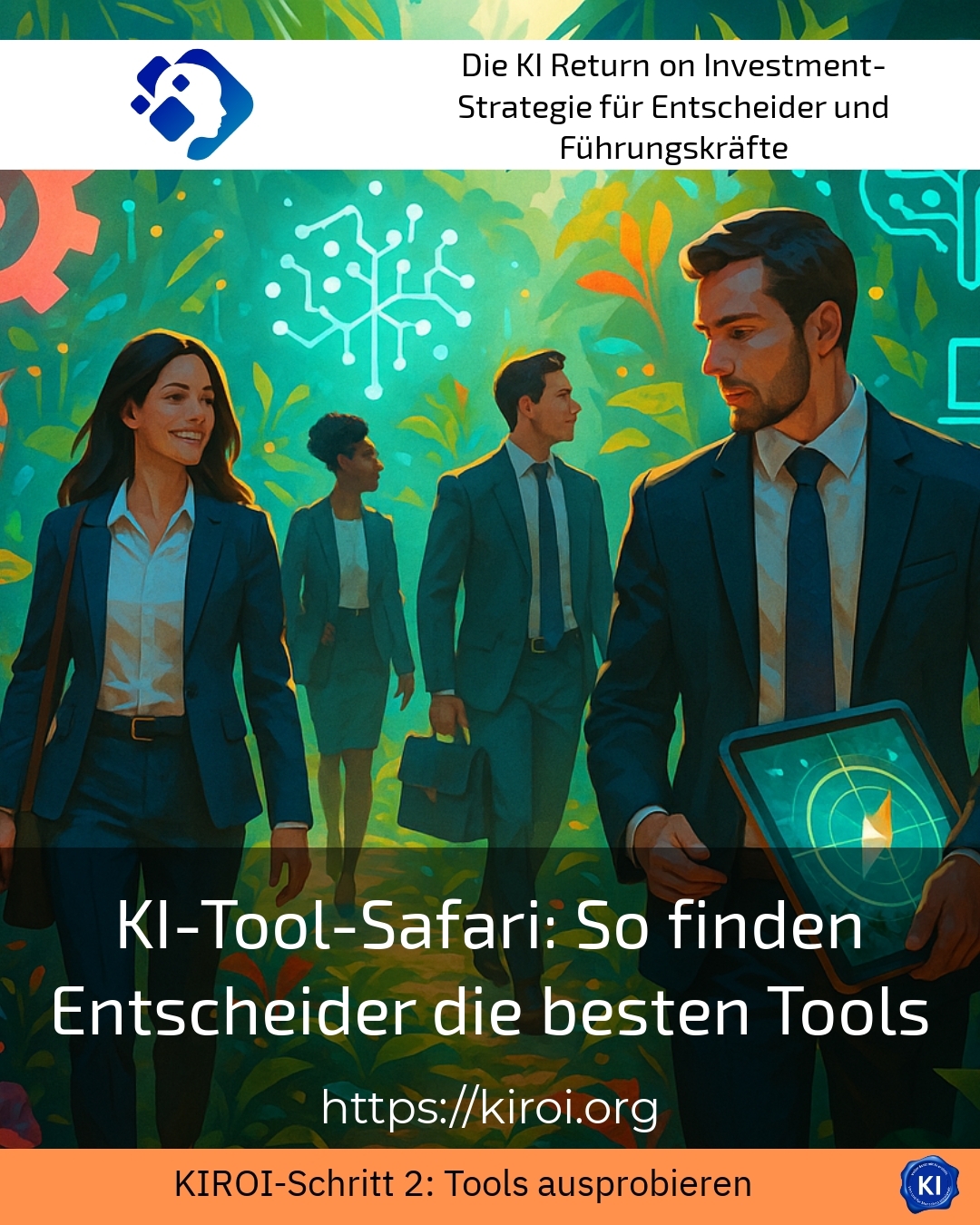
Choosing the right digital tools is like an ambitious expedition through a dense jungle of possibilities. Leaders face the challenge of filtering suitable solutions from thousands of offerings. A structured AI Tool Safari helps to manage this complexity and make informed decisions. In this post, you'll learn how to approach things systematically and which criteria really count.
Why a systematic AI tool safari is indispensable
The market for intelligent software solutions is growing rapidly. New applications promising increased efficiency appear daily. Many decision-makers feel overwhelmed by this flood. They then resort to quick decisions that are later regretted. A structured selection process protects against costly mistakes. It saves time and resources in the long run. Furthermore, it strengthens employees' trust in new technologies.
Many companies have already had painful experiences. They invested in solutions that did not fit their processes. Others chose tools that were discontinued after a few months. Such situations can be avoided through careful preparatory work. Several factors play a decisive role in this.
First, decision-makers must clearly define their own needs. What problems need to be solved? What processes require support? These questions form the foundation of any successful selection. Without clear objectives, the search becomes a aimless wandering.
Best practice with a KIROI customer
A medium-sized manufacturing company was faced with the challenge of modernising its quality control. Management had already contacted several providers and was confused by the different promises made. Within the scope of transruption coaching, we supported the team in analysing their actual requirements. Together, we developed a catalogue of criteria that took into account technical and organisational aspects. The company then tested three selected solutions in a controlled pilot phase. After eight weeks, it was clear which tool best suited the existing processes. Employees were involved early on and openly expressed their concerns. This significantly increased the acceptance of the new technology. Clients often report that this structured approach gives them confidence. The company was able to significantly reduce its error rate within a quarter.
The most important criteria for an AI tool safari
When evaluating intelligent tools, decision-makers should consider several dimensions. Technical performance is often at the forefront. However, it alone does not guarantee success. Equally important are integration into existing systems and user-friendliness. A highly developed tool is of little use if no one can operate it.
Data security deserves special attention. The highest standards must be met, particularly with sensitive business data. European companies should ensure GDPR compliance. The question of data sovereignty also plays a central role. Where is the data stored? Who has access to it?
The scalability of the solution impacts the long-term benefit. Can the tool grow with the company? Can it be adapted to changing requirements? These questions are becoming increasingly important with increasing digitalisation. A flexible tool offers more future security than a rigid solution.
The provider's support frequently determines success or failure. How quickly does customer service respond? Are there training opportunities? Are regular updates provided? These aspects deserve just as much attention as the functionality itself [1].
Technical evaluation criteria in detail
The accuracy of the results is at the heart of every evaluation. Does the tool deliver reliable results? How high is the error rate? These metrics can be determined in pilot projects. Realistic test scenarios should be used.
Processing speed influences practical usability. Slow systems frustrate users and delay processes. In production, delays can cause significant costs. Therefore, it is worth taking a closer look at the performance metrics.
The API interfaces enable connection with other systems. An open architecture significantly simplifies integration. Closed systems often lead to isolated solutions. In the long term, these cause high maintenance costs and inefficiencies [2].
Strategies for successful tool selection
Experienced managers use a multi-stage selection process. In the first phase, they gather information about available solutions. Trade journals, conferences, and industry associations offer valuable guidance. Exchanging information with other companies also provides helpful insights.
The second phase involves a preliminary selection based on defined criteria. Unsuitable options are sorted out during this process. Only candidates who meet the basic requirements remain. These go into the shortlist for practical tests.
Pilot projects form the third phase of the selection process. This is where the actual performance of the tools is demonstrated. Employees can gain initial experience. Their feedback will be incorporated into the final decision.
Best practice with a KIROI customer
A logistics company wanted to optimise its route planning and was looking for a suitable solution. The IT department had already identified three providers, but senior management was uncertain. As part of our support, we collaboratively developed an assessment matrix with weighted criteria. Each criterion was assigned a score based on its importance to the company. The three candidates were systematically compared using this matrix. It became clear that the cheapest offer performed poorly on important criteria. The mid-price segment offered the best balance of performance and cost. This insight would not have been gained without a structured analysis. Clients often report similar surprises during the process. After implementation, the company was able to reduce its delivery times by approximately fifteen percent. The investment fully amortised within nine months.
Choosing the right time for an AI tool safari
Not every point in time is equally suitable for a comprehensive selection of tools. Organisational changes can complicate the process. A stable starting position makes the evaluation considerably easier. Seasonal fluctuations should also be taken into account.
Some companies wait too long to modernise, thereby missing out on important competitive advantages. Others act in haste and regret their decisions. The right middle ground requires a realistic assessment of one's own situation.
External impulses can provide the impetus for a reorientation. Legislative changes, market developments, or technological breakthroughs often create the necessary pressure to act. Savvy decision-makers use such opportunities for strategic realignments [3].
Common mistakes and how to avoid them
Many selection processes fail due to avoidable errors. A common pitfall is the lack of involvement of future users. They know the practical requirements best. Their perspective should be considered from the outset.
Another mistake is the overvaluation of features. Not every additional feature brings real added value. Sometimes, less is indeed more. A lean tool can be more effective than an overloaded system.
Underestimating the implementation effort regularly leads to problems. New tools require training and adjustments. This effort must be planned realistically. Otherwise, there's a risk of delays and frustration for everyone involved.
Neglecting long-term costs often proves costly too. Licence fees, maintenance costs and updates add up over the years. A comprehensive cost analysis prevents nasty surprises. It allows for a fair comparison of different offers [4].
The role of corporate culture in implementation
Technical excellence alone does not guarantee successful implementation. Company culture significantly influences how new tools are adopted. Openness to change greatly facilitates the transition. Resistance to innovation can cause even the best tool to fail.
Leaders bear a special responsibility here. They must lead by example. Their enthusiasm is infectious for their employees. Conversely, their scepticism is also contagious.
Transparent communication accompanies successful introduction processes. Employees want to understand why changes are necessary. They want to know what benefits will result for them personally. This information should be shared early and regularly.
Best practice with a KIROI customer
A trading company had already attempted to introduce new technologies twice. Both attempts failed due to resistance from the workforce. Management was at a loss and turned to us. In transruptions coaching, we first analysed the causes of the previous failures. It emerged that the employees had been informed too late. They felt bypassed and developed defensive attitudes. On the third attempt, we fundamentally changed the strategy. We organised workshops where concerns could be openly addressed. Pilot groups from various departments tested the new tools in advance. These groups became ambassadors for change. Their positive experiences also convinced sceptical colleagues. Clients often report that this involvement makes the crucial difference. The company now successfully uses the new solutions in its daily operations.
Future-proofing as a key criterion
The technology landscape is evolving rapidly. Tools that are leading today could be obsolete tomorrow. Decision-makers must therefore act with foresight. They should choose suppliers who continuously invest in further development.
The financial stability of the provider is worth considering. Start-ups often offer innovative solutions at attractive prices. However, they also carry higher default risks. Established providers offer more security, but potentially less innovation.
Open standards increase flexibility for the future. They enable a later switch to other solutions. Proprietary systems can lead to unwanted dependencies. These ties significantly hinder later adjustments [5].
My KIROI Analysis
The successful selection of intelligent tools requires a systematic approach. Decision-makers benefit from a structured AI Tool Safari, taking all relevant aspects into consideration. This is not just about technical specifications. Integration into existing processes and employee acceptance are equally important.
From my consultancy practice, it repeatedly becomes clear that hasty decisions can prove expensive. Companies that take sufficient time for evaluation achieve better results. They avoid costly mistakes and create sustainable solutions. Investing in a thorough selection process pays off in the long run.
Involving all stakeholders from the outset proves particularly valuable. Employees who are involved early on actively support the change. They bring valuable practical experience to the selection process. Their concerns should be taken seriously and addressed.
The AI Tool Safari remains a one-off expedition. The market is continuously evolving. Regular reviews of the tools deployed are therefore essential. Only in this way can companies ensure that their solutions still fit optimally. Professional support from transruptions-coaching helps organisations to successfully master these challenges and shape their digital transformation sustainably.
Further links from the text above:
[1] Bitkom – Artificial Intelligence in Business
[2] Gartner – IT Research and Advisory
[3] McKinsey Digital Insights
[4] Forrester Research – Technology Valuations
[5] Fraunhofer – Research into Artificial Intelligence
For more information and if you have any questions, please contact Contact us or read more blog posts on the topic Artificial intelligence here.











 Deutsch
  English (UK)