
Why do so many companies invest thousands of euros in digital tools every month without ever seeing any measurable added value from them?
This question is currently being asked by numerous executives and decision-makers who notice that their organization has an impressive list of software licenses, but none of them are being used effectively. viable AI strategy Companies have developed systems that have transformed these investments into real business success. The reality in many companies today is that departments procure applications independently of one another, employees experiment with different solutions, and in the end, a patchwork of individual solutions emerges that neither communicate with each other nor align with overarching corporate goals. There is often a lack of a well-thought-out architecture that connects technological capabilities with strategic goals while simultaneously empowering employees to use these tools profitably.
Understanding the phenomenon of tool hoarding
In almost every industry, we are currently observing an interesting pattern. Companies are responding to technological change by signing up for subscriptions. They hope to avoid losing their footing in the process. But this response is similar to buying fitness equipment that then gets stored in the basement. The actual transformation does not take place because the foundation is lacking.
Take, for example, a medium-sized machine engineering company with about 500 employees. The marketing department uses a tool for automated content creation. The sales department relies on a different solution for customer communication. The human resources department experiments with applicant management systems. The production department tests predictive maintenance software. Each department acts independently, but no one has checked whether these tools fit together. No one has defined the overarching goals the company wants to achieve with technology.
Another example is seen in healthcare. Clinics and practices procure documentation systems, diagnostic support, and appointment management software. Often, these solutions come from different providers. The data do not flow together. Doctors and nursing staff spend more time operating various systems than with patients. The hoped-for efficiency increase turns into additional strain.
Best practice with a AIROI customer
A traditional trading company with several branches in Germany had purchased a total of seventeen different software solutions over a period of eighteen months, each of which was intended to solve individual problems. The monthly license costs amounted to more than twelve thousand euros. In a joint analysis, we found that only four of these tools were actually used regularly. The remaining thirteen licenses were practically unused because no one had trained the employees and no clear processes had been defined. Together, we developed a structured approach that initially focused on the business goals. Subsequently, we identified which technological skills were actually needed. The result was a reduction to six core tools that now seamlessly integrate with each other. The employees received intensive training and now understand why they use which tool for which purpose. The license costs fell by more than half, while the actual value creation through technology increased many times over.
From the collection to a viable AI strategy
The difference between a collection of tools and a real strategy lies in the combination of technology with business goals. A well-thought-out approach never begins with the question of which software is available. It begins with the question of which problems should be solved. What opportunities does the company want to seize? What skills do the employees need?
In the banking sector, this challenge is particularly evident. Financial institutions are under enormous pressure to modernize their processes. They are acquiring systems for fraud detection, customer service automation, and risk assessment. But without a comprehensive vision, data silos emerge. Insights from one system do not reach other areas. The opportunity for holistic customer service is lost.
Similar patterns can be found in the logistics industry. Forwarders rely on route optimization, warehouse management, and fleet management. Each system in itself offers added value. However, only the integration of these systems enables real efficiency gains. If the warehouse system does not communicate with route planning, potential gains remain untapped. The competitive advantage is not created by individual tools, but by their intelligent interconnection.
The education sector faces similar challenges. Schools and universities have introduced numerous platforms over the past few years. Learning management systems, video conferencing tools, and exam software coexist side by side. Students and faculty must switch between different interfaces. The technological diversity makes the learning process more difficult rather than easier.
The human dimension of a viable AI strategy
Technology alone does not change anything. People change things when they can use technology in a meaningful way. This principle is often overlooked in strategic considerations. Companies invest in licenses, but neglect the empowerment of their employees. They expect productivity increases, but do not provide training.
In the automotive industry, we see this discrepancy every day. Engineers have access to powerful simulation tools. But without intensive training, they use only a fraction of the features. The full potential remains hidden. The investment does not pay off. Similarly, in the pharmaceutical industry. Researchers work with complex analysis systems. The software offers capabilities that go far beyond daily use. Because there is no time for further training, the teams do not tap into the potential.
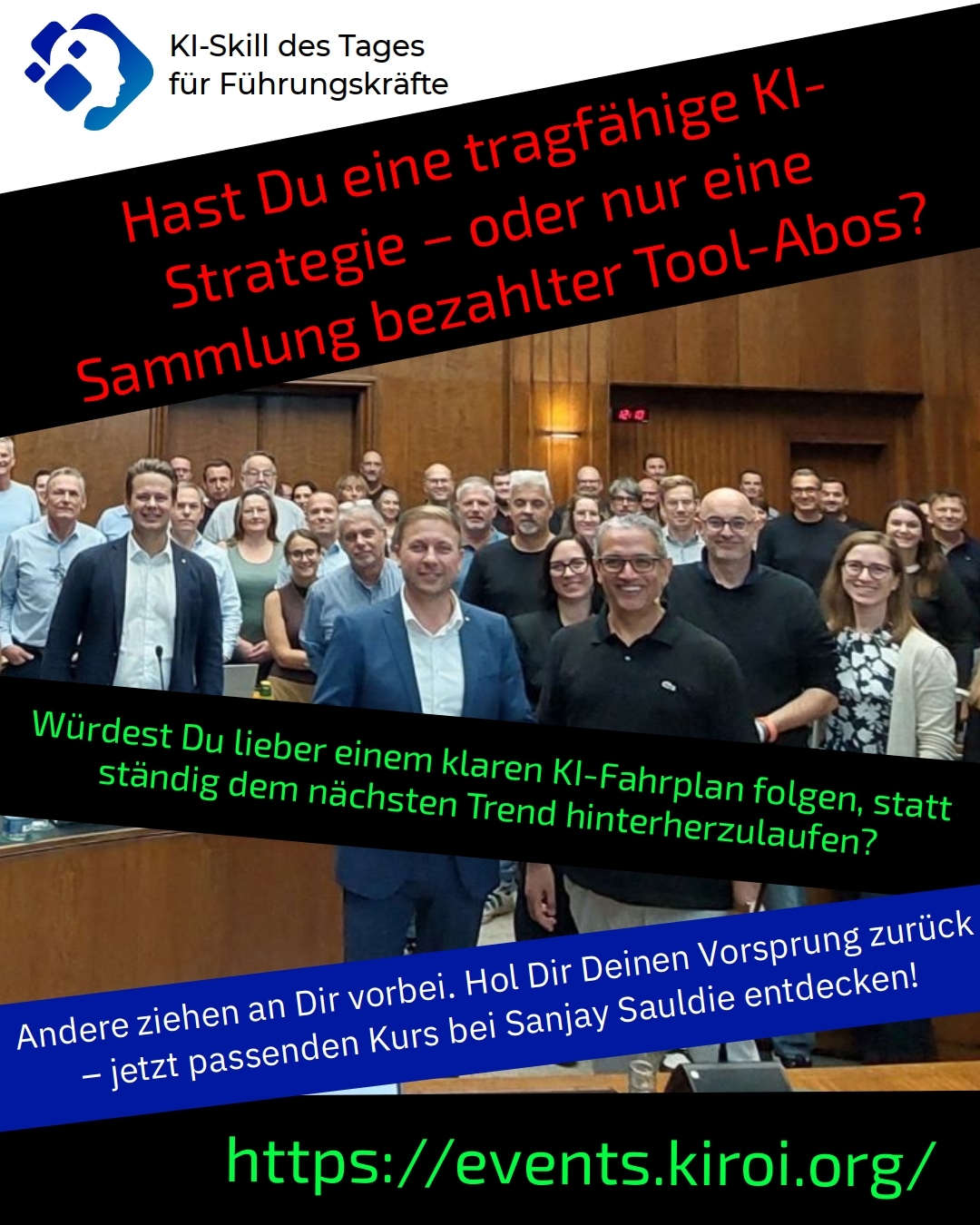
Take your existing skills to the professional level – just as over 8,000 people from over 500 companies have already done with Sanjay Sauldie! https://events.kiroi.org/ You will find ways to systematically develop your technological skills and create real added value for your company.
Strategic questions before the next procurement
Before companies sign on to further subscriptions, they should pause. An honest inventory creates clarity. What tools already exist within the organization? How intensively are they actually being used? What problems should they originally solve? Have they solved those problems?
In retail, these questions are particularly pressing. Retailers rely on inventory management, customer retention programs, and sales analytics. The volume of data is growing, but the insights remain superficial. Only when all systems work together can meaningful customer profiles be created. Only then can personalized offers have an impact.
Insurance companies face similar challenges. They operate damage handling, sales support, and risk modeling on different platforms. The transitions between these systems are often bumpy. Claim handlers spend valuable time transferring data instead of providing customer support.
Best practice with a AIROI customer
A medium-sized energy provider had invested significant sums in various software solutions in recent years, without ever conducting an overall inventory of its digital tools. When we jointly undertook an inventory of all digital tools, a surprising picture emerged. Several departments used different applications for almost identical tasks. The customer service department worked with one system, while the sales department preferred another. Communication between the two departments was sometimes still carried out via email and phone calls, even though both systems theoretically offered interfaces. In the course of the follow-up, we developed a roadmap that initially analyzed the business processes and then optimized the technological landscape. Within nine months, the company significantly consolidated its tool landscape. Employees reported significantly smoother workflows. Customer satisfaction increased measurably because inquiries could now be processed more quickly and consistently.
The role of leadership in developing a viable AI strategy
Strategic technology decisions should be on the management agenda. They must not be left solely to the IT department. Technology is now a business driver, not just an infrastructure issue. This insight has not yet been adopted in many industries.
In the media industry, the importance of strategic leadership becomes particularly evident. Publishers and broadcasters are facing fundamental changes. They are experimenting with automation in content production. They are testing personalized recommendation systems. But without clear leadership decisions, parallel initiatives arise that hinder each other.
The construction industry offers further examples. Construction companies are digitizing project planning, resource management, and quality control. The individual construction sites often use different systems. The central office does not receive uniform data. Comparisons between projects are therefore made more difficult. Learning effects are therefore lacking.
These patterns are also present in the restaurant industry. Restaurant chains are implementing point-of-sale systems, reservation platforms, and delivery service integrations. Each solution addresses a real problem. However, the lack of coordination leads to data inconsistencies and additional workload for the staff.
My AIROI Analysis
The distinction between a real sustainable AI strategy And a mere accumulation of tool subscriptions is becoming increasingly crucial to business success. My experience from numerous accompanying projects shows that organizations often come to me with the issue of technological overload. They feel that their investments are not delivering the expected added value. They notice that employees are frustrated. They recognize that competitors with similar resources achieve better results.
The AIROI framework offers valuable guidance in such situations. It begins with an honest assessment of the current situation and systematically leads to an integrated strategy. The human being is at the center of this process. Technology serves as a tool, not an end in itself. The guidance in such projects repeatedly shows: The path from the collection of tools to a real strategy requires the courage to make decisions. It sometimes means canceling licenses. It means investing in training. It means rethinking processes.
Clients often report that it was only the external perspective that helped them break out of the vicious cycle of constant acquisition. They gain clarity about their actual needs. They develop the skills to critically evaluate technological offerings. They create structures that enable sustainable value creation. Transruptive coaching supports companies in successfully navigating this transformation and achieving real viable AI strategy to develop one that fits the individual business model.
Further links from the text above:
[1] AIROI Events – Training and Strategy Development
For more information and if you have any questions, please contact Contact us or read more blog posts on the topic Artificial intelligence here.







 Deutsch
 English (UK)