
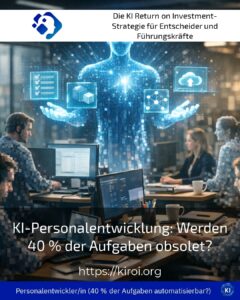
Will four out of ten tasks in your company soon be taken over by intelligent systems – and what does that mean for the development of your workforce?
This question is currently of concern to executives and HR managers alike. The Job Future Observatory of the Institute for Employment Research [1] provides data on this topic. It shows how many tasks could already be automated. The AI personnel development This presents fundamental challenges. At the same time, new opportunities open up for companies. These opportunities affect all industries and professional fields. Intelligent technologies are fundamentally changing the world of work. Therefore, human resources managers must act strategically now. The future of work begins today.
Understanding the data base: What the Job Futureometer reveals
The Institute for Employment Research operates the Job-Futureometer as an interactive online tool. Users can enter individual professions and analyze them. The system calculates the proportion of tasks that can be automated per profession. For many professions, this proportion is around 40 percent. However, this figure varies greatly between different job profiles. Especially repetitive and routine tasks are affected. Creative and social activities, on the other hand, show lower potential for automation.
The platform differentiates between different levels of requirements. Helfer tasks have higher automation potential. Technically demanding tasks are often less affected. This distinction is essential for personnel planning. Companies can thus develop targeted qualification measures. The job-future model serves as a guide for strategic decisions.
AI personnel development in the administration: Examples from practice
Public institutions are increasingly using intelligent systems. Clerical staff spend less time entering data. Instead, they perform advisory and verification functions. Application processing is increasingly automated. Staff monitor the results and handle special cases. This shift fundamentally changes the skills requirements.
Municipal authorities are continuously digitizing their citizen services. Chatbots automatically answer frequently asked questions. Staff members gain time for complex consultation sessions. The AI personnel development actively supports this transformation. Trainings provide new digital skills. Executives learn how to manage hybrid teams.
Tax offices use intelligent verification systems for tax returns. Routine checks are performed algorithmically. Tax investigators focus on suspicious cases. This specialization significantly increases efficiency. At the same time, the requirements for analytical skills are increasing.
Best practice with a AIROI customer
A medium-sized municipal administration approached our team with a specific challenge. The human resources department reported on increasing uncertainty among the workforce. Employees wondered whether their jobs would be secure in the long term. Together, we analyzed all job profiles using the Job Future Matrix. We systematically identified activities with high and low potential for automation. Subsequently, we developed individual development paths for different groups of employees. Clerks received training in process optimization and quality control. Managers learned to accompany change processes with appreciation. Transruptive coaching helped transform fears into constructive energy. After six months, 78 percent of the employees reported increased confidence. The municipal administration successfully implemented three intelligent systems. Not a single job was lost, but many job profiles changed. Clients often report similar transformation experiences. The support provided by structured coaching processes contributes to this change in a sustainable way.
Changes in healthcare through intelligent systems
Hospitals are integrating learning algorithms into their diagnostic processes. Radiologists are working with image recognition software. These systems mark potential abnormalities in images. Doctors continue to make the final diagnosis decisions. The collaboration between humans and machines improves the quality of results.
Nurses use digital assistance systems for documentation tasks. Voice-activated input significantly reduces administrative workload. The time gained is used to directly provide patient care. Empathy and human touch remain indispensable. These activities have very low automation potential.
Pharmacies are deploying intelligent systems for drug interaction testing. Pharmaceutical staff receive automatic warnings for critical combinations. Final advice is still provided in person. Patients appreciate the human touch and individual recommendations.
Designing AI personnel development in the production environment
Manufacturing companies are undergoing profound changes due to automation. Industrial robots reliably perform repetitive assembly tasks. Skilled workers are transitioning into supervisory and control roles. This transition requires comprehensive training measures. Technical expertise alone is no longer sufficient.
Quality control inspectors work with computer-based testing systems. Cameras and sensors capture deviations in real time. Employees analyze complex error patterns and develop solutions. Human judgment remains indispensable for borderline cases.
Maintenance teams use predictive maintenance systems. Sensor data enables early detection of errors. Technicians proactively plan maintenance work instead of reactively. This way of working requires new analytical skills.
Accompanying transformation in the financial sector
Banks are comprehensively automating standard processes in private banking. Account openings are increasingly taking place digitally and autonomously. Customer advisors are focusing on complex financing issues. Personal advice is gaining strategic importance.
Insurance companies are using intelligent systems for claims processing. Standard cases are automatically reviewed and resolved. Claims handlers handle contentious or unusual cases. This specialization significantly changes the requirements profiles.
Accountants use data analysis tools for extensive audits. Algorithms identify anomalies in large data sets. Auditors evaluate the results and draw professional conclusions. The combination enhances audit quality and efficiency alike.
Best practice with a AIROI customer
A medium-sized financial services company came to us with a typical problem. The management had decided to introduce intelligent systems in the credit assessment process. Employees showed strong reservations about the new technology. Many feared losing their professional relevance and expertise. We supported the project from conception to successful implementation. First, we thoroughly analyzed the existing work processes together. In doing so, we identified activities that would be automated in the future. At the same time, we defined new areas of responsibility for the employees involved. The transruptive coaching provided impetus for the personal development of each individual. Employees developed their own ideas for utilizing the freed up capacities. The credit analysts increasingly took on advisory roles for complex cases. They also trained new colleagues on how to use the intelligent system. After the introduction, customer satisfaction increased measurably. Processing times were reduced by an average of 35 percent. No employee left the company due to the changes.
Develop strategies for successful transformation
Companies need well-thought-out concepts for the AI personnel development. A systematic analysis of the activity profiles forms the basis. The Job Futureometer provides initial guidance for this analysis. Human resources managers should combine this data with internal knowledge.
Qualification programs must start early. Employees need time to build new skills. Technical training alone is not enough. Soft skills like critical thinking are gaining in importance.
Communication plays a central role in the change process. Leaders should openly discuss planned changes. Transparency reduces fears and promotes acceptance. Employees want to understand how their role is evolving.
The role of coaching in digital transformation
Professional guidance supports companies in complex change projects. Transruptions coaching helps to design individual development paths. Coaches work with leaders and teams alike. They accompany projects related to the digital realignment.
Many clients come with questions about career reorientation. They want to understand how their industry is changing. Others seek support in managing employees during transformation phases. Executives often report uncertainties in communication.
Coaching provides the impetus for constructive solutions. It does not replace strategic planning or technical expertise. The guidance complements these elements with the human dimension.
My AIROI Analysis
The figure of 40 percent of tasks that can be automated deserves a differentiated view. It describes a technological potential, not an inevitable future. Companies actively decide which technologies they use. These decisions should be strategic and not reactive. Human labor remains indispensable in many areas.
Intelligent systems often complement human capabilities meaningfully. They take on repetitive tasks and reduce error rates. People focus on creative and social activities. This division of labor can be beneficial for all involved.
The biggest challenge lies in the transition phase. Employees need support in developing their competencies. Leaders must approach change processes with appreciation. Companies should invest in training and support.
The job foresight report provides valuable guidance for strategic planning. However, it does not replace an individual analysis of one’s own organization. Each company must find its own path through the transformation. Professional guidance can significantly support this process. The future of work lies in the successful collaboration between humans and machines.
Further links from the text above:
[1] Job-Futuromat of the Institute for Employment Research
For more information and if you have any questions, please contact Contact us or read more blog posts on the topic Artificial intelligence here.







 Deutsch
 English (UK)