
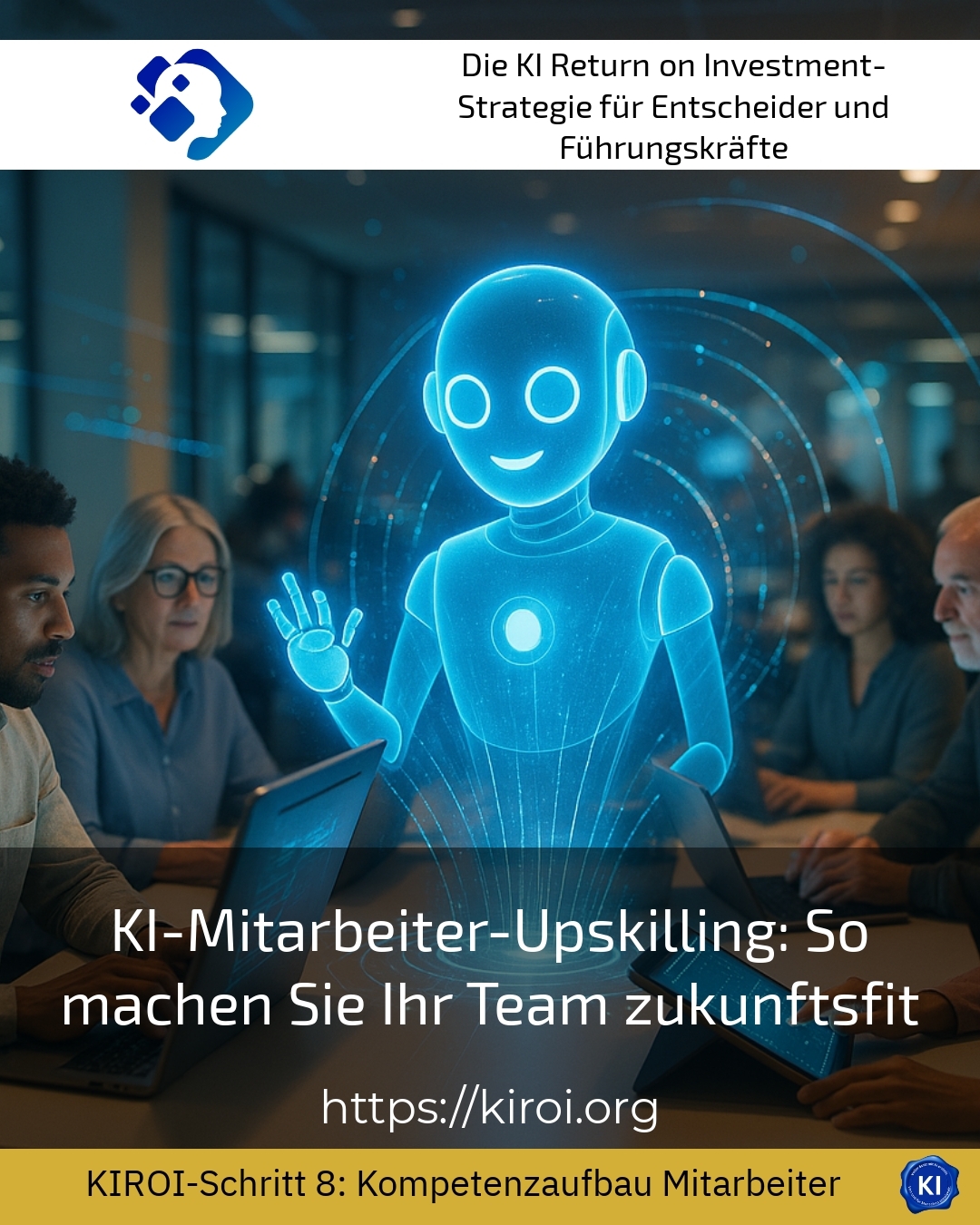
Digital transformation is changing workplaces at a rapid pace. Many companies are facing a crucial question. How do they prepare their workforce for collaboration with intelligent systems? AI Employee Upskilling This is developing into the strategic imperative of our time. Those who do not invest in the skill development of their teams today risk losing out tomorrow. The good news is that with the right support, this change can be achieved sustainably and in a people-centred way.
Why AI employee upskilling is becoming indispensable now
The integration of intelligent technologies is fundamentally transforming almost every professional group. Routine tasks are increasingly being automated. At the same time, new areas of activity are emerging with different skill requirements. Studies show that up to 40 percent of all employees will need new skills [1]. This development affects industries from manufacturing to the creative economy equally.
This transformation is particularly evident in the field of management consulting. Here, analysts are already using intelligent systems for data analysis. This is shifting human expertise towards strategic interpretation and client consultation. The work in the marketing departments of large corporations is changing in a similar way. Creative teams now collaborate with generative tools. They require new competencies in prompt engineering and critical evaluation of results. In human resources too, intelligent assistants are completely transforming the recruitment process.
Companies that invest in skills development early on often report significant competitive advantages. They can deploy technology investments productively more quickly. Their employees show higher satisfaction and lower turnover. The return on investment for such programmes often significantly exceeds that of traditional further training measures [2].
The five pillars of successful competence development
Effective upskilling is based on a holistic approach. Technical knowledge alone is not enough. Rather, companies must also address mindset, work culture, and organisational structures. The transruption coaching methodology supports organisations with a tried-and-tested five-pillar model.
The first pillar encompasses fundamental technological competence. Employees learn how intelligent systems function. They understand their strengths and limitations. This foundation enables informed decisions in their daily work. A leading mechanical engineering company recently trained 500 engineers in these fundamentals. This led to a significant increase in the acceptance of new tools.
The second pillar focuses on critical thinking and judgement. Automated systems do not always produce correct results. Humans must be able to evaluate outputs. A publishing house, for example, trains its editors in fact-checking automatically generated texts.
The third pillar concerns collaborative skills. Collaboration between humans and machines requires new forms of communication. Teams must learn to distribute tasks meaningfully. An international auditing firm developed its own collaboration protocols for this purpose.
Designing AI employee upskilling in practice
The fourth pillar addresses ethical competence and a sense of responsibility. Intelligent systems give rise to complex questions. Who bears responsibility for automated decisions? How do we deal with bias and discrimination? A financial service provider recently integrated such topics into all its leadership programmes.
The fifth pillar, finally, concerns adaptability and lifelong learning. Technologies are continuously developing. Employees must develop an attitude of permanent willingness to learn. A telecommunications group therefore introduced personal learning budgets. Every employee receives time and resources for self-directed further training.
Best practice with a AIROI customer
A medium-sized automotive supplier approached us with a complex challenge. Management had invested heavily in intelligent manufacturing systems. However, the workforce was showing reservations about the new technologies. Productivity gains fell significantly short of expectations. Together, we developed a comprehensive twelve-month support program. First, we conducted skills analyses for all 180 production employees. This allowed us to identify individual learning needs and existing strengths. We then designed modular learning paths for different functional groups. Involving experienced skilled workers as multipliers was particularly important. These so-called technology ambassadors supported colleagues in practical application. The program included both in-person workshops and self-directed digital learning. After six months, surveys showed a significant shift in the workforce. Acceptance of the new systems rose from an initial 35 percent to over 80 percent. Productivity ultimately reached the projected target values. The reduced error rate in automated quality control was particularly pleasing.
Leaders as catalysts for change
The success of competency development programmes depends significantly on leadership. Managers shape their teams' learning culture through their behaviour. They must themselves be role models for continuous development. At the same time, they create space for experimentation and tolerable failure.
A pharmaceutical company from southern Germany took a remarkable approach here. Management was the first to complete the entire training program. Subsequently, the board members openly reported on their own learning experiences. This transparency significantly lowered the inhibition threshold for all employees.
Leaders in an insurance group today use regular reflection sessions. They discuss specific use cases with their teams. Both successes and challenges are addressed during these sessions. This open communication fosters a positive culture of learning from mistakes throughout the entire company.
In retail, a major chain established so-called Innovation Labs. There, employees can test new technologies in a protected environment. Managers act as enablers and supporters. They do not evaluate, but constructively accompany the learning process [3].
Developing strategies for sustainable AI employee upskilling
Sustainability in competence development requires systemic thinking. One-off training sessions quickly fade in daily routine. Instead, companies must integrate learning into their processes. Transruption coaching support helps with proven impulses and tools.
For example, an energy supplier implemented weekly learning sprints. In these sprints, teams jointly dedicate themselves to a new topic. The insights gained are directly incorporated into ongoing projects. This linking of learning and working significantly increases the effectiveness of knowledge transfer.
A management consultancy developed a peer learning programme. Experienced employees systematically share their knowledge with colleagues. This creates informal learning communities across departmental boundaries. Motivation is high because both sides benefit.
In the banking sector, an institution is experimenting with playful learning formats. Gamification elements are noticeably increasing engagement. Employees collect points for completed learning units. Leaderboards and small competitions foster healthy ambition within the team.
Best practice with a AIROI customer
A logistics company with 3,000 employees across Europe was looking for a scalable approach. The decentralised structure with many locations made uniform training measures difficult. Furthermore, the employees' prior knowledge varied considerably. Together, we designed a hybrid learning architecture with three components. The foundational modules were designed as self-directed e-learning. Employees could complete these units flexibly at their workplace. For in-depth topics, we established virtual live workshops with interactive elements. There, participants could ask questions and exchange experiences. The third component comprised practical application projects at each site. Local project groups solved real tasks with their newly acquired skills. These projects were supported by trained internal coaches. The results of the site projects were fed into a central knowledge database. This way, all departments benefited from the insights of individual teams. After eighteen months, the company had built up a critical mass of competent employees. This measurably accelerated the digital transformation of logistics processes. Customer satisfaction rates also rose by twelve percentage points in parallel.
Understanding and constructively addressing resistance
Change naturally creates uncertainty for those affected. Many employees worry about their professional future. Some fear they will not be able to meet the demands. These anxieties deserve serious attention and empathetic support.
A media company therefore set up anonymous consultation channels. Employees could express their concerns there without consequences. The insights gained were incorporated into programme design. This resulted in needs-based offerings instead of standardised, one-size-fits-all solutions.
In a production plant, experienced skilled workers initially proved critical. Decades of expertise suddenly seemed less valuable. Through targeted appreciation and involvement, this scepticism transformed. The experienced colleagues became valuable bridge-builders between the old and the new.
A local authority struggled with technophobia. Many employees had worked for years without digital tools. Low-threshold introductory offers gradually reduced these inhibitions. Small successes sustainably strengthened the participants' self-confidence.
Ensuring measurability and continuous improvement
Successful programmes require clear success criteria and regular evaluation. Companies should define before starting what results they aim for. These objectives must be formulated concretely and measurably. Only then can progress be objectively assessed.
A chemical company uses a competence tracking system for this. All employees have digital competence profiles. These are updated after training courses and projects. Managers receive aggregated overviews for their departments.
In the healthcare sector, a clinic group measures the frequency of use of new tools. Usage data shows whether training content is actually being applied in daily practice. If adoption is low, targeted retraining is offered.
A software company conducts regular pulse surveys. Employees rate their own competence development and satisfaction. This data enables rapid adjustments to the programmes [4].
My AIROI Analysis
The systematic development of competence for collaboration with intelligent technologies determines the competitiveness of companies. My experience from numerous support projects shows clear patterns of successful transformation. Organisations that invest in people achieve more sustainable results. Technology alone creates no added value without competent users.
The integration of learning and working seems particularly important to me. Separate training measures without practical relevance quickly lose their effectiveness. Instead, companies should embed learning opportunities into the everyday working day. This way, the transfer is much more successful and sustainable.
The role of leaders is often underestimated. They must lead by example and create learning environments. Without their active commitment, programmes often remain ineffective. Investing in leadership development is therefore particularly worthwhile.
Resistance and fears deserve serious consideration. They are not obstacles, but valuable sources of information. Through empathetic support, they often transform into engagement. The human dimension of transformation deserves at least as much attention as the technical one.
Finally, I would like to emphasise that every company must find its own way. Standard solutions rarely work in practice. Transruption coaching provides impetus and direction. However, the specific implementation must fit the respective organisational culture.
Further links from the text above:
[1] World Economic Forum – Future of Jobs Report
[2] McKinsey – Insights on People and Organisational Performance
[3] Harvard Business Review – Leadership and Management
[4] Gartner – Human Resources Research
For more information and if you have any questions, please contact Contact us or read more blog posts on the topic Artificial intelligence here.










 Deutsch
  English (UK)