
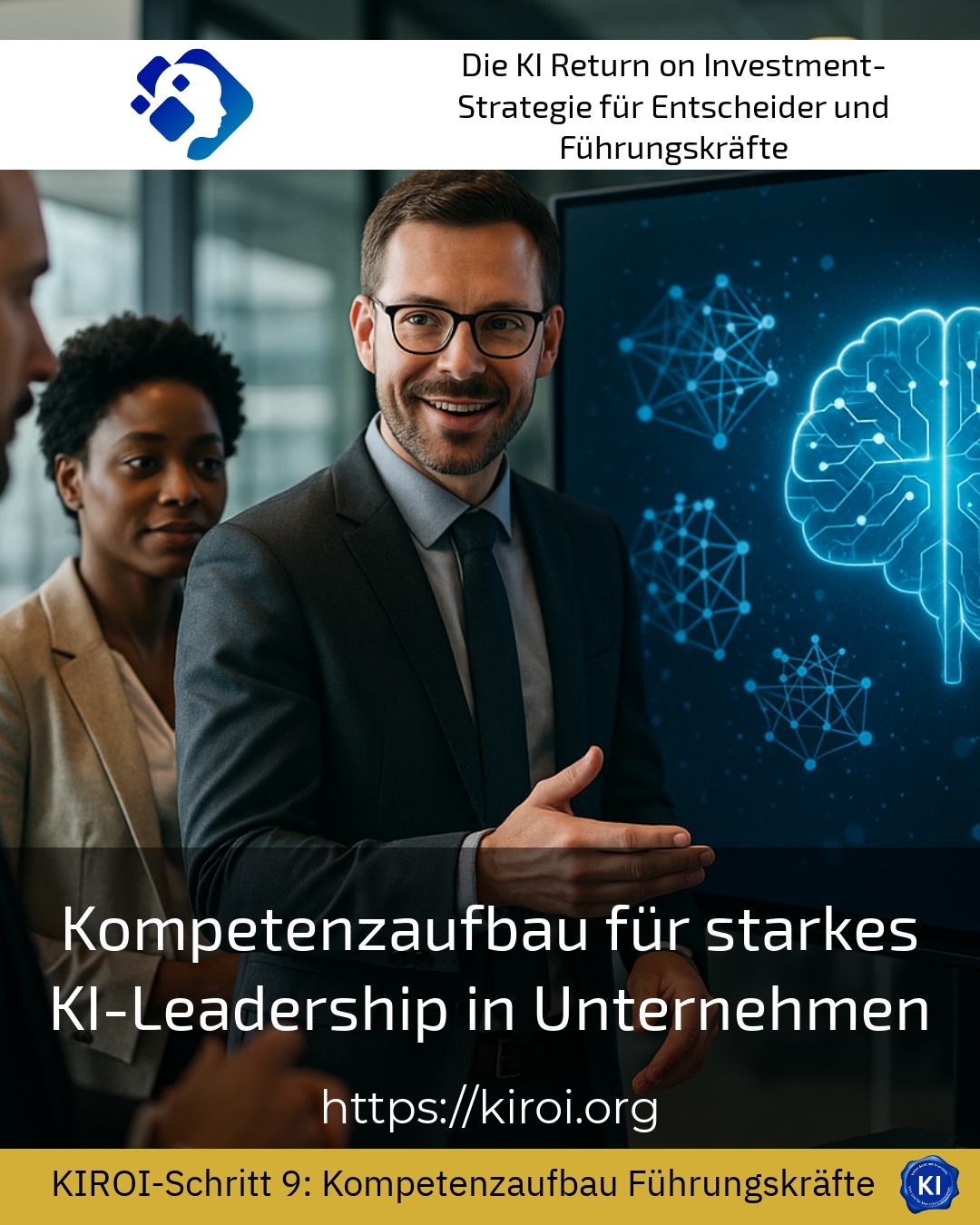
The digital transformation is changing companies at a rapid pace and presenting leaders with completely new challenges. Anyone who wants to make strategic decisions today must understand intelligent systems and be able to recognize their potential. Building competence for strong AI leadership This makes it a central task for organizations that want to remain viable. But how do companies manage to develop their leadership team in such a way that they not only accompany technological innovations, but actively shape them? This question concerns board members, executive management, and personnel development alike. The answer lies in a systematic approach that combines knowledge dissemination with practical application.
Why leaders today need new skills
The requirements for modern leadership have fundamentally changed. Traditional management methods are no longer sufficient. Leaders must be able to keep up with technological developments. They need an understanding of data-driven decision-making processes. At the same time, they are to accompany their teams through changes. This combination of technical knowledge and human leadership qualities forms the foundation for successful transformation.
In the automotive industry, this development is particularly evident. Production managers today need to understand how predictive maintenance systems work and what data they need. Sales managers in the mechanical engineering sector are increasingly using intelligent forecasting tools for their sales planning. In the financial sector, risk managers analyze complex algorithms before releasing credit decisions. These examples illustrate that a basic understanding of technology is no longer an option; it has become a prerequisite for effective leadership.
Clients often report uncertainties in dealing with new technologies. They feel overwhelmed by the speed of development. Some fear losing their footing. Others don’t know which competencies to prioritize. This is where professional support comes in. TransRuption Coaching helps executives find direction and develop individual learning paths.
Systematically design competence building for strong AI leadership
Sustainable skills development requires more than isolated training measures. It requires a thoughtful strategy that links different learning formats together. Workshops provide theoretical foundations and create a shared understanding. Project work enables the practical application of what has been learned. Coaching sessions accompany the transfer into leadership practice. This combination significantly increases the effectiveness of development measures [1].
In healthcare, clinic managers are increasingly implementing systems for diagnostic support. They need to understand how these tools generate recommendations. In retail, store managers rely on automated inventory optimization. In the energy sector, intelligent networks use predictive load peaks and coordinate generation. Each of these sectors places specific demands on leadership skills. A standardized training program can hardly cover this diversity. Therefore, individualized development approaches are gaining in importance.
Best practice with a AIROI customer
A medium-sized logistics company faced the challenge of preparing its management team for the deployment of intelligent route optimization. The management team realized that technical understanding alone would not be enough. First, we jointly analyzed the existing competencies within the leadership team. It became apparent that most of the management team lacked experience with data-based decision-making processes. We developed a multi-stage program that linked theoretical foundations with practical application cases. In workshops, the participants worked out how intelligent systems prepare decisions and what role human judgment plays in this process. In parallel, we supported the implementation of a pilot project in a selected branch. The management team was able to directly experience how the new technology transformed their work. This experience created trust and eliminated fear of contact. After six months, the company not only had a functioning system in place, but also leaders who were able to independently develop its potential.
The role of leaders in technological transformations
Leaders significantly influence how employees adopt new technologies. Their own attitude acts as a role model and influences the corporate culture. When leaders show openness to change, their teams are more likely to follow suit. Conversely, when they convey skepticism, resistance increases. This dynamic creates a vicious cycle that perpetuates the gap between the needs of the business and the capabilities of the workforce. Building competence for strong AI leadership for a cultural project [2].
In the insurance industry, department heads are transforming their teams from traditional manual processing to analytical decision support. Media companies are training their editors in handling automated content creation. Industrial manufacturing companies are training their masters in collaboration with autonomous systems. These examples show that leadership development and technological transformation are inextricably linked. Those who approach one without the other risk failure and frustration.
TransRuptions Coaching accompanies companies in these very projects. We provide guidance on the design of development programs. We support in identifying relevant competencies. And we help understand and constructively address resistance. This holistic approach significantly increases the likelihood of success of transformation initiatives.
Practical building blocks for leadership development
An effective development program combines different formats and methods. We provide basic knowledge in compact workshops that do not overwhelm executives. Small groups work on in-depth content in moderated discussion sessions. The application takes place in guided practical projects that address real challenges from everyday business life. Individual coaching sessions reflect personal learning progress and development needs. This combination corresponds to the principle of experiential learning [3].
Banks are developing their executives to handle automated credit decisions. Pharmaceutical companies are training research managers to use intelligent analysis tools. Telecommunications companies are training their executives in interpreting network analysis data. Each of these examples requires specific competencies and adapted learning formats. A successful program takes these differences into account and still creates a common foundation.
The exchange between executives from different departments is particularly valuable. A production manager learns about other perspectives from a sales colleague. A finance chief brings insights from regulatory requirements. This diversity enriches the shared learning process and promotes cross-departmental collaboration. Moderated formats support this exchange and ensure that all participants benefit.
Building competence for strong AI leadership in the medium-sized business sector
Medium-sized companies face special challenges in leadership development. Their resources are limited, but the demands are rising just as they are for large corporations. At the same time, shorter decision-making processes offer opportunities for rapid implementation. This combination makes the middle class an interesting field for innovative development approaches.
A machine manufacturer with two hundred employees cannot implement the same programs as a DAX-listed company. But it can specifically develop individual executives and use them as multipliers. A regional energy provider uses peer learning to efficiently disseminate knowledge. A family-run food company combines external impulses with internal exchange of experience. These pragmatic approaches show that effective development does not have to be expensive.
Best practice with a AIROI customer
A long-established business wanted to modernize its leadership culture without sacrificing its values. The management realized that new technologies would only gain acceptance if leaders understood and advocated them. Together, we developed a program that linked technical fundamentals with the specific corporate culture. The leadership team first gained an overview of relevant technological developments in retail. We emphasized clear explanations without unnecessary jargon. Subsequently, small groups developed concrete use cases for their respective areas. The purchasing department focused on intelligent demand planning and automated supplier evaluation. The human resources department explored opportunities for data-driven personnel development. The sales department analyzed potential for personalized customer engagement and dynamic pricing. This sector-specific deepening created relevance and practical benefits. The executives developed their own project ideas, which they then promoted in their teams. We supported this process with regular reflection rounds and individual coaching conversations. After one year, the company had completed several successful pilot projects and built significantly higher technological expertise at the leadership level.
Success factors for sustainable competence development
Sustainable competence development requires more than one-off measures. It requires continuous support and regular updates. Technology continues to evolve, and with that, so do the requirements. A development program should take into account this dynamic and create opportunities for ongoing learning [4].
In the chemical industry, plant managers regularly update their knowledge through professional conferences and peer networks. Executives in the tourism sector use digital learning platforms for self-directed learning. In the public sector, exchange formats between authorities are becoming increasingly common. These examples show different ways in which organizations can promote continuous learning. It is crucial that learning is understood as a normal part of leadership work.
TransRuption Coaching offers long-term support programs for companies that seek sustainable development. We help establish learning cultures and create spaces for reflection. We take into account the specific conditions of each organization. This individual support distinguishes professional coaching from standardized training programs.
Challenges and how companies overcome them
The path to competent leadership in technological transformations is rarely linear. Resistance arises when leaders fail to recognize the benefits or fear losing their status. Lack of time often prevents participation in development initiatives. And a lack of support from the management can endanger entire programs. These challenges are real, but they can be overcome.
Pharmaceutical companies solve the time problem through compact learning formats that can be integrated into everyday work. Financial service providers create incentives by incorporating competence development into agreement agreements. Industrial companies attract skeptical executives by piloting projects that enable quick success. These pragmatic approaches show that challenges are solvable. The prerequisite is a willingness to take a close look and develop appropriate solutions.
Clients often report that the exchange with other leaders is particularly helpful. They realize that they are not alone in their questions. This realization reduces pressure and opens up spaces for honest learning. Professional moderation supports this process and ensures that all voices are heard.
My AIROI Analysis
The systematic development of leadership competencies for technological transformations is gaining increasing strategic importance for companies of all industries and sizes. My analysis shows that successful programs must combine three essential elements. First, leaders need a solid understanding of technological contexts that enables them to make informed decisions and to lead their teams competently. Second, sustainable development requires practical applications that translate abstract knowledge into concrete action skills. Third, it requires continuous reflection and guidance to permanently anchor what is learned and adapt it to changing requirements.
The AIROI-methodology has proven to be an effective framework for this development in numerous projects. It takes into account both individual learning needs and organizational frameworks, thereby creating a solid foundation for sustainable transformation. The integrative approach, which addresses both technical and human aspects equally, is particularly valuable. Companies that Building competence for strong AI leadership By taking it seriously and addressing it systematically, they create a significant competitive advantage. They prepare their leadership team for future challenges and develop the ability to proactively capitalize on technological opportunities. This strategic investment in human capital pays off in the long run because it makes organizations more resilient and adaptable.
Further links from the text above:
[1] Harvard Business Review – Leadership Development
[2] McKinsey – People and Organisational Performance
[3] ATD – Association for Talent Development Insights
[4] World Economic Forum – Future of Work
For more information and if you have any questions, please contact Contact us or read more blog posts on the topic Artificial intelligence here.







 Deutsch
 English (UK)