
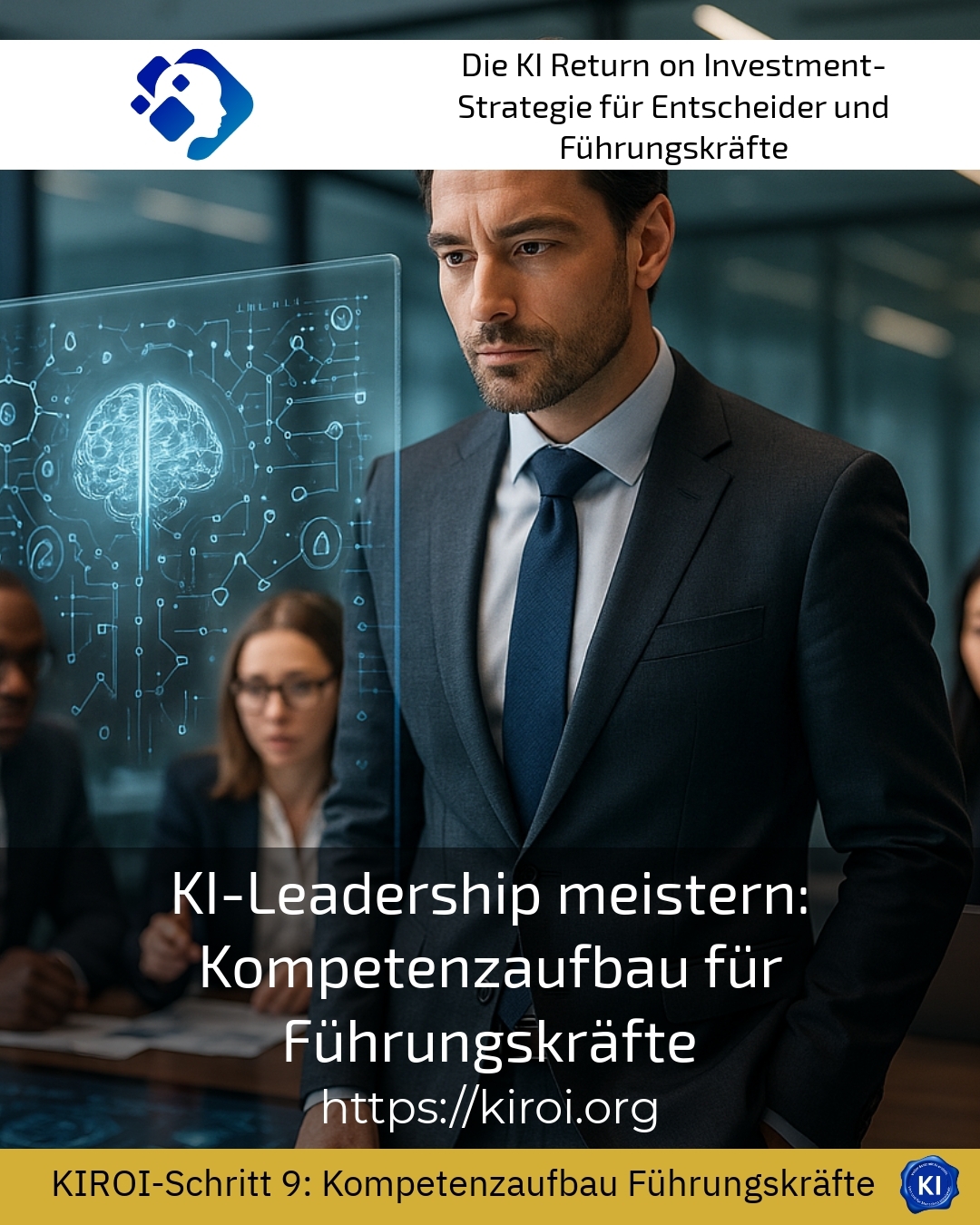
Digital transformation is fundamentally changing organisations and presenting decision-makers with completely new challenges. Those who lead teams today must be able to understand intelligent systems and deploy them strategically. Mastering AI Leadership: Competence Building for Executives This becomes the central task of our time. But how can this change be achieved in practice? What skills do modern decision-makers really need? And why do so many transformation projects fail, despite the best of intentions? These questions currently concern countless organisations worldwide. The answers to them are more complex than many would initially suspect.
Understanding the new reality in businesses
Intelligent algorithms are now permeating almost every business area of modern organisations. In the financial sector, self-learning systems analyse credit risks within milliseconds and support advisors with complex investment decisions. Insurance companies use predictive models to assess the probability of claims more accurately than ever before. At the same time, banks are automating their customer service processes through intelligent chatbots and virtual assistants. These developments require a fundamentally new understanding of leadership and competence development [1].
Many executives report uncertainty in dealing with these technologies. They question which decisions they should continue to make themselves. Others want to know where machine support would be sensible. These questions are legitimate and indicate a growing awareness of change. Transruption coaching accompanies decision-makers precisely with such questions and offers structured guidance. The path always leads through individual competence development and reflected practical experience.
Why traditional leadership models are reaching their limits
Classical management approaches are often based on linear planning models and hierarchical decision-making structures. In a world of self-learning systems, these approaches are only partially effective. An example from the logistics industry illustrates this point emphatically: previously, dispatchers planned routes manually and adjusted them as needed. Today, algorithms optimise supply chains in real-time, taking hundreds of variables into account simultaneously. The manager must now understand when to trust the system and when human intervention becomes necessary.
A similar picture can be seen in healthcare regarding diagnostic support through intelligent image analysis. Radiologists are increasingly working with systems that highlight anomalies in scans. Medical responsibility remains, but working methods are fundamentally changing. In the pharmaceutical industry too, machine learning methods are significantly accelerating drug development and altering established research processes. These examples show that Mastering AI Leadership: Competence Building for Executives has become relevant across industries.
Best practice with a AIROI customer
A mid-sized manufacturing company faced the challenge of preparing its management level for the introduction of predictive maintenance systems. The leadership recognised early on that technical implementation alone would not be sufficient. Therefore, they decided on a supported skills development programme for the entire management team over several months. Initially, the plant managers and department heads gained a fundamental understanding of how the new systems worked. Subsequently, they worked with the coaching team to develop concrete application scenarios for their respective areas. This revealed that many initial concerns could be resolved through practical experience and structured reflection. The managers developed a new understanding of their role as orchestrators between humans and machines. After the programme concluded, participants reported significantly increased confidence in their day-to-day actions. Acceptance of the new technology among the workforce increased measurably because their superiors could now communicate competently and convincingly. The company was able to significantly reduce its downtime while simultaneously increasing employee satisfaction.
Mastering AI Leadership: Building Competence for Leaders in Practice
The development of relevant competencies rarely occurs through theoretical knowledge transfer alone. Rather, sustainable skills emerge from the combination of reflection, application, and continuous support. In retail, for example, managers are increasingly using systems for demand forecasting and dynamic pricing. They must learn to critically evaluate the recommendations of these systems and reconcile them with their market knowledge. One purchasing manager recently reported that she initially blindly trusted the algorithmic suggestions. It was only through structured reflection that she realised when her experience could provide valuable corrections [2].
In HR, intelligent systems are changing the way recruitment processes are designed. Recruitment managers work with matching algorithms that automatically analyse candidate profiles. This raises ethical questions around fairness and transparency, which require competent leadership. In the area of employee development, personalised learning platforms support individual qualification. Managers must use these tools sensibly without losing personal contact with their teams. Finding this balance is one of the key leadership tasks of today.
Emotional Intelligence as an indispensable supplement
Technical understanding alone is not enough for successful leadership in the digital age. People still need leaders who can listen, understand, and inspire. This is particularly evident in the customer service sector of the telecommunications industry when new automated systems are introduced. Employees often express concerns about their jobs and require empathetic guidance through the transition. Leaders who take these emotional aspects seriously create sustainable change processes. They combine technological competence with human intuition for the needs of their teams.
In the banking sector, branch managers are experiencing similar challenges in the digitalisation of advisory services. Customers expect both personal support and digital availability in equal measure. Employees need to assume new roles as hybrid advisors and require support in doing so. In the insurance industry, managers are shaping the transition to data-driven business models. They are guiding their teams through training programmes and creating spaces for open discussion about uncertainties. This ability for empathetic leadership can be developed and deepened through targeted coaching.
Best practice with a AIROI customer
A financial services provider with several hundred employees implemented a comprehensive leadership development programme in the context of intelligent systems. The initial situation was characterised by a heterogeneous management team with varying levels of technical knowledge and attitudes. Some managers approached the technology with great scepticism, while others held unrealistically high expectations. The transruption coaching addressed this heterogeneity directly, creating a safe space for open dialogue. In moderated workshops, participants were able to articulate their concerns and jointly develop solutions. A central element was the work with concrete case studies from their own company. The managers jointly analysed which processes could benefit from intelligent support. They also discussed where human expertise would remain indispensable and why. A particularly valuable insight was that technological competence and emotional intelligence are not opposites. After the programme concluded, stable networks for collegial exchange had been formed. Managers supported each other with questions and challenges in their day-to-day work. Company management observed a noticeably improved innovation culture in all areas.
Strategic perspectives for sustainable development
Long-term success requires more than isolated training measures or one-off workshops. Organisations need integrated development concepts that enable and promote continuous learning. This is evident in the automotive sector with the transformation towards connected mobility services. Managers must understand entirely new business models and prepare their teams for them. In the energy sector, managers are shaping the transition to smart grids and decentralised supply structures. They require competencies that, just a few years ago, would not have appeared in any job description [3].
The chemical industry is increasingly using data-driven approaches for process optimisation and quality assurance. Production managers are working with systems that detect deviations before they become problems. In mechanical engineering, predictive maintenance models are fundamentally changing the relationship between manufacturers and customers. Managers need to be able to strategically classify and operationally implement these changes. Mastering AI Leadership: Competence Building for Executives means here, combining technological possibilities with entrepreneurial thinking. This requires both technical expertise and the ability for strategic reflection.
Shaping organisational frameworks
Individual competence development only unfolds its full potential in a supportive organisational environment. Leaders need scope for experimentation and a culture of failure that enables learning. In the media sector, editorial management is shaping the use of automated text generation and content personalisation. They must preserve journalistic standards while simultaneously unlocking efficiency potential. In marketing departments across various industries, intelligent systems are revolutionising customer engagement and campaign management. Leaders here balance creative freedom with data-driven optimisation.
In the public sector, agency heads face particular challenges in digitising administrative processes. They must balance data protection, transparency, and efficiency. In educational institutions, school leaders shape the use of adaptive learning systems and digital teaching tools. These examples illustrate that context-specific solutions are in demand and that standard approaches often fall short. Transruption coaching supports managers in developing suitable strategies for their specific challenges. The focus is always on practical applicability and sustainable effectiveness.
My AIROI Analysis
The engagement with the demands of modern leadership in technology-driven environments clearly shows that a fundamental change is underway. Leaders across all industries face the task of fundamentally expanding and adapting their competencies. This is not about choosing between humans or machines, but about intelligent collaboration between both. The most successful leaders will be those who understand technological possibilities while simultaneously preserving human values.
My observations from numerous mentoring projects show that the biggest success factor is the willingness for personal development. Leaders who remain open to new things and reflect on their own limitations master transformations significantly better. They manage to bring their teams along and establish a positive culture of change. At the same time, they retain the awareness that technology always remains a tool and should never be an end in itself.
The AIROI methodology offers a structured framework for this complex development work and has proven itself many times in practice. It combines strategic analysis with practical implementation support and individual reflection. Organisations that invest in the competence development of their leaders create sustainable competitive advantages. They position themselves as attractive employers and attract talented employees. Investment in leadership competence pays off on many levels and has a long-term stabilising effect.
Further links from the text above:
[1] McKinsey – The State of AI
[2] Harvard Business Review – Artificial Intelligence
[3] World Economic Forum – Artificial Intelligence Agenda
For more information and if you have any questions, please contact Contact us or read more blog posts on the topic Artificial intelligence here.








 Deutsch
  English (UK)