
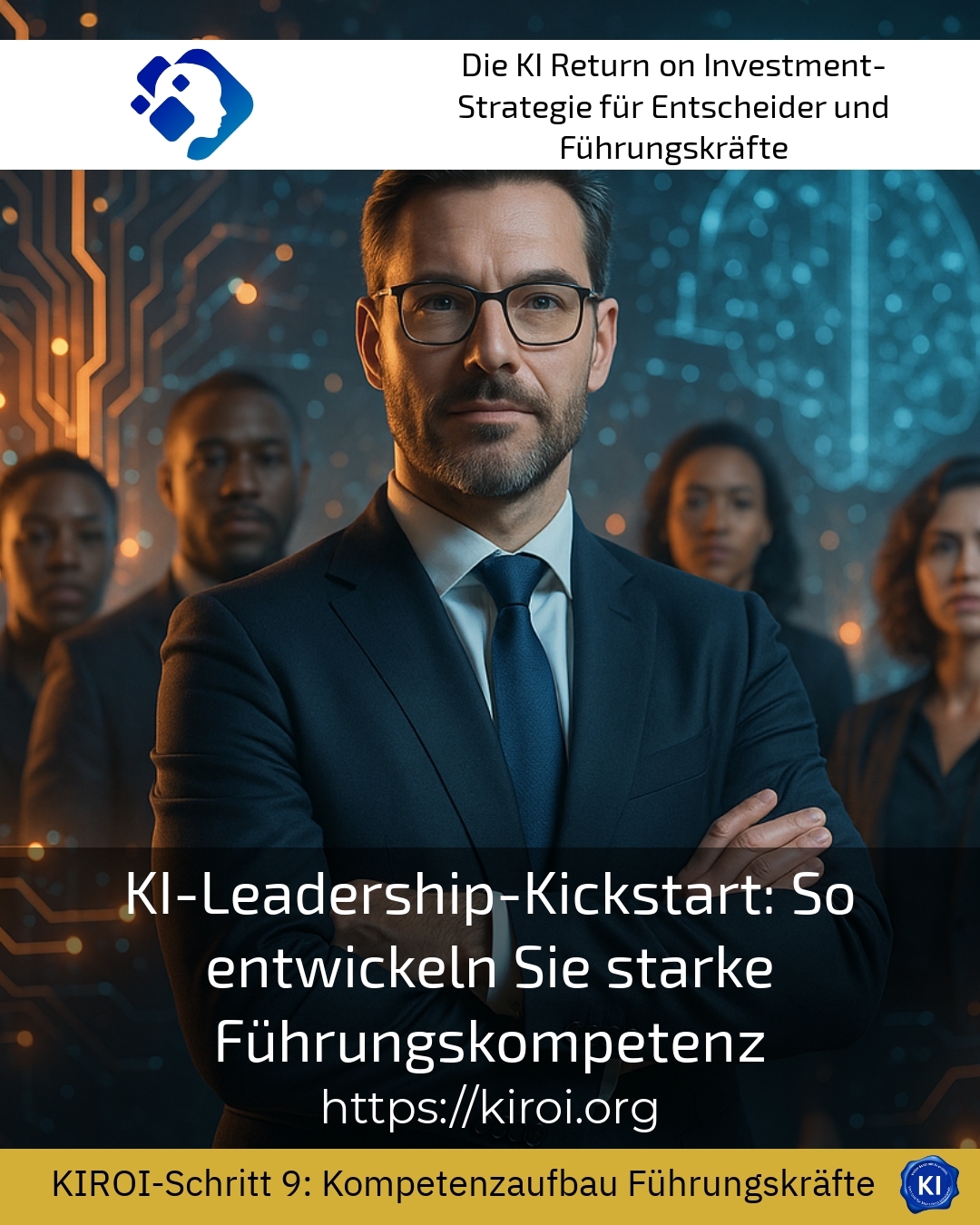
Imagine walking into your company on a Monday morning and immediately sensing a completely new dynamic. Your employees are working with more motivation, decisions are made faster and more precisely. The atmosphere feels constructive rather than tense. What has changed? The answer lies in a transformed leadership culture that intelligently uses modern technologies. AI Leadership Kickstart opens up entirely new avenues for managers to develop their skills today. But how can this crucial transformation be achieved in practice? Which strategies actually lead to measurable results? And why do so many companies fail in practical implementation despite the best of intentions?
The fundamentals of modern leadership competence in the digital age
Leadership has fundamentally transformed in recent years. Previously, technical expertise combined with assertiveness sufficed. Today, organisations demand emotional intelligence, strategic foresight, and technological affinity. This combination presents significant challenges for many experienced leaders. At the same time, it offers unprecedented opportunities for advancement for younger talent. A medium-sized mechanical engineering company from Southern Germany recognised this shift in good time and consistently invested in the further development of its management level. The result convinced all stakeholders in the long term. Management turnover decreased by a remarkable forty percent. Another example comes from the logistics industry, where a family business completely realigned its leadership culture. Management decided on a participatory approach with regular feedback loops. This led to a significant improvement in employee satisfaction. Similar developments are also evident in healthcare. A hospital chain implemented new leadership guidelines and provided intensive training for its department heads. Patient satisfaction increased measurably [1].
AI Leadership Kickstart as a Catalyst for Sustainable Change
The systematic use of intelligent technologies can effectively support leaders in their daily work. This is not about replacing human intuition. Rather, modern tools sensibly complement existing skills. Clients often report initial scepticism towards technological support. However, this reluctance usually quickly gives way to pragmatic enthusiasm. A financial services provider from Frankfurt used data-driven analyses to improve its leadership development. The insights gained were directly incorporated into individual coaching programmes. A retail company relied on automated feedback systems for its branch managers. Regular feedback allowed for timely course corrections in leadership behaviour. In the manufacturing sector, an automotive supplier experimented with simulation-based training scenarios. Its leaders practised difficult communication situations in a protected environment.
Best practice with a AIROI customer
An international technology company with several thousand employees faced a unique challenge. Middle management leaders were showing distinct signs of being overloaded. Staff turnover in this critical leadership tier had reached concerning levels. In collaboration with transruptions-coaching, we developed a bespoke support programme over twelve months. The approach combined individual coaching sessions with structured group workshops. We placed particular emphasis on integrating technological tools into daily leadership activities. Participants learned to make data-driven decisions without neglecting their intuition. They developed competencies in managing complex stakeholder situations and their communication skills improved noticeably. Upon completion of the programme, over eighty percent of participants reported a tangible reduction in workload-related stress. Company management registered a significant decrease in sick days within the relevant leadership level. Furthermore, the results of the internal employee survey improved significantly. The project was subsequently rolled out to other business units and is now considered a benchmark model for sustainable leadership development across the entire group.
Practical strategies for a successful AI leadership kick-start
The implementation of new leadership approaches requires a systematic process. Hasty changes are often unsuccessful due to resistance from those affected. Instead, a gradual introduction with clear milestones is recommended. An energy supplier from North Rhine-Westphalia successfully chose this cautious path. It first identified pilot areas with particularly open-minded managers. These early supporters were trained as internal multipliers. Their positive experiences convinced more sceptical colleagues. A pharmaceutical company took a similar approach when introducing new leadership tools. It started with voluntary pilot groups and carefully documented all experiences. The insights gained were incorporated into the company-wide rollout. A large insurance company also relied on this pragmatic approach when modernising its leadership culture.
Combining emotional intelligence and technological competence
Tomorrow's successful leaders are characterised by a special combination. They combine deep human empathy with a masterful understanding of technological possibilities. This dual competence does not develop on its own. It requires targeted development and continuous reflection. Many leaders come to us for support with precisely this issue. They sense that the demands on their role have fundamentally changed. At the same time, they often lack the time for intensive further training. A telecommunications provider recognised this dilemma and created innovative learning formats. Short, practice-oriented learning units were integrated into everyday work. Leaders could learn self-determinedly without neglecting their operational tasks. A food group developed a mentoring program for its junior leaders. Experienced managers shared their knowledge in structured tandem relationships. In the construction industry, a general contractor experimented successfully with virtual leadership networks [2].
The role of transruption coaching in transformation projects
Profound changes in leadership cultures require professional support. External perspectives help to uncover blind spots. At the same time, experienced coaches offer a safe space for honest reflection. At transruptions-Coaching, we support companies with exactly these kinds of projects. We provide impetus for the strategic alignment of leadership development. We support the identification of suitable technologies and methods. A chemical company used this support for a complete realignment of its leadership academy. The external expertise helped to break down entrenched patterns of thought. A media house received professional support in developing new leadership guidelines. The structured process led to broad acceptance throughout the company. A sports equipment manufacturer also relied on external coaching support for a change project within its leadership levels.
Best practice with a AIROI customer
A family business with a rich tradition in the consumer goods sector found itself in a critical growth phase. The established structures no longer suited the new company size of several hundred employees. The owning family realised that more professional management structures were urgently needed. Together, we first analysed the existing leadership skills and identified areas for development. We used modern diagnostic tools for an objective assessment of the current situation. The results sometimes surprised even long-serving managers and opened up new perspectives. In the second step, we developed individual development plans for each manager based on their specific strengths and development areas. These plans were regularly reviewed and adjusted as necessary. The introduction of an internal management circle for peer consultation proved particularly valuable. Participants supported each other with specific leadership challenges and learned from one another. After eighteen months of intensive support, the company presented a completely new leadership culture. The professionalisation enabled further growth without losing the family values. Looking back, the owning family considers this project to be one of the most important investments in the company's future.
Achieve measurable success with the AI Leadership Kickstart
Investments in leadership development must also be economically viable. Modern approaches allow for significantly better success measurement than traditional training formats. This is not just about hard metrics. Qualitative improvements can also be systematically recorded and evaluated. A retail group introduced comprehensive before-and-after measurements for its leadership programmes. The results convinced even critical controllers of their effectiveness. An IT service provider used pulse surveys for continuous success monitoring of its leadership initiatives. The regular data enabled quick adjustments as needed. In the banking sector, an institution implemented a differentiated key performance indicator system for its leadership development. Various indicators were condensed into a meaningful overall picture [3].
Challenges and stumbling blocks in implementation
Not every transformation project goes smoothly, and that's perfectly normal. Resistance is part of the change process and can be used constructively. It often signals unexpressed concerns that deserve attention. A mechanical engineering company significantly underestimated the communication needs for its leadership initiative at first. The lack of transparency led to rumours and uncertainty among management. After a course correction with more open communication, the situation stabilised again. A logistics company struggled with overly ambitious timelines for its change project. Managers felt overwhelmed and withdrew. Slowing down the pace eventually led to better results. A medical technology manufacturer also had to adjust its original plans after initial setbacks.
Ensuring the sustainable embedding of new leadership competencies
Short-lived enthusiasm after training often quickly fades in everyday work. Sustainable change requires systematic follow-up and transfer support. Unfortunately, many companies still neglect this crucial phase. One car manufacturer recognised this problem and established a comprehensive transfer system. Managers received coaching support in implementing learned content. Regular refresher modules kept what was learned alive and present. A textile company introduced.
My AIROI Analysis
Developing strong leadership competence presents one of the key challenges for companies across all sectors. The examples in this article clearly show that successful transformation is possible and delivers measurable results. This requires a clever combination of different elements. Technological possibilities should be utilised without neglecting the human component. A systematic approach reduces resistance and significantly increases the chances of success. The sustainable embedding of new competencies requires continuous attention beyond the mere training period. Companies that consider these aspects position themselves for the future. They attract talented young professionals and retain experienced high performers in the long term. Investing in leadership competence thus pays off many times over and has an impact at all levels. From my experience in supporting numerous transformation projects, I can confirm that the decisive success factor often lies in the willingness for honest self-reflection. Leaders who are open to feedback and want to continuously work on themselves achieve remarkable developments. Technological support through modern tools further accelerates and deepens these processes. However, personal commitment and a willingness to change remain crucial. Companies should be courageous and pave new ways in developing their leaders. The examples presented offer numerous suggestions for their own initiatives and experiments.
Further links from the text above:
[1] McKinsey – Leadership Development That Works
[2] Harvard Business Review – Leadership Topics
[3] Gallup – Workplace Leadership Research
For more information and if you have any questions, please contact Contact us or read more blog posts on the topic Artificial intelligence here.








 Deutsch
  English (UK)