
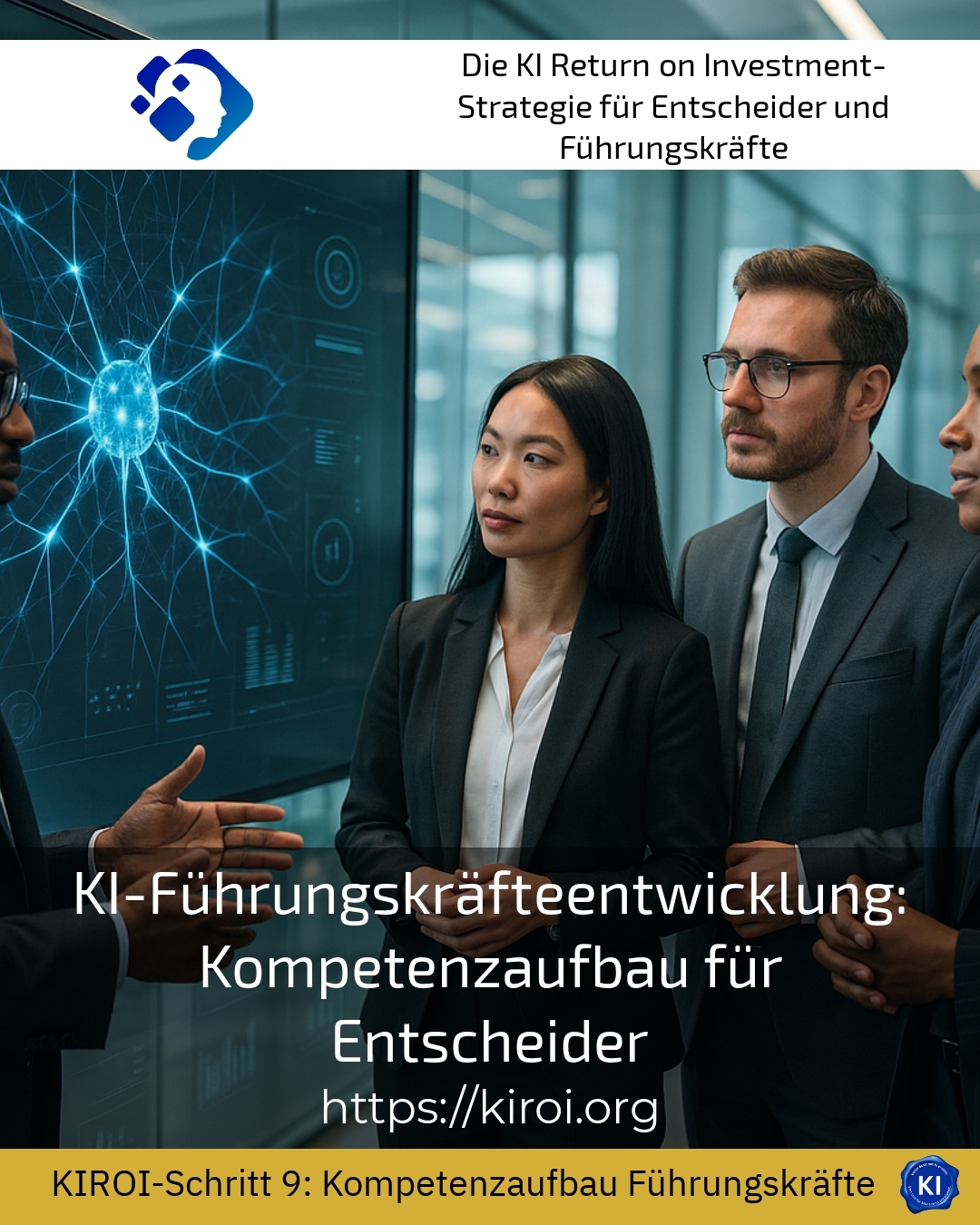
Digital transformation is fundamentally changing leadership roles. Today, decision-makers face completely new challenges. They need to understand intelligent systems and use them strategically. At the same time, many lack the necessary knowledge. This is where the AI Leadership Development: Competency Building for Decision-Makers Because anyone who wants to lead successfully tomorrow must develop new skills today. This article shows how modern leaders can actively shape this change. It is not about technical details. It is about strategic capability in a rapidly changing business world.
Why traditional management models are no longer sufficient
Traditional management approaches are based on linear planning processes. They assume stable markets and predictable developments. These assumptions no longer hold true today. Intelligent systems analyse data faster than any human team. They recognise patterns in customer behaviour and market developments. Managers must learn to deal with these insights. They need new competencies for data-driven decisions.
A retail example illustrates this impressively. Large retail chains use automated inventory optimisation systems. These systems forecast demand and manage orders independently. Managers must understand how these forecasts are generated. Only then can they critically evaluate and adjust system recommendations.
This development is also clearly evident in the financial sector. Banks use intelligent algorithms for credit risk assessment. Insurers utilise automated claims evaluation and fraud detection. Executives in these areas require a deep understanding of these processes. They must recognise when human judgement is required.
The healthcare sector offers further clear examples. Hospitals are implementing systems for diagnostic support and resource planning. Care facilities are optimising staff deployment through intelligent forecasting models. Leaders here must be able to weigh up ethical and practical considerations.
AI Leadership Development as a Strategic Imperative
Building competency for decision-makers is no longer optional professional development. It is a strategic necessity for any forward-looking business. Leaders without the relevant knowledge are increasingly losing their ability to act. They can neither make informed investment decisions nor manage teams effectively.
This is especially visible in the automotive industry. Manufacturers are transforming their entire value chain. Autonomous driving requires completely new product development processes. Leaders must understand how sensor data is processed. They must be able to assess which technology partners are suitable.
The logistics sector is showing similar developments at all levels. Freight forwarders are continuously optimising route planning through intelligent algorithms. Warehouses are deploying automated picking systems and robots. Managers require knowledge of the integration possibilities and limits of these technologies.
The media industry is also undergoing a fundamental and rapid transformation. Publishers are using automated text generation for standard sports reports. Streaming services are personalising content for users through intelligent recommendation systems. Leaders must be able to combine creative and technological aspects.
Best practice with a AIROI customer
A medium-sized mechanical engineering company with around 800 employees was facing a fundamental strategic challenge. The executive board recognised the need for digital transformation and intelligent systems early on. However, the management team lacked the necessary knowledge to make well-founded decisions. The company leadership turned to transruptions-Coaching for comprehensive support. Together, we developed a tailored programme for the top management level. Over a period of six months, we worked intensively with the management. We conveyed fundamental concepts of intelligent systems in an understandable form. At the same time, we systematically analysed concrete use cases within the company. The executives learned how to ask technology providers relevant questions. They independently developed evaluation criteria for investment decisions. The work on corporate culture for everyone was particularly valuable. The management understood the importance of change communication in this context. Upon completion of the programme, the company was able to make well-founded strategic decisions. The executives frequently report a significantly increased level of operational confidence. They are now able to critically evaluate and prioritise project proposals. In the meantime, the company has implemented several successful pilot projects.
Core competence areas for modern leaders
The capacity-building process comprises several interconnected areas. First of all, managers require a fundamental technological understanding. They do not need to be able to program or develop algorithms, but they must be able to understand the operating principles and limitations of intelligent systems.
In the pharmaceutical industry, this is particularly relevant for decision-makers. Companies use intelligent systems for drug development and active ingredient discovery. Leaders must understand how these systems analyse molecular structures. Only then can they direct research investments sensibly.
The energy sector offers further insightful examples of change. Utilities are continuously optimising grid control through intelligent forecasting and analysis systems. Wind farms are making comprehensive use of automated maintenance planning based on sensor data. Executives need knowledge of data integration and system architectures to make decisions.
Agriculture is also undergoing a fundamental transformation through new technologies. Large enterprises use precision farming systems to optimise yields. Drones and sensors provide data for targeted irrigation and fertilisation. Leaders must be able to combine ecological and economic aspects.
AI leadership development through guided learning
Books and online courses impart foundational knowledge effectively and flexibly. However, genuine skills development requires more than theoretical knowledge alone. Leaders need guided learning with a concrete practical connection to their environment. They must be able to apply new concepts to their specific situation.
Transruptions Coaching offers precisely this type of guidance. We work with leaders on their real-world challenges. Together, we develop an understanding of relevant technologies and their application. In doing so, we always take our clients' specific industry context into account.
In the construction industry, the benefits of this approach are clearly evident. Construction companies use intelligent systems for project planning and risk assessment. They continuously optimise material procurement and workforce planning through data-driven forecasts. Managers must be able to integrate these tools into existing processes.
The telecommunications industry illustrates further important aspects for decision-makers. Network operators use automated network optimisation and fault detection in operations. Customer service is supported daily by intelligent chatbots and voice systems. Executives must be able to balance customer and efficiency aspects.
The tourism industry is also experiencing profound changes through technology. Hotels are successfully using dynamic pricing based on demand forecasts. Tour operators are continuously personalising offers through intelligent customer analysis. Managers need knowledge of data protection and personalisation alike.
Ethical competence as an indispensable building block
Alongside technological understanding, ethical competence is gaining increasing importance. Leaders make decisions with far-reaching societal impacts daily. They must be able to address questions of fairness and transparency. Automated systems can unintentionally amplify or reproduce biases.
In human resources, this is becoming particularly visible to everyone. Companies regularly use intelligent systems for applicant pre-selection today. These systems can perpetuate unconscious discrimination without intent. Managers must be able to define fairness criteria and monitor compliance with them.
The insurance industry faces similar challenges in everyday operations. Automated risk models can systematically disadvantage certain customer groups. Leaders must be able to understand and critically question model decisions. They bear responsibility for the fair treatment of all customers equally.
These questions also play a central role in the public sector. Authorities are implementing intelligent systems for application processing and resource allocation. Leaders must ensure transparency and traceability for citizens. They must be able to embed democratic values into technological processes.
Best practice with a AIROI customer
A large financial services company approached us with a specific request. The executive board was planning to introduce automated decision-making systems in customer service. At the same time, there was considerable uncertainty within the team regarding regulatory requirements. The managers did not know which questions they should be asking. Transruption Coaching accompanied the management over a period of four months. We first developed a comprehensive shared understanding of the technological foundations. Subsequently, we worked together to create a catalogue of criteria for ethical evaluation. Raising awareness of potential discrimination risks within the system was particularly important. The managers learned to formulate relevant audit questions and assess the answers. We ran realistic simulations of discussions with technology vendors and internal project teams. The management independently developed a governance framework for the responsible use of technology. Following the conclusion of the support, the managers reported a significantly increased sense of confidence. They were able to make well-founded decisions and represent them to stakeholders. The company successfully implemented the system on schedule while complying with all requirements. The skills developed now also support further digitalisation projects within the organisation.
Strategic agility through capability building
Today, now more than ever, leaders need to be able to think and act strategically. The AI Leadership Development is aimed precisely at decision-makers. It does not impart isolated technical knowledge without context. It systematically builds strategic capability in a digitised world.
In mechanical engineering, this becomes apparent in concrete decision-making situations every day. Companies must regularly choose between different automation strategies. They need to be able to evaluate and prioritise investments in predictive maintenance. Managers require knowledge about cost-benefit analyses of such systems for this.
The chemicals sector illustrates further strategic challenges for decision-makers. Companies today are continuously optimising production processes through intelligent process control. They make comprehensive use of data analytics for quality assurance and resource optimisation. Leaders must be able to make well-founded investment decisions.
The education sector is also undergoing a fundamental transformation through new technologies. Educational institutions use adaptive learning systems to personalise content. Examination systems are increasingly employing automated assessment and feedback. Leaders must be able to combine pedagogical and technological aspects.
The role of transruption coaching in projects
Many managers come to us regularly with similar issues. They openly report feeling overwhelmed by technological change. They frequently feel misunderstood by vendors and consultants. Technical terms are often used without regard for clarity.
Transruptions-Coaching clearly positions itself as a companion for projects involving technology transformation. We translate between the technical and strategic perspectives for you. We provide impetus for independent decision-making within the team. Clients frequently report having a light-bulb moment after workshops.
In retail, we actively support omnichannel strategies and customer analytics projects. In the industrial sector, we professionally accompany automation initiatives and predictive maintenance projects. In the services sector, we collaborate on process optimisation and customer service transformation. People are always at the heart of our work.
The real estate industry is showing further relevant use cases for guidance. Companies are using intelligent systems for property valuation and market analysis. Facility management is being continuously optimised through sensor technology and data analysis. Leaders must be able to integrate technical and commercial perspectives.
My AIROI Analysis
The analysis of current developments shows a clear picture for decision-makers. Leaders without the corresponding competencies are increasingly losing their strategic relevance. They are inadvertently becoming driven rather than drivers of transformation. This has implications for careers and business success alike today.
At the same time, building competence offers enormous opportunities for leaders everywhere. Anyone who invests in knowledge today will regain room for manoeuvre tomorrow. The ability to combine technological and human aspects will become central. Leaders with this competence will become sought-after shapers.
The AIROI methodology supports this development of competencies systematically and effectively [1]. It combines a basic understanding of technology with a strategic, action-oriented approach tailored to your needs. In doing so, it always takes a holistic view of individual starting points and industry contexts. The result is not a superficial transfer of knowledge lacking in depth. It is genuine competence development for sustainable leadership in the digital age.
The support provided by transruptions coaching offers a safe environment for development. Leaders can ask questions in coaching without fear of exposure. They can address uncertainties and work through them together with us. This creates the foundation for sustainable, authentic leadership through change. Because only those who understand themselves can convincingly lead others through transformation.
Investment in AI Leadership Development: Competency Building for Decision-Makers pays off multiple times over. Today, companies gain capable leadership teams equipped for the future. Leaders themselves systematically develop future-proof career competencies for tomorrow. And employees benefit daily from competent leadership through change.
Further links from the text above:
[1] AIROI – A methodology for the responsible integration of AI in organisations
For more information and if you have any questions, please contact Contact us or read more blog posts on the topic Artificial intelligence here.








 Deutsch
  English (UK)