
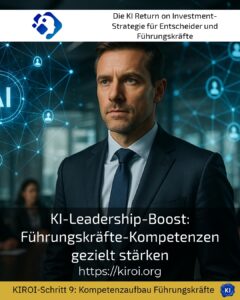
Digital transformation is fundamentally changing companies. Leaders face entirely new challenges. They need to understand how intelligent systems work and influence decisions. This is no longer just about technical knowledge. Strengthening AI leadership skills deliberately means developing a new way of thinking today. It requires strategic skill and emotional intelligence in equal measure. Many decision-makers come to transruptions coaching with precisely this concern. They are looking for orientation in a rapidly changing world. This article shows how modern leaders can build this competence. It offers practical ideas and concrete examples from various industries.
Why traditional leadership models are reaching their limits
Classic leadership approaches stem from a different era. They are based on hierarchies and linear processes. However, intelligent systems work differently. They network information and recognise patterns in real time. Leaders must therefore rethink and develop new skills. In retail, for example, automated inventory planning completely changes the role of store management. Decisions that previously required experience are now made by an algorithm. The situation is similar in the logistics industry. Here, intelligent systems optimise supply chains autonomously. Humans take on a controlling and supervisory role. In the financial sector, automated processes analyse creditworthiness and market risks. Bank managers must be able to interpret and communicate these results. Clients often report feeling overwhelmed in such situations. They feel caught between technology and people management. Transruptions coaching supports them in using this tension productively.
Targeted strengthening of AI leadership competence through systematic learning
The development of new competencies requires a structured approach. The AIROI model, a proven framework for development processes, supports this. It offers guidance without imposing rigid requirements. In the healthcare sector, clinic managers are already successfully using this model. They learn to use diagnostic support systems effectively, while still retaining their medical judgement and empathy. In the automotive industry, production managers are adopting similar approaches, integrating predictive maintenance systems into their management routines. The result is a new form of decision-making. The insurance industry is also showing interesting developments. Claims managers work with automated assessment systems, and must critically evaluate their recommendations and act in a customer-oriented manner. The key lies in understanding the system logic. Only those who grasp the fundamentals can lead with confidence.
Best practice with a AIROI customer
A medium-sized engineering company faced a particular challenge. Management had invested in modern analysis systems, but the leadership team was unable to use them effectively. As part of the transruption coaching, we supported the entire management team over a period of six months. Initially, we analysed existing skill gaps and developed individual learning paths for each manager. The production manager learned to interpret quality forecasts correctly and integrate them into her shift planning. The sales manager developed an understanding of automated customer analyses and their limitations. The work on communication with the teams was particularly important. The managers had to learn to explain technological changes in an understandable way. They developed new discussion formats for regular exchange with their employees. Upon completion of the project, all participants reported increased confidence in using the new systems. Acceptance among the workforce increased measurably because management now communicated competently and transparently.
The role of emotional intelligence in digital leadership
Technical knowledge alone is not enough. Leaders must also develop their emotional intelligence. This is because the introduction of intelligent systems often triggers anxiety among employees. They fear for their jobs and their value to the company. This dynamic is particularly evident in the banking sector [1]. Employees are experiencing algorithms taking over their previous tasks. Leaders must provide reassurance and highlight new perspectives in these situations. In the media industry, automated content production is fundamentally changing roles. Editorial management faces the task of re-motivating creative teams. The hotel industry is experiencing similar upheavals through automated booking and service processes. General managers must show their teams that human hospitality remains irreplaceable. This communication task requires a high degree of emotional intelligence and authenticity.
Scaling AI leadership skills in growing organisations
Individual competent leaders are not enough. Companies must embed these skills throughout the organisation. This requires systematic approaches and long-term strategies. In the pharmaceutical industry, some corporations have already done exemplary work [2]. They established internal academies for digital leadership skills. There, leaders at all levels learn from each other continuously. The food retail sector relies on similar concepts with regional learning groups. Store managers regularly exchange experiences. Together, they develop solutions for typical everyday challenges. The telecommunications industry uses digital learning platforms for widespread further training. Leaders can learn there at their own pace. Peer coaching formats sensibly supplement individual learning units. The energy sector faces particular challenges when scaling. Here, traditional grid operators must build entirely new skills.
Practical Tools for Everyday Management
Theoretical knowledge must prove itself in everyday life. That's why, in transruption coaching, we work with concrete tools and methods. The AIROI model offers a proven framework for implementation. In construction project management, structured decision protocols are particularly effective. Site managers document how they incorporate automated recommendations into their decisions. This creates transparency and promotes team learning. In the advertising industry, creative directors use special reflection formats for working with generative systems. They systematically question where human creativity remains indispensable. The fashion industry is developing its own evaluation criteria for design-support technologies. Purchasing managers learn to critically assess algorithmic trend forecasts. A common pattern emerges across all industries: successful leaders combine technical understanding with human judgment.
Best practice with a AIROI customer
An international hotel chain wanted to fundamentally modernise its leadership culture and turned to our coaching team. The challenge was to develop over fifty hotel managers across different countries simultaneously. We designed a hybrid programme that combined digital learning modules with in-person coaching sessions. Firstly, all participants completed a standardised foundational module on intelligent systems in hotel management. Subsequently, they worked in regional groups on industry-specific case studies covering topics such as automated revenue management. The in-person coaching sessions addressed individual development areas and the specific cultural nuances of each location. A mentoring programme between experienced and junior managers proved particularly successful. The senior managers shared their knowledge of guest relations, while the junior managers provided technological insights. After one year, the corporate leadership reported a significantly increased willingness to innovate throughout the management team. Staff turnover among managers decreased because they felt more competent and future-ready.
The importance of ethical reflection for modern leadership
Intelligent systems make decisions that directly affect people. Leaders bear responsibility for the ethical implications of these technologies. This dimension is particularly evident in human resources [3]. Automated application screening systems can have an unintentionally discriminatory effect. HR managers must be able to recognise these risks and actively counteract them. In the banking sector, algorithms decide financial life chances. Bank directors must ensure that these decisions remain fair and understandable. The healthcare industry faces similar challenges with diagnostic systems. Chief physicians must weigh up when to follow machine recommendations and when not to. The justice system is experimenting with predictive systems for risk assessment. Here, the ethical questions are particularly complex and far-reaching. Strengthening AI leadership competence specifically also means developing ethical judgment.
Sustainable anchoring of new competencies
One-off training sessions are not enough for lasting change. Leaders require continuous support and opportunities for reflection. transruptions-coaching therefore sees itself as a long-term partner on this development path. In retail, progressive companies are establishing regular reflection rounds on technological topics. District managers meet monthly for the exchange of experiences and mutual learning. The chemical industry relies on accompanying supervision when introducing new systems. Plant managers are given space for open questions and uncertainties. In the media industry, new formats are emerging, such as technology retrospectives after major projects. Teams collectively reflect on what worked well in the interplay between people and systems. The aviation industry uses its established safety cultures for this purpose. Crew Resource Management is expanding to include new digital dimensions and questions.
My AIROI Analysis
The development of leadership expertise in the context of intelligent systems presents one of the central challenges of our time. In my consulting practice, I have observed for years how differently organisations approach this topic. Successful companies are characterised by an integrated approach that combines technical knowledge, emotional intelligence, and ethical reflection. They understand that it is not about competition between humans and machines. Instead, intelligent collaboration is at the heart of all endeavours. The AIROI model offers a proven framework that can be flexibly adapted to different industries and company sizes. I find the realisation that this competency development is never finalised to be particularly important. Technologies are continuously evolving and require constant learning. Leaders who face this reality gain a decisive advantage. They can guide their teams through change and convey trust and orientation. Transruptions-Coaching supports these processes with experience and methodological competence. We provide impetus, ask critical questions, and support individual development. The future belongs to those leaders who understand technology as a tool while keeping people at the centre.
Further links from the text above:
[1] McKinsey study on the state of intelligent systems in companies
[2] Harvard Business Review on Leadership and Intelligent Technologies
[3] World Economic Forum analyses on ethical issues of digital transformation
For more information and if you have any questions, please contact Contact us or read more blog posts on the topic Artificial intelligence here.









 Deutsch
  English (UK)