
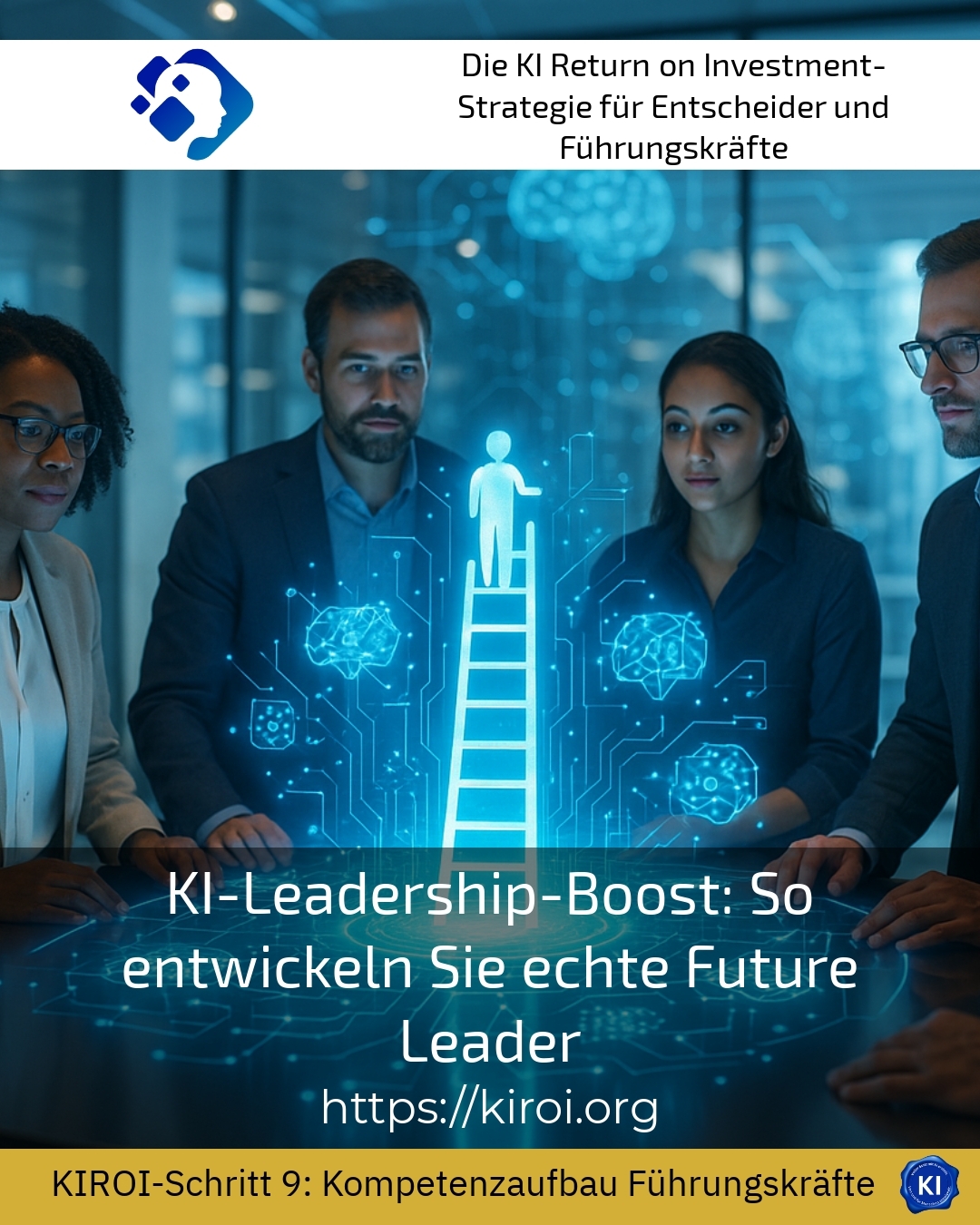
Executive floors are facing a fundamental transformation that goes far beyond traditional management approaches. While many companies are still discussing the implementation of digital tools, forward-thinking organisations have long recognised that the real competitive advantage lies in the development of future-proof leaders. AI Leadership Boost marks a decisive turning point, as it unites technological expertise with human intuition in a completely new way. Leaders often report feeling torn between algorithmic efficiency and authentic leadership. This is precisely where a new generation of development programmes comes in, synergistically combining both worlds while neither ignoring the technological reality nor neglecting the interpersonal dimension.
The reinvention of leadership in the digital age
Traditional leadership models are increasingly reaching their limits. The speed at which markets are changing requires completely new ways of thinking. For example, a medium-sized mechanical engineering manufacturing company recognised that its tried-and-tested leadership principles were no longer sufficient. Management noticed that younger talent brought different expectations of leadership. At the same time, automated processes demanded managers with a basic understanding of technology.
A similar pattern is emerging in the finance industry. Banks and insurance companies face the challenge of equipping experienced managers with new skills. As a result, a regional credit institution introduced a comprehensive development programme. The managers learned to combine data-driven decisions with emotional intelligence. This combination proved to be particularly valuable in customer interactions.
The healthcare sector is also facing profound changes. Clinic managers today must combine medical expertise with digital competence. A hospital group therefore launched a pilot project for leadership development. The participants engaged intensively with the question of how technology can support patient care. In doing so, they discovered entirely new possibilities for collaboration between humans and machines.
AI Leadership Boost as a Strategic Development Approach
The term AI Leadership Boost It describes more than just a training programme. It is a holistic development approach for forward-thinking leaders. At its core, it is about merging technological understanding with human leadership qualities. This integrative approach fundamentally differs from isolated training measures.
The logistics industry provides a vivid example of this. A large logistics provider recognised that its managers were inadequately supporting digital transformation projects. Employees felt overwhelmed by the changes and resisted them. The situation only improved when the company invested in the development of its managers. The managers learned to design change processes in a human-centred way.
Comparable dynamics are evident in retail. Store managers are faced with the task of bridging the online and offline worlds. Consequently, a retail company with over a hundred branches launched a development programme. Managers received input on integrating new technologies into everyday sales. At the same time, they strengthened their skills in staff management and customer advisory services.
The energy sector is currently undergoing a fundamental transformation. Leaders in this sector require entirely new competencies. A regional energy provider therefore intensively supported its leadership through this transformation. The company relied on a combination of technological workshops and personal coaching. The results significantly exceeded initial expectations.
Best practice with a KIROI customer
A technology company with international operations, headquartered in Southern Germany, faced a particular challenge as its middle management exhibited significant uncertainty in dealing with automated decision-making processes. The managers feared being replaced by intelligent systems or having their importance diminished. Transruptions coaching provided intensive support to the company over an eight-month period for this transformation project. Initially, we jointly analysed the existing leadership competencies and identified development potentials for each individual manager. In the next step, we developed individual development paths that took into account both technological and human aspects. The managers received regular coaching sessions where they could reflect on their experiences. The work on concrete practical cases from within the company proved particularly valuable. The participants learned to perceive intelligent systems as support rather than a threat. After the programme concluded, over ninety percent of the managers reported significantly increased self-confidence. Employee satisfaction in the affected departments improved measurably. The company was able to implement its transformation projects significantly faster and more smoothly.
Emotional Intelligence as a Key Competence for Future Leaders
The more routine tasks are taken over by machines, the more important genuinely human skills become. Emotional intelligence is at the forefront of this [1]. Future leaders must be able to navigate complex interpersonal situations. They need a keen sense for the needs of their employees.
This development is particularly evident in the pharmaceutical industry. Research managers must guide highly specialised teams through uncertain innovation processes. One pharmaceutical company therefore specifically invested in the development of emotional leadership skills. Team leaders learned to constructively manage frustration and setbacks. They developed strategies for motivating their teams during difficult phases.
The media industry provides another example of this development. Editorial directors are under enormous time pressure and must also lead creative teams. A media company therefore introduced a special development programme for its executives. The participants engaged intensively with techniques for stress management and team leadership. The results were evident in an improved working atmosphere and higher productivity.
Emotional intelligence is also gaining importance in the education sector. School principals and university managers face complex challenges. A university implemented a leadership development programme with a focus on emotional competence. Deans and heads of departments received input to improve their communication skills. This had a positive impact on the working atmosphere and student satisfaction.
AI leadership boost through systematic skills development
The development of future-proof leaders requires a structured approach. Isolated training measures are not sufficient to bring about sustainable change. Instead, a well-thought-out development programme spanning several months is needed [2]. The AI Leadership Boost connects different learning formats and thus creates optimal development conditions.
The automotive industry is facing a profound structural transformation. Leaders in this sector require entirely new competencies compared to just a few years ago. Therefore, a supplier company launched a comprehensive development programme for its entire leadership level. Managers addressed topics such as agility, data-driven decision-making, and change management. The peer-learning formats, in which leaders learned from one another, were particularly valuable.
Similar developments are also evident in the construction industry. Site managers and project managers are facing increasingly complex tasks. A large construction company therefore invested in the systematic development of its managers. The participants received both technical and personality-related development impulses. The combination of workshops, coaching and practical projects proved to be particularly effective.
The tourism industry is also undergoing profound changes. Hotel managers and tour operators must constantly adapt to new customer expectations. A hotel group therefore introduced a leadership development programme. The managers learned to combine digital tools with personal hospitality. This integration proved to be a decisive competitive advantage.
Best practice with a KIROI customer
A medium-sized company in the food industry approached our transruption coaching team with a specific question: how could their leadership culture be modernised without completely abandoning tried-and-tested traditions? The third-generation family business faced the challenge of integrating younger leaders while simultaneously developing experienced managers. We supported the company over a period of six months with a combination of individual coaching, team workshops, and strategic reflection sessions. In the first step, we analysed the existing leadership culture, identifying both strengths and areas for development. Subsequently, together with management, we developed a bespoke development programme for all leadership levels. Older leaders received input on digital competency development, while younger managers benefited from the experience of their colleagues. The intergenerational dialogue formats, which we regularly facilitated, proved particularly valuable. The leaders developed a shared understanding of future-proof leadership. The company reported significantly improved collaboration between generations. The turnover rate among younger talent measurably decreased, and the company became more attractive as an employer.
Practical Implementation of the Leadership Boost Concept
The transformation of leadership skills is only successful through consistent practical application. Theoretical knowledge alone is not sufficient to bring about sustainable changes in behaviour [3]. Leaders must be able to test and reflect on new approaches in their day-to-day work. This is precisely where professional support comes in.
The importance of practical implementation is particularly evident in the telecommunications industry. A telecommunications provider introduced a development programme with a strong practical focus. Executives worked on real projects from their daily work. They received regular feedback on their leadership behaviour from colleagues and coaches. This continuous reflection led to sustainable behavioural changes.
The public sector faces similar challenges. Heads of departments must lead their organisations through complex modernisation processes. Therefore, a city administration implemented a comprehensive leadership development programme. Department heads received coaching support for specific change projects. The practical connection proved to be crucial for success.
The insurance industry provides another example of successful practical implementation. An insurance company faced the task of modernising its sales organisation. Sales managers received intensive support during this transformation process. They learned to guide their teams through the changes and to address resistance constructively. The result was a significantly increased acceptance of the new ways of working.
Identify and target future leaders for development.
Identifying leadership talent presents many organisations with challenges. Traditional selection criteria often fall short and overlook important potential. Future-proof leaders are characterised by competencies that are not always immediately apparent. They possess a willingness to learn, adaptability, and a constructive approach to uncertainty.
In the chemical industry, the importance of proactive talent development is particularly evident. A chemical company developed a systematic programme for identifying leadership talent. The candidates went through various assessment formats with a focus on future competencies. Particular attention was paid to the ability to navigate complex and uncertain situations.
The technology sector is also focusing on early talent identification. A software company introduced a high-potential programme for aspiring leaders. Participants gained early insights into leadership tasks and received targeted development. The combination of mentoring, project work, and coaching proved to be particularly effective.
Comparable approaches are evident in the consumer goods industry. A branded goods manufacturer invested in the systematic development of its junior executives. The talents went through a multi-year development programme with various placements. They gained experience in different functions and countries. This broad development optimally prepared them for future leadership roles.
My KIROI Analysis
The development of future-proof leaders represents one of the central challenges of our time and requires a holistic approach that goes far beyond traditional training formats. My experience from numerous support projects shows that AI Leadership Boost then is most effective when it combines technological competence development with personal maturation, taking into account the specific contextual conditions of the respective organisation.
The leaders I've had the privilege of coaching often report an initial feeling of being overwhelmed by the diverse demands placed upon them today. They feel torn between the expectations of their employees, market demands, and the possibilities offered by new technologies. This is precisely where transruption coaching comes in, by offering leaders a safe space for reflection where they can clarify their own position and develop new strategies for action.
I am always particularly impressed by how quickly positive changes become apparent when leaders develop clear direction and become aware of their own strengths. The path to becoming a Future Leader is not a sprint, but a marathon that requires stamina, the ability to reflect, and a willingness for continuous development. Organisations that invest in this development not only create better leaders, but also more resilient and adaptable cultures that are equipped to face the challenges of the future.
Further links from the text above:
[1] Harvard Business Review: Emotional Intelligence in Leadership
[2] McKinsey: Leadership Development – What Works
[3] Forbes: The Future of Leadership Development
For more information and if you have any questions, please contact Contact us or read more blog posts on the topic Artificial intelligence here.









 Deutsch
  English (UK)