
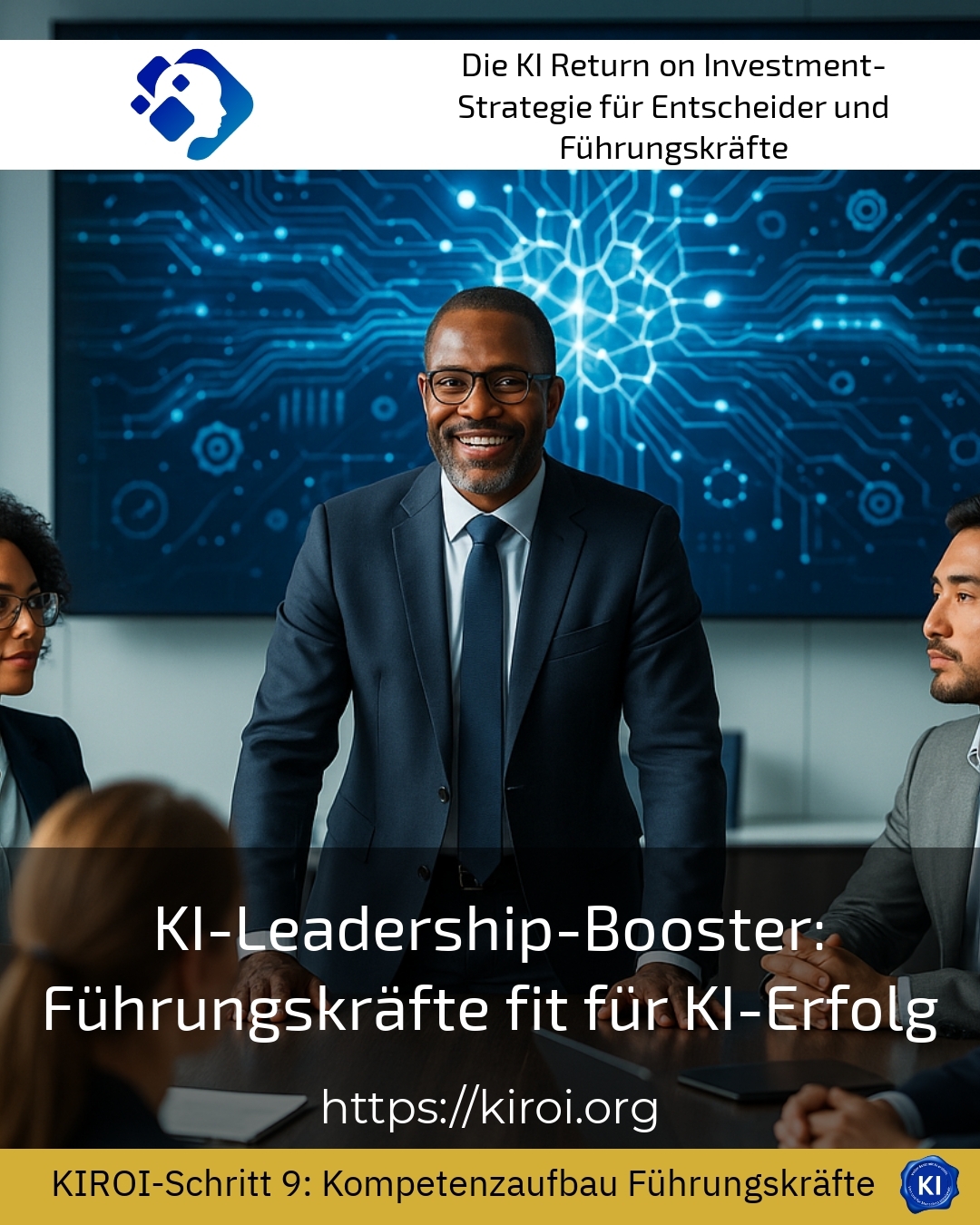
The digital transformation is changing companies at a pace that presents many leaders with entirely new challenges. While some organisations are already achieving impressive successes with intelligent systems, others are still struggling with fundamental implementation questions. AI Leadership Booster: Making Leaders Fit for AI Success offers valuable guidance and practical recommendations here. Because one thing is clear: Without competent leadership, even the best technology projects will fail due to a lack of acceptance or a missing strategic direction. This article will show you concrete ways to successfully navigate your organisation through this exciting time.
The new role of the leader in the digital age
Today's leaders are facing a fundamental reorientation of their roles and responsibilities. They must not only understand technological developments but also be able to assess their impact on business models and employees. This requires less in-depth programming knowledge and more strategic foresight and the ability to recognise and communicate complex interrelationships. Many leaders report feeling uncertain when dealing with new technologies. They wonder what decisions they should make and how they can motivate their teams. These questions are valid and deserve serious consideration.
For example, a production manager in the automotive industry faces the challenge of introducing automated quality control systems without losing the trust of their experienced employees. In the insurance sector, department heads need to understand how algorithmic risk assessments work in order to explain them to customers and regulatory authorities. And in retail, store managers decide how personalised recommendation systems should improve the shopping experience without devaluing personal customer interaction. All these situations require a new understanding of leadership.
The AI leadership booster as a strategic compass
The AI Leadership Booster: Making Leaders Fit for AI Success It acts as a strategic compass for decision-makers in turbulent times. It not only imparts theoretical knowledge but, above all, practical skills for everyday leadership. The focus is on developing a technology-open attitude that recognises opportunities and adequately assesses risks. Transruption coaching accompanies managers on projects related to this transformation and provides valuable impetus for practical implementation.
In the logistics industry, advanced companies are already using intelligent route optimisation and warehouse management. Leaders there have had to learn to interpret data analytics and prepare their teams for changing workflows. In healthcare, diagnostic assistance systems support doctors in interpreting results, posing entirely new demands on the management of medical teams [1]. And in the financial sector, automated advisory systems are revolutionising customer interaction, with team leaders needing to find the right balance between efficiency and personal care.
Best practice with a AIROI customer
A medium-sized company in the manufacturing industry approached us with a typical challenge experienced by many organisations in a similar situation. Management had decided to implement intelligent maintenance systems to reduce unplanned machine downtime and increase production efficiency. However, this initiative met with significant resistance from shift leaders and technician teams, who felt their years of experience and intuition were being devalued. Within the framework of transruption coaching, we guided management in developing a completely new communication strategy that valued employees' expertise while highlighting the benefits of the new technology. The shift leaders became active co-designers of the implementation process by contributing their specialist knowledge to the configuration of the systems. After six months, both management and employees reported significantly improved collaboration and a substantial increase in production quality. This example vividly demonstrates the importance of the human element in technological transformation projects.
Core competencies for future-oriented leadership
Successfully navigating technological disruption requires specific competencies that go beyond traditional management skills. Firstly, leaders need a solid foundation in understanding technological possibilities and their limitations. They must be able to ask critical questions and place expert statements in context [2]. Furthermore, the ability for ethical reflection is increasingly important, as algorithmic decisions can have far-reaching effects on people.
In the media industry, chief editors need to understand how automated news selection works and what editorial standards must be maintained. HR managers in large corporations are grappling with how to make algorithmically supported application processes fair and non-discriminatory. And marketing managers are learning to use personalised advertising in a way that offers customers genuine added value without veering into manipulative practices. These examples highlight the ethical dimension of modern leadership.
Emotional intelligence as a key factor
Paradoxically, the more technologically advanced our working world becomes, the more important emotional intelligence becomes. Leaders must be able to take their employees' fears and concerns seriously and address them constructively. They act as bridge-builders between technological possibilities and human needs. Clients often report difficulties in finding this balance. Transruption coaching supports them in further developing their communication skills and leading authentically.
For example, a bank department head needs to understand why experienced advisors react skeptically to automated investment recommendations and to address these concerns in a way that shows appreciation. In hospitals, ward managers face the task of explaining to nurses why digital documentation systems will make their jobs easier in the long run, even if the initial transition involves extra effort. And in architectural firms, project managers support their teams in perceiving generative design tools as a creative enrichment rather than a threat [3].
Best practice with a AIROI customer
A customer service company approached us with the challenge that the introduction of intelligent chatbots had led to significant tension within their customer service team. Team leaders felt overwhelmed because, on the one hand, they had to defend the efficiency gains of the new technology, while on the other hand, they couldn't ignore their employees' legitimate concerns about their jobs. In coaching, we jointly developed a concept that turned the service employees into quality assurance officers and trainers for the automated systems. This new role required different skills and offered more interesting development opportunities than their previous duties. The managers learned to communicate this transformation as an opportunity and to actively involve their teams in the further development of the systems. The realisation that human expertise remains indispensable for the continuous improvement of automated systems was particularly valuable. Employee satisfaction increased significantly after the realignment, and the quality of customer service improved measurably.
Practical implementation strategies for everyday leadership
Theoretical insight into the necessity of change is not enough on its own. Practical implementation in daily leadership action is crucial. The AI Leadership Booster: Making Leaders Fit for AI Success therefore places particular emphasis on concrete recommendations for action and proven methods. A tried-and-tested strategy is to start with small pilot projects and learn systematically from them.
In the real estate industry, innovative estate agents have begun to use virtual viewing tools, initially presenting only selected properties with them. The experiences from this pilot phase then flowed into the broader rollout [4]. In the catering industry, restaurant chains are experimenting with automated ordering systems, with service staff actively involved in the evaluation. And in agriculture, farm managers initially test the possibilities of precision-controlled farming on individual fields before making larger investments.
From AI Leadership Booster to Sustainable Cultural Change
Sustainable changes don't happen overnight; they require continuous work on the corporate culture. Leaders must lead by example and foster a culture of experimentation and learning. Mistakes should be understood as valuable learning opportunities, not as failures. Transruption coaching supports organisations in this cultural transformation and provides impulses for constructively dealing with uncertainty.
For example, a publishing house established regular innovation workshops where editors and technicians jointly test new possibilities for content creation. In a mechanical engineering company, cross-departmental teams were formed to develop and test innovative maintenance concepts. And a tax consulting firm set up an internal knowledge exchange where employees share their experiences with automated analysis tools and learn from each other. These examples show how cultural changes can be put into practice.
Best practice with a AIROI customer
A retail company with multiple branches faced the challenge of introducing data-driven assortment optimisation, while simultaneously preserving the local knowledge of branch managers. The head office had developed algorithmic recommendations for assortment design, based on sales data and trends. However, these recommendations sometimes contradicted the local expertise of the branch managers, who had known their clientele for years. In transruptions coaching, we worked with regional and branch managers to develop a hybrid decision-making model. This model combines the strengths of data-based analysis with the local market knowledge of the on-site managers. The branch managers learned to interpret data analyses and reconcile them with their own observations. At the same time, the head office developed a feedback system that allows local knowledge to flow back into the algorithms. The result was significantly improved assortment design, which is both data-based and locally adapted. The branch managers reported an increased sense of appreciation and a better understanding of the possibilities of technological support.
Challenges and approaches
Despite all odds, technological transformations also bring significant challenges that must be openly addressed. Many leaders report feeling overwhelmed by the speed of change and the sheer number of options. Others struggle with resistance within their teams or with a lack of support from senior management. These issues regularly arise in our coaching, and we have developed proven approaches to deal with them constructively.
In the construction industry, project managers face the challenge of introducing Building Information Modelling, while many experienced site managers stick to traditional methods [5]. In law firms, partners need to understand how automated contract analysis works in order to competently represent its findings to clients. And in advertising agencies, creative directors grapple with how to use generative tools without losing creative originality. All these situations require sensitive leadership and intelligent communication.
My AIROI Analysis
The intensive engagement with the topic AI Leadership Booster: Making Leaders Fit for AI Success clearly shows that technological competence alone is not enough to successfully guide organisations through the current transformation. Instead, it requires a combination of strategic foresight, emotional intelligence, and the ability to take people along on journeys of change. The numerous examples from various industries illustrate that there is no one-size-fits-all solution, but rather each organisation must find its own path.
Particularly noteworthy is the realisation that human leadership qualities are not losing their importance in an increasingly automated world, but rather, on the contrary, are becoming more crucial than ever. Leaders who understand how to reconcile technological possibilities with human needs will become indispensable architects of their organisations' futures. Transruption coaching offers valuable guidance and provides impetus that enables sustainable change.
Our AIROI clients' best-practice examples impressively show that successful transformation is possible when leaders are willing to develop themselves and break new ground. This is not about changing everything at once, but about proceeding systematically and with careful consideration. Small successes build trust and motivation for bigger steps. The future belongs to leaders who understand how to combine technological innovation with human warmth and wisdom.
Further links from the text above:
[1] McKinsey Healthcare AI Transformation Insights
[2] Harvard Business Review – Artificial Intelligence Leadership
[3] World Economic Forum – Artificial Intelligence Agenda
[4] Forbes AI and Technology Coverage
[5] Boston Consulting Group – AI Strategy and Implementation
For more information and if you have any questions, please contact Contact us or read more blog posts on the topic Artificial intelligence here.









 Deutsch
  English (UK)