
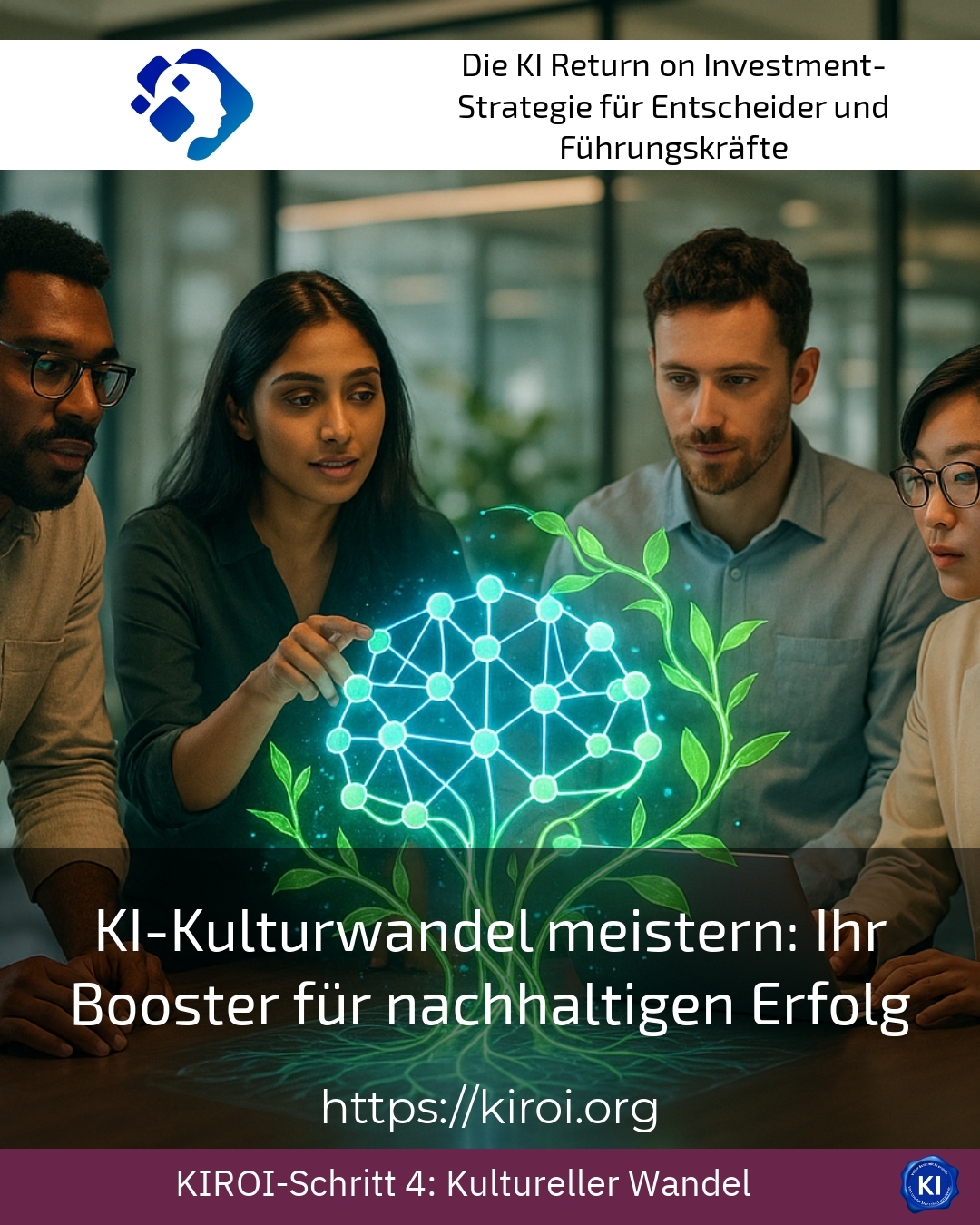
Imagine that your organization is undergoing a profound transformation that affects every process, every department, and every employee. The Mastering AI cultural change This becomes a crucial skill for companies that want to remain competitive in the long term. But how do you get people on board, overcome resistance, and at the same time advance technological innovation? This question concerns executives worldwide. Many organizations fail not because of the technology itself; they fail because of the people and their willingness to change. In this article, you will learn which strategies actually work and how you can achieve sustainable success.
Why mastering the AI culture change is indispensable today
The introduction of intelligent systems fundamentally changes working methods. Employees must develop new skills. Managers need changed management approaches. At the same time, completely new job profiles and areas of responsibility are emerging. This development affects all industries without exception. In retail, for example, automated warehouse systems are revolutionizing the entire logistics sector. Cashiers suddenly work alongside self-checkout stations. Store managers use predictive analytics for their ordering planning. The human component remains central to success.
Insurance companies are using intelligent algorithms for damage assessment. Claims handlers must learn to cooperate with these systems. Their expertise remains indispensable for complex individual cases. At the same time, their job profile is changing significantly. Routine tasks are being eliminated, while analytical skills become more important. Banks are partially automating credit decisions through machine learning. Customer advisors are focusing more on relationship management and individual advice. This shift requires a fundamental realignment of corporate culture [1].
The psychological dimension of transformation
Change initially generates uncertainty and resistance in many people. This reaction is completely natural and should be taken seriously. Successful transformation projects take the emotional level into account from the very beginning. They create spaces for open dialogue and honest communication. In healthcare, we see this dynamic particularly clearly. Nurses fear being replaced by automated documentation systems. Doctors worry about their diagnostic autonomy. Hospital managers must actively address and dispel these fears.
The automotive industry is also undergoing massive change. Production workers on traditional production lines are experiencing the introduction of collaborative robots. Engineers are working with generative design systems that calculate thousands of variants. Salespeople in car dealerships use virtual configurators and augmented reality applications. Each of these groups requires specific support on their path to change. transruptions coaching accompanies organizations precisely during these complex transformation processes and provides valuable impulses.
Best practice with a AIROI customer
A medium-sized logistics company with about three hundred employees faced the challenge of introducing intelligent route optimization. The dispatchers felt threatened by the new system and were not valued for their expertise. Together, we developed a communication strategy that explicitly acknowledged their years of experience. We organized workshops where dispatchers could directly contribute their practical knowledge to the system configuration. This involvement transformed initial resistance into active support and enthusiasm. The employees recognized that their expertise remained indispensable for fine-tuning the system. Routine decisions were taken by the system, while complex situations continued to require human judgment. After six months, many dispatchers report increased job satisfaction and less stress. The fluctuation in the department significantly decreased, and the sick days decreased noticeably. The management was impressed by the positive development of the team dynamics overall.
Mastering strategies for sustainable success in the AI cultural transformation
Successful transformation always starts with a clear vision and transparent communication. Employees need to understand why change is necessary. They need to recognize the opportunities that arise for them personally. Abstract promises of efficiency rarely convince. Concrete examples from their own workdays are much more motivating. In the education sector, this is exemplified by the introduction of adaptive learning systems. Teachers benefit from automated evaluation of standardized tests. They gain time for individual support and creative teaching design. School administrations use data analysis for better resource planning and personnel development [2].
The pharmaceutical industry offers further insightful examples of successful change. Laboratory technicians work with automated analysis devices and intelligent evaluation systems. Researchers use machine learning to identify promising drug candidates. Quality managers rely on predictive maintenance and automated documentation. These changes require continuous training and mental adaptation. The energy sector is undergoing a fundamental transformation of its core processes in parallel. Network operators are implementing intelligent load control and predictive maintenance systems. Customer service employees are using chatbots as the first point of contact for standard inquiries.
Leaders as enablers of change
The role of leaders can hardly be overstated in transformation projects. They must lead by example and actively support change. At the same time, they themselves need guidance and development of their competencies. transruptions coaching supports leaders in navigating their teams through uncertain times. In the media industry, we experience this dynamic particularly intensively and directly. Editors must combine journalistic quality with automated news production. Graphic designers work with generative design tools and must develop new workflows. Publishing managers balance innovation with proven business models from the past.
The hospitality industry faces similar challenges in the digital transformation. Hoteliers are implementing automated check-in systems and intelligent room control. Restaurant owners are using reservation algorithms and dynamic pricing. Service staff must learn to view technology as support rather than a threat. Personal hospitality remains the crucial competitive advantage. Clients often report that at first they were overwhelmed by the speed of change. However, with targeted guidance, they found their individual path through the transformation.
Best practice with a AIROI customer
A regional insurance group wanted to accelerate and optimize its claims processing through intelligent systems. The experienced claims handlers with an average of fifteen years of service showed considerable skepticism towards the project. We jointly developed a mentoring program in which these experts actively contributed their expertise. They trained the algorithms using case examples from their long-standing practical experience and documented important decision criteria. This approach recognized their competence and simultaneously created acceptance for the new system throughout the entire workforce. The claims handlers now saw themselves as indispensable partners of the technology rather than as its victims or competitors. The processing time for standard cases was reduced by approximately forty percent through automation. At the same time, customer satisfaction increased because complex cases received more individual attention than before. Employee satisfaction improved measurably, and the company gained employer appeal in a challenging market environment. This success story was internally used as a model for further transformation projects in other departments.
Common stumbling blocks and how to avoid them
Many transformation projects fail due to avoidable errors in implementation. A common stumbling block is the lack of involvement of those affected from the outset. When decisions are made solely at the leadership level, the necessary acceptance among the workforce is lacking. In mechanical engineering, this is particularly evident when introducing predictive maintenance systems. Technicians must fundamentally change their approach and learn to trust data. Without their active participation, even excellent systems remain ineffective and are circumvented [3].
The food industry faces similar challenges in process automation. Production workers suddenly work with image recognition systems for quality control. Lab technicians use automated analysis methods that change their work. Logistics professionals control autonomous transport vehicles in the production halls. Each group needs specific training and emotional support along this path. The construction sector is experiencing parallel developments with Building Information Modeling and automated planning. Architects use generative design tools that can calculate thousands of variants. Site managers work with digital twins of their projects and connected devices.
Mastering the importance of continuous support in the transformation of AI culture
One-time training rarely suffices for sustainable change. Transformation is a continuous process that requires long-term support. Regular feedback and adapting strategies are essential for lasting success. transruptions coaching supports organizations precisely in this long-term development using proven methods. In the financial sector, we observe how asset managers are learning to handle algorithmic investment recommendations. Compliance employees use automated monitoring systems to detect suspicious transaction patterns. Customer service agents work with intelligent assistants that prequalify and answer standard inquiries.
The telecommunications industry offers further instructive examples of successful transformation. Network technicians now monitor complex infrastructures using intelligent monitoring systems. Call center employees use real-time analytics to improve their conversation management and customer service. Sales representatives rely on predictive models to predict customer churn and identify upselling opportunities. These tools require new skills and a changed work mentality among all involved parties.
Best practice with a AIROI customer
A leading retail company with over fifty stores implemented intelligent demand forecasts for its product range. The purchasing professionals with decades of experience did not feel sufficiently valued and appreciated their expertise. We initiated a structured dialogue between data experts and experienced retail professionals from the day-to-day business. In joint workshops, algorithms were refined and improved with the practical knowledge of the purchasing professionals. Seasonal specialities, regional preferences, and experience were directly incorporated into the models, increasing their accuracy. The purchasing professionals recognized that their intuition and market knowledge remained indispensable for excellent forecasts. The system took over routine calculations, while strategic decisions continued to require human expertise and evaluation. After one year, the forecast accuracy had improved by approximately twenty-five percent compared to the initial value. The inventory decreased while the availability of the requested products for customers increased. The purchasing department became an internal model for successful human-machine collaboration throughout the entire group of companies.
My AIROI Analysis
Observations from numerous transformation projects reveal a clear pattern. Technical excellence alone does not guarantee success in introducing intelligent systems into organizations. The human factor determines whether such ambitious endeavors succeed or fail. Organizations that involve their employees early achieve significantly better results in implementation. They create psychological safety and enable honest communication about fears and hopes among all involved parties.
Leaders play a key role as role models and catalysts for cultural change. They must themselves be willing to learn and able to withstand uncertainty in difficult moments. At the same time, they need support in navigating complex change processes from the outside. Successful transformations are characterized by patience and perseverance over extended periods of time. Rapid successes may motivate in the short term, but more sustainable change takes time to take root. The industries I have been able to accompany show amazing similarities despite their diversity among themselves.
Whether in trade, insurance, logistics, or healthcare – everywhere I encounter similar challenges in the transformation process. People want to be understood and valued for their previous expertise and experience. They want to actively participate rather than being passively managed from above. Technology can support these needs when implemented properly with consideration and empathy. The future belongs to organizations that understand and promote people and machines as complementary partners. transruptions coaching provides valuable impulses for a successful integration of both sides in practice [4].
Further links from the text above:
[1] McKinsey – Culture change that sticks
[2] Harvard Business Review – Insights on Change Management
[3] Gartner – Change Management Research
[4] AIROI Blog – More articles about transformation
For more information and if you have any questions, please contact Contact us or read more blog posts on the topic Artificial intelligence here.










 Deutsch
  English (UK)