
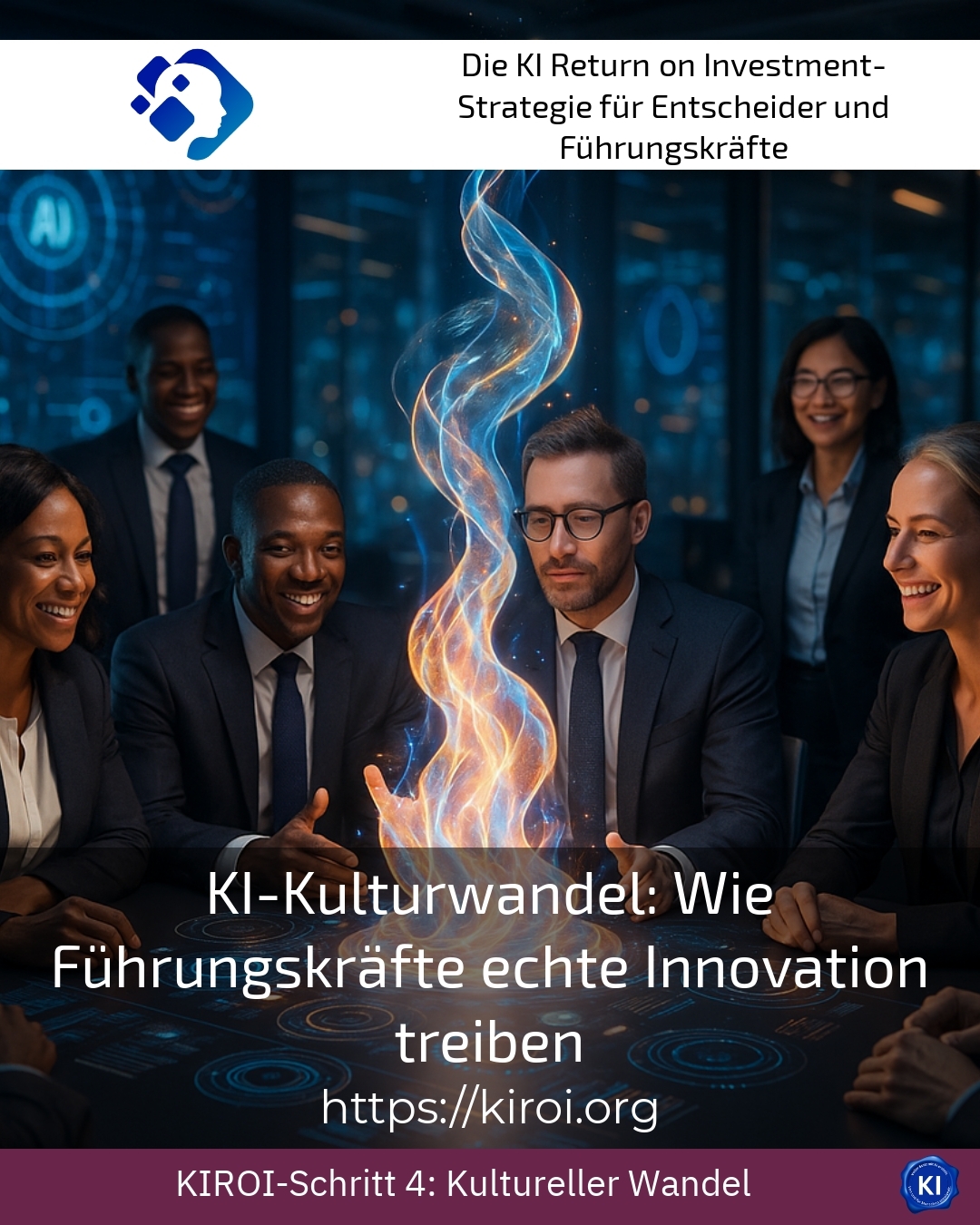
Imagine your company has state-of-the-art technology, but no one is really using it. This is exactly where AI Culture Change: How Leaders Drive Real Innovation Because without a fundamental change in mindset, even the best tools will remain unused. In numerous organisations, we are currently experiencing a phenomenon that gives cause for thought. Billions are invested, projects are launched, and training is carried out. Yet the expected breakthrough does not materialise. The cause seldom lies in the technology itself. It lies in the way people collaborate and make decisions. Leaders face a historic challenge. They must not only implement digital tools, but also win hearts and minds.
The invisible barrier between technology and transformation
Many decision-makers underestimate how deeply traditional working methods are rooted in their organisations. Employees have developed routines over years that give them security and orientation. When algorithmic systems then question these accustomed processes, natural resistance arises. This resistance is by no means irrational or destructive. Rather, it reflects a fundamental human need for stability. Successful leaders recognise this dynamic and actively work to build bridges. They create spaces for dialogue and invite co-creation. This gradually creates a culture of openness.
In manufacturing companies, this challenge is particularly evident. Experienced skilled workers possess decades of knowledge. This knowledge is often difficult to document and exists mainly in people's minds. When intelligent systems then make decision suggestions, this can be perceived as a devaluation. Smart leadership therefore uses a different approach. It positions new technologies as enhancers of human expertise. It emphasises collaboration between humans and machines. Service companies face similar challenges in customer interaction. Here too, it's about the balance between efficiency and personal appreciation.
The AI Culture Change: How Leaders Drive Real Innovation requires a rethink at all levels of the organisation. It is not enough to introduce new tools and offer training. Instead, values, beliefs and behaviours must be questioned. Transruption coaching supports leadership teams in precisely this profound change work. Clients often report initial scepticism from their teams. However, through patient dialogue and visible quick wins, this scepticism often turns into curiosity.
Best practice with a KIROI customer
A medium-sized engineering company faced a critical decision regarding its quality assurance processes. Management had already invested substantial sums in predictive analytics tools, yet acceptance among long-serving quality engineers remained alarmingly low. In collaboration with our KIROI approach, we first developed a deep understanding of the workforce's concerns. It emerged that many employees feared their expertise would be replaced by algorithmic decisions. We then designed a participatory process where experienced specialists were actively involved in fine-tuning the systems. Their experiential data flowed directly into the parameterisation of the algorithms. This approach fundamentally changed perceptions. Suddenly, the technology was no longer seen as a threat, but as a tool to enhance their own competencies. Acceptance rates rose significantly within a few months. Today, quality engineers report a noticeable easing of their workload in complex analyses.
AI Cultural Shift: How Leaders Drive Real Innovation Through Role Modelling
The role of leaders in transformation processes can hardly be overestimated. Employees observe very closely how their superiors handle new technologies. Does management itself use the implemented systems? Or do they delegate their use entirely to others? These questions are discussed in informal conversations and significantly shape the corporate culture. Leaders who are themselves keen to experiment with new possibilities send strong signals. They show that continuous learning is valuable. They demonstrate that even experienced individuals can develop new skills.
In the financial sector, we are observing interesting developments regarding this role model. Some executives actively use analytical systems for their strategic decisions. They openly talk about the support they receive as a result. Others, however, view such tools as purely the responsibility of the IT department. The impact of these differing attitudes is measurable. Teams with tech-savvy leaders show significantly higher innovation rates. They independently develop new use cases and drive improvements forward.
In healthcare, this dynamic is particularly nuanced. Medical staff possess a strong professional identity. The willingness to accept algorithmic decision support varies greatly. Leaders in hospitals and practices must proceed with particular sensitivity here. They must respect the medical ethos while simultaneously enabling openness. If this balance is achieved, remarkable synergistic effects arise. Diagnostic systems can provide indications, which human experts then evaluate professionally.
Psychological safety as a foundation for willingness to innovate
Without a sense of security, people will not take risks. This is particularly true for innovation. Trying out new ideas always involves the risk of potential failure. In cultures that punish mistakes, no one will experiment. Therefore, leaders must actively work towards an environment that values learning from setbacks. They must make their own mistakes transparent and emphasise their learning potential. In this way, an atmosphere in which creativity can flourish will gradually emerge.
Craft businesses offer surprisingly fertile ground for this. The often family-like atmosphere and flat hierarchies favour open communication. If the master craftsman themselves experiments with digital planning tools, journeymen and apprentices will follow. Personal proximity allows for quick feedback and immediate corrections. Larger corporations often have to create this sense of closeness artificially. They set up innovation labs or cross-functional teams with flat structures. Retail, in turn, uses its direct proximity to customers as an innovation driver. Employees with customer contact gather valuable insights into needs and desires.
Structural prerequisites for sustainable change
Cultural transformation requires supportive structures to be sustainable. Incentive systems must be reviewed and adapted. Do they continue to reward traditional behaviour or do they foster a willingness to experiment? Promotion criteria send strong signals about which behaviours are truly desired. If only short-term results count, no one will invest time in learning processes. Leaders must therefore consciously create breathing room and secure it structurally. Time budgets for experimentation and tolerance for initial productivity losses are essential.
The logistics industry impressively illustrates the importance of structural adjustments. This sector is traditionally characterised by tight deadlines and strict efficiency metrics. The introduction of intelligent route optimisation initially required adjustments to these key performance indicator systems. Drivers needed time to build trust in the systems' recommendations. This would have been impossible without appropriate tolerance in the performance metrics. Energy supply companies are having similar experiences. There, maintenance teams have to learn to trust predictive analysis results.
Best practice with a KIROI customer
A retail company with several hundred branches wanted to optimise its inventory planning through intelligent forecasting systems. However, the initial implementation failed due to massive resistance from the branch managers. They felt their autonomy was being curtailed by the centrally generated order proposals. As part of our coaching process, we developed a completely new implementation approach. First, together with representatives from the branches, we analysed the existing decision-making processes. It became clear that local knowledge of customer habits and regional specificities was crucial. This knowledge was not to be displaced by standardised algorithms. Instead, we developed a system where algorithmic suggestions served as a starting point. The branch managers were explicitly given the authority to make adjustments based on their local expertise. Their corrections were systematically recorded and continuously improved the forecasting models. This resulted in a learning system that integrated human judgement rather than replacing it. Employee satisfaction demonstrably increased, and the quality of forecasts also demonstrably improved.
Communication as the key to successful AI cultural change
The way changes are communicated significantly influences their perception and acceptance. Abstract announcements about digital transformation often generate uncertainty rather than enthusiasm. People want to understand what changes concretely mean for their daily work. They have questions about job security, new requirements, and support services. These questions deserve honest and understandable answers. Therefore, leaders should establish regular dialogue formats. Town halls, workshops, and informal exchange formats offer spaces for questions and concerns.
In the education sector, we are currently witnessing intense debates about the use of new technologies. Teachers are expressing valid concerns regarding pedagogical quality and equal opportunities. School leaders must moderate and constructively shape these discussions. They need to involve both enthusiasts and sceptics. Only then will viable concepts for the classroom of the future emerge. Similar questions with a particular ethical dimension are arising in the care sector. Here, the focus is on vulnerable groups and interpersonal relationships.
The AI Culture Change: How Leaders Drive Real Innovation therefore demands comprehensive communicative competence. It's not just about conveying information. It's about creating meaning and generating emotional resonance. Storytelling can be a powerful tool here. Stories of successful transformations, of overcome obstacles and gained insights inspire. They make abstract concepts tangible and show that change is possible.
Competence development as a continuous process
Technological changes require new competencies at all levels of the organisation. This starts with a fundamental understanding of algorithmic decision-making processes. It continues with specific application skills for new tools. And it encompasses overarching abilities such as critical thinking and judgement. Leaders must create learning architectures that address all these dimensions. One-off training sessions are insufficient. Learning must be understood and organised as an ongoing process.
Insurance companies are currently investing heavily in the further training of their claims handlers. These individuals must learn to work with automated claims assessments. Their role is shifting from routine processing to quality assurance and exception handling. This requires new analytical skills and a deeper understanding of systems. Similar developments can be observed in tax consulting and the legal profession. Wherever repetitive cognitive work is being automated, new job profiles are emerging.
In the construction industry, we are experiencing an exciting convergence of various technological developments. Building Information Modelling, drone surveying and smart planning are growing together. Architects and civil engineers need to learn completely new ways of working. The integration of various digital tools is becoming a core competency. Trades businesses active in construction face similar challenges. They need to be able to read digital construction plans and interact with networked systems.
Best practice with a KIROI customer
A technical testing services company recognised the need for comprehensive skills development early on. The management approached us with a desire for holistic transformation support. Together, we developed a multi-stage programme that combined various learning formats. Firstly, we conducted awareness workshops for all management levels. These workshops created a shared understanding of the potential and limitations of new technologies. Subsequently, we worked with pilot teams on specific use cases from daily operations. The teams independently developed prototypes for new workflows. They documented their experiences on internal knowledge platforms and shared them in regular exchange formats. This resulted in an organic learning network that extended beyond formal structures. The peer-to-peer support that spontaneously developed was particularly valuable. Employees with a greater affinity for new technologies became informal mentors for their colleagues. This social dimension of learning proved crucial to the sustainable success of the transformation.
AI Culture Change: How Leaders Drive Real Innovation in Practice
The practical implementation of cultural transformation rarely follows a linear path. There are setbacks, resistance, and unexpected obstacles. Leaders must develop and instil resilience in their teams. They need to combine long-term thinking with pragmatic action-orientation. Quick wins are important to generate momentum and convince sceptics. At the same time, short-term successes must not distract from fundamental structural changes. The balance between the two requires experience and continuous reflection.
In the hospitality sector, tensions between tradition and innovation are particularly evident. Personal interaction and individual customer care form the core of the industry. At the same time, new technologies offer significant potential for increasing efficiency and personalisation. Successful hotels and restaurants find creative ways to combine both. They use intelligent systems for back-end processes such as reservation management or inventory control. The time saved is then invested in more intensive guest care. Companies in the cultural sector, such as museums or theatres, pursue similar strategies.
Agriculture is currently undergoing a fundamental transformation through precision technologies. Satellite-based field monitoring and autonomous machines are changing traditional working methods. Farmers must familiarise themselves with completely new areas of expertise. The emotional attachment to time-honoured practices is often very strong. This requires particularly sensitive guidance that respects this attachment. Transruption coaching can help to build bridges between tradition and innovation.
My KIROI Analysis
Following intensive work on numerous transformation projects, key insights are emerging that are crucial for the success of cultural change processes. The technological dimension is often the easier part of the equation, as systems can be implemented and configured. The real challenge lies in the human dimension, which leaders must not underestimate. People need time to build trust in new ways of working and require support along the way. The most successful transformations combine technological excellence with a deep appreciation for human needs and competencies.
The KIROI methodology offers a structured framework for these complex change processes. It integrates various perspectives and creates space for genuine dialogue. In doing so, it avoids both technocratic over-control and naive innovation euphoria. The focus is on sustainable development that brings all stakeholders along. Leaders receive concrete tools and, at the same time, impulses for fundamental reflection. The combination of a practical focus and strategic depth makes the difference. Clients often report that it was this combination that enabled a breakthrough.
The future belongs to organisations that develop cultural agility as a core competency. They will not only overcome individual technological waves but will cultivate fundamental adaptability. Their employees will experience change not as a threat, but as an opportunity. Leaders will become enablers of development rather than managers of the status quo. This change requires courage, patience, and consistent action. The reward is an organisation that not only survives but thrives in a dynamic world, excitingly bringing its employees along on this journey [1] [2] [3].
Further links from the text above:
[1] Transruption – The Approach to Real Transformation
[2] KIROI Methodology for Businesses
[3] Harvard Business Review – AI and Machine Learning
For more information and if you have any questions, please contact Contact us or read more blog posts on the topic Artificial intelligence here.











 Deutsch
  English (UK)