
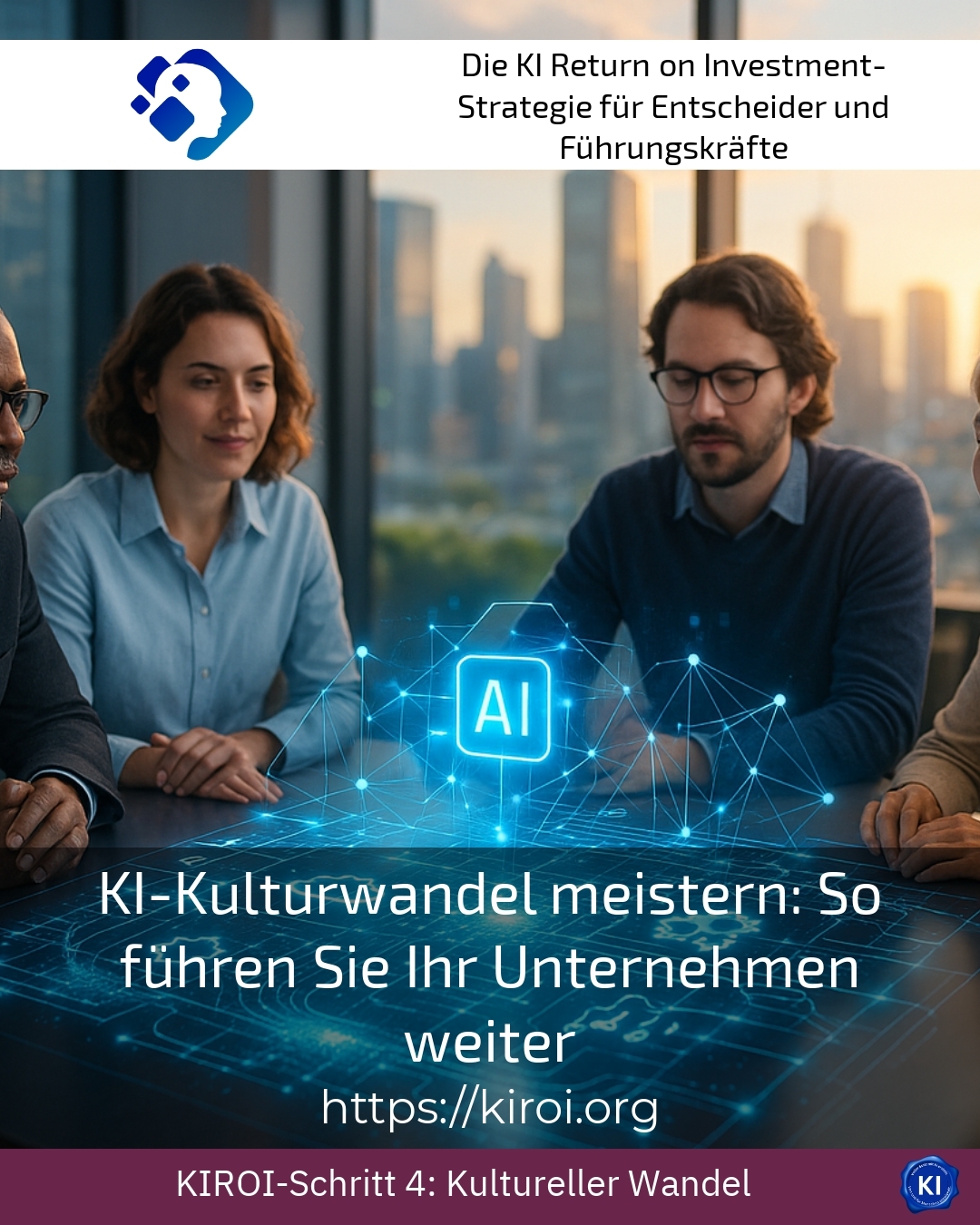
The digital revolution is currently changing the way we work and do business. Leaders face a crucial challenge. They must Mastering AI cultural change and at the same time bring their teams along. Many companies don't fail because of the technology itself. They fail due to resistance from their employees. That's why you need more than just new software. You need a well-thought-out strategy for the human factor. In this post, you'll learn how to make this transformation successful. We'll show you tried-and-tested methods and real-world examples.
Why the human factor determines success and failure
Technological innovations only bring benefits if people accept and use them. Unfortunately, many decision-makers forget this simple truth far too often. They invest millions in new systems and then wonder about the lack of acceptance. The reason is hidden deep within human psychology. Change initially creates uncertainty and sometimes even fear of the unknown. Employees wonder if their jobs are at risk and if their skills will still be needed.
In the healthcare sector, for instance, hospital managements often report initial resistance to the introduction of diagnostic assistance systems. Nurses feared being replaced by algorithms, even though reality looks different. In fact, these systems support medical staff with time-consuming routine tasks and create scope for actual patient care. Similar patterns are observed in the manufacturing industry, where production employees were initially sceptical of collaborative robots. However, after appropriate training and introduction, they recognised the advantages of these new tools.
In the financial sector, we are experiencing comparable situations with the implementation of automated advisory systems. Customer advisors feared the loss of their advisory function and thus their professional identity. However, experience shows a different picture. The systems take over standardised enquiries, allowing advisors to concentrate on complex customer needs [1].
Mastering AI cultural change through transparent communication
The first step towards a successful transformation lies in open and honest communication. Leaders must clearly state the reasons for changes and highlight the associated opportunities. At the same time, they should take legitimate concerns of the workforce seriously and actively address them. Communication that only emphasises the benefits while omitting potential challenges quickly appears unbelievable.
In the logistics industry, a major shipping company has successfully implemented this approach. Management communicated early on about planned automation in warehouses and explained in detail the impact on individual work areas. Employees were given the opportunity to ask questions and voice concerns. This open dialogue culture led to significantly higher acceptance compared to similar projects without a corresponding communication strategy. Similar patterns are emerging in the retail sector. Branch managers who actively involve their teams in the change process report less resistance and higher motivation.
The media industry offers another instructive example of successful communication. Newsrooms that informed their journalists early on about the use of text-assistance systems experienced fewer conflicts than those that introduced these tools silently [2].
Best practice with a KIROI customer
A medium-sized company in the mechanical engineering sector approached transruptions-coaching with a specific challenge. The management had already made significant investments in intelligent production systems, but the expected efficiency gains were not materialising. Upon closer inspection, it became apparent that the workforce was reluctantly using the new systems and frequently resorted to tried-and-tested manual processes. Together, we developed a comprehensive communication strategy that involved all levels of hierarchy. Managers first received intensive training on change communication. Subsequently, we organised dialogue formats where employees could voice their concerns. The outcomes of these discussions were incorporated into the further project planning. After six months of intensive support, user behaviour had fundamentally changed. The production employees recognised the added value of the new systems and even contributed their own suggestions for improvement. This example clearly demonstrates how crucial the human element is for the success of technological transformations.
Mastering the Role of Leaders in AI Cultural Change
Leaders hold a key position in the change process. They are role models for their teams and significantly shape the corporate culture. If leaders themselves are sceptical of new technologies, this attitude is transferred to their employees. This is why successful transformation always begins at the top of the organisation. Leaders must use new tools themselves and authentically communicate their benefits.
In the insurance industry, we frequently observe that successful digitalisers rigorously train and support their leaders. Team leaders in claims departments who work with automated assessment systems themselves can take their teams along much more convincingly. A similar pattern is evident in the banking sector. Branch managers who use digital advisory tools themselves report higher acceptance within their teams. The tourism industry provides comparable findings. Hotel managers who operate intelligent booking systems themselves can better support their reception teams [3].
Qualification as the key to successful transformation
Resistance to change often stems from uncertainty about one's own abilities. Employees question whether they will be able to cope with new requirements. This concern is legitimate and should be taken seriously. Companies that offer comprehensive qualification programmes experience significantly less resistance in transformation projects. Training should not be designed as one-off events but as continuous learning journeys.
In healthcare, hospitals have had good experiences with mentoring programmes. Experienced employees, who have already mastered new systems, support their colleagues in learning. These peer-to-peer approaches are often more effective than traditional frontal training. In the automotive industry, manufacturers rely on so-called learning factories, where production employees can test new technologies safely. The food retail sector is experimenting with playful learning formats that make it easier to handle inventory management systems.
The construction industry is showing interesting approaches to qualifying for digital planning tools. Construction companies that gradually introduce their site managers to new systems report higher acceptance than those that opt for rapid changes [4].
Understanding and constructively using resistance
Resistance to change is not a weakness of employees. It often contains valuable information about potential problems and blind spots in the planning. Smart leaders use critical voices as a resource, not an obstacle. They invite skeptics to voice their concerns and propose constructive alternatives. This involvement not only creates buy-in but also improves the quality of the solutions.
In the pharmaceutical industry, companies have established so-called critic boards. These bodies consist of particularly sceptical employees who critically question new projects. Their objections are incorporated into project planning and help to identify errors early on. The energy sector uses similar formats when introducing intelligent grid control systems. Technicians who were initially critical became valuable advisors in the implementation process. The aviation industry demonstrates the importance of involving experienced employees in the introduction of new cockpit systems.
Best practice with a KIROI customer
A retail company with several branches sought support in implementing a new inventory management system with intelligent analysis functions. Initial pilot attempts had failed because experienced branch managers rejected the system. They trusted their own experience more than the system's recommendations. As part of our support through transruptions coaching, we first organised structured discussions with the most critical voices. This revealed that the branch managers had valid objections. The system did not sufficiently take local specificities into account and sometimes gave unrealistic ordering recommendations. These findings were incorporated into the further development of the system. The original critics became co-designers and later convinced supporters. Their practical experience made the system significantly better. Today, these branch managers actively recommend the system to their colleagues. This case illustrates how resistance can be transformed into constructive energy.
Building a learning organisation
Successful transformations are not one-off events. They require a corporate culture that promotes continuous learning and adaptation. Organisations must create structures that enable experimentation and view mistakes as learning opportunities. This attitude cannot be imposed; it must be exemplified and fostered. Leaders once again play a central role in this.
In mechanical engineering, innovative companies have established so-called innovation labs. There, employees can try out new technologies without performance pressure. The chemical industry relies on regular reflection rounds in which teams exchange their experiences with new processes. The telecommunications sector is experimenting with agile work formats that allow for rapid adjustments. These examples show how diverse the path to a learning organisation can be [5].
Make successes visible and celebrate
Change processes are often lengthy and exhausting for everyone involved. Therefore, it is important to make interim successes visible and to acknowledge them together. These positive experiences strengthen motivation and build trust in the change process. Success stories should be communicated widely and serve as an inspiration.
In logistics, companies have had good experiences with internal success stories. Teams that work particularly well with new systems present their experiences to other departments. In the retail sector, successful digitalisation projects are showcased in internal newsletters. The insurance industry uses video messages in which employees talk about their positive experiences.
My KIROI Analysis
The experiences from numerous support projects show a clear pattern. Technological transformations rarely fail due to the technology itself, but rather due to a lack of attention to the human factor. Companies that invest in communication, qualification and cultural development achieve their transformation goals significantly more often than those that rely solely on technology. Mastering AI cultural change requires a holistic approach that puts people at its centre.
From my perspective as a facilitator of such processes, several key success factors can be identified. Firstly, genuine commitment from top management, which goes beyond lip service, is required. Secondly, employees must be involved early on and their concerns taken seriously. Thirdly, successful transformation requires comprehensive training opportunities that are continuously developed. Fourthly, companies should use resistance as a valuable source of information and not suppress it. Fifthly, patience and perseverance are needed, as cultural changes do not happen overnight.
The future belongs to organisations that combine technological possibilities with human creativity and experience. This path is not easy, but it is worth it. Companies that set the right course today will reap the rewards of their work tomorrow. Transruption Coaching will support you in mastering these challenges and future-proofing your organisation.
Further links from the text above:
[1] McKinsey: Successful Transformations
[2] Harvard Business Review: Change Management
[3] Gartner: Insights into Change Management
[4] World Economic Forum: Future of Work
[5] MIT Sloan: Læring i Organisationer
For more information and if you have any questions, please contact Contact us or read more blog posts on the topic Artificial intelligence here.











 Deutsch
  English (UK)