
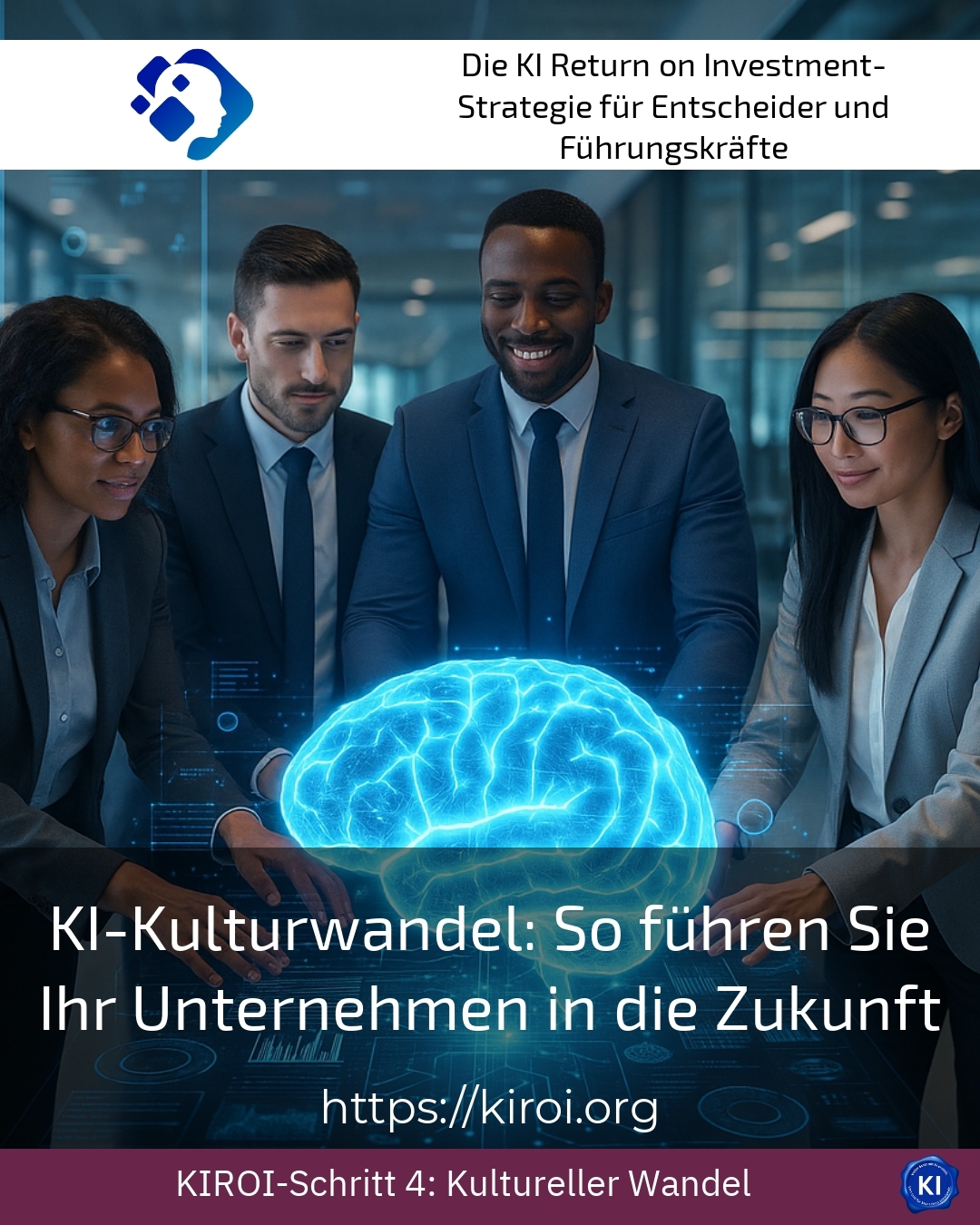
The digital transformation is fundamentally changing our working world. Companies face a crucial crossroads. Either they shape the AI cultural change active with. Or they will be overtaken by more dynamic competitors. Executives frequently report uncertainty and resistance within their teams. The good news is: with the right support, this transformation can be achieved sustainably. This article shows you concrete ways and practice-proven strategies.
Why cultural change is more important than technology itself
Many organisations invest considerable sums in modern technologies. Nevertheless, the hoped-for results often fail to materialise. The reason for this is rarely the technology itself. Rather, projects fail due to a lack of acceptance within the workforce. People are accustomed to performing certain tasks in tried-and-tested ways. Sudden changes therefore trigger understandable fears and reservations. A medium-sized mechanical engineering company from Southern Germany experienced precisely this situation. Management had introduced modern analysis tools. However, employees barely used these tools. The situation only fundamentally changed through targeted support and open dialogue.
Another example comes from the logistics sector. A shipping provider wanted to optimise its route planning. The technical solution worked perfectly. However, the drivers trusted their own experience more. As a result, they largely ignored the system's recommendations. Acceptance only improved when management actively listened. Such situations clearly show: technology alone does not solve problems. The human factor determines success or failure.
Similar experiences can be found in the healthcare sector too. A chain of clinics introduced digital diagnostic support. Initially, doctors feared a restriction of their autonomy. The clinic management took these concerns seriously. Joint workshops helped to build trust. Today, the technology effectively supports the medical professionals.
Best practice with a KIROI customer
A family-run business with a long tradition in the automotive supply sector faced significant challenges. The workforce had grown over decades and developed set working routines. When management wanted to introduce modern analysis systems, they encountered considerable resistance. Particularly experienced employees felt threatened by the innovations. They feared their long-standing expertise would be devalued. Transruption coaching accompanied this change process over several months. In structured discussion rounds, all parties involved were able to voice their concerns. Together, the team developed new working methods that combined tradition and innovation. The experienced skilled workers were appointed as internal mentors for digital tools. This new role significantly boosted their confidence and motivation. After approximately six months, the company culture had noticeably changed. Productivity increased by a considerable fifteen percent. At the same time, staff turnover dropped to its lowest level in years. This example impressively demonstrates how valuable professional support can be. Without external impetus, the change would likely have failed.
The AI culture change begins with leadership.
Leaders have a crucial impact on company culture. Their attitude towards change is passed on to the entire team. Those who show uncertainty themselves can hardly convince others. Therefore, leaders must first clarify their own position. An example from the financial industry illustrates this connection. The board of a regional bank wanted to introduce automated advisory systems. However, some middle management leaders blocked the project. They feared a loss of importance for their positions. Their attitude only changed after intensive one-on-one discussions.
A trading company had similar experiences. The management had formulated ambitious digitisation goals. However, the department heads did not consistently implement these goals. They argued with a lack of resources and insufficient time. In reality, they lacked the necessary understanding of the new opportunities. Targeted training and coaching sessions brought about a change. The managers recognised the opportunities for their own development. After that, they actively drove forward the change.
Leaders also play a key role in the education sector. A university wanted to introduce digital teaching methods across the board. The deans of the individual faculties showed varying degrees of willingness. Some enthusiastically welcomed the changes. Others were more hesitant or resistant. Only through joint strategy days did a unified approach emerge.
Practical steps for a successful AI culture shift in management
The first step is an honest assessment. Leaders should realistically evaluate their own digital literacy. This should then be followed by structured further training. This doesn't necessarily have to be technically focused. Often, a basic understanding of the possibilities and limitations is sufficient. A pharmaceutical company successfully implemented this approach. The management team completed a multi-day workshop. During this, they learned about various application scenarios. They subsequently passed this knowledge on to their teams.
An energy supplier took a different approach. There, tandems were formed from experienced managers and young junior staff. These tandems regularly exchanged knowledge. The older managers benefited from the digital affinity of the younger ones. At the same time, they imparted valuable experience from their many years of work. This collaboration significantly strengthened mutual understanding.
In retail, a third model has proven itself. A department store chain appointed digital ambassadors at every hierarchical level. These ambassadors acted as contact persons for questions and suggestions. They collected feedback from the workforce and passed it on. This created a continuous dialogue between all levels.
Involving employees as active shapers of change
Sustainable changes do not arise from top-down directives. Instead, all stakeholders must be able to actively shape the transformation. Successful companies consistently implement this realisation. An example from the insurance sector illustrates this approach. An insurance group planned to automate its claims processing. Instead of presenting employees with a fait accompli, they were involved from an early stage. In several workshops, they gathered suggestions and concerns. Many of these ideas were incorporated into the final solution.
The food industry offers another example. A dairy company wanted to modernise its quality control. The production staff knew the processes best. Therefore, they were asked for their assessments. They identified weak points that management had not noticed. They then jointly developed tailor-made solutions.
This participatory approach also works in the public sector. A city council introduced digital citizen services. The case workers were involved in the planning from the very beginning. They were able to contribute their practical experience. This resulted in user-friendly and efficient processes.
Best practice with a KIROI customer
A medium-sized mechanical engineering company from North Rhine-Westphalia faced a particular challenge. The average age of the workforce was over fifty. Many employees had been with the company for decades. Management feared significant resistance to digital innovations. Transruption coaching recommended an unusual approach. Instead of introducing changes top-down, working groups were formed. Each working group dealt with a specific area for improvement. The employees were able to develop and test their own solution proposals. This personal responsibility significantly increased motivation. The reaction of the experienced skilled workers was particularly pleasing. They contributed valuable process knowledge that would otherwise have been lost. The younger colleagues contributed technical know-how. This intergenerational collaboration proved to be extremely fruitful. After a year, the company had successfully completed several innovation projects. Employee satisfaction increased measurably. Management was positively surprised by the results. This case shows how important genuine participation is for success.
Communication as the Key to Successful Change
Open and honest communication forms the foundation of any change. People want to understand why things need to change. They want to know how it will affect their work. A telecommunications company learned valuable lessons in this regard. It had introduced new systems without adequately explaining the reasons behind them. This resulted in rumours and uncertainty among employees. It was only a comprehensive information campaign that calmed the situation down again.
The construction industry provides a positive counterexample. A large construction company planned the introduction of digital project management tools. From the outset, leadership communicated transparently. Regular information sessions kept all stakeholders up to date. Questions were answered promptly and honestly. This openness fostered trust and acceptance.
A media house went a step further. It set up an internal blog on the topic of digitalisation. Employees reported on their experiences there. Both successes and difficulties were openly discussed. This platform fostered exchange and alleviated fears.
Adapting structures and processes for AI cultural change
Cultural change often requires structural changes too. Old hierarchies and rigid processes can hinder innovation. Therefore, companies must critically review their organisation. An example from the chemical industry shows how this can succeed. A chemical group had strictly hierarchical structures. Decisions had to go through several levels. This significantly slowed down the introduction of new technologies. Through flatter hierarchies, change accelerated significantly.
The tourism industry provides another example. A tour operator completely reorganised its departments. Instead of functional silos, cross-functional teams were created. These teams worked on specific customer experiences. The new structure encouraged collaboration and a spirit of innovation.
Structural adjustments can also be observed in the trades. A Chamber of Crafts introduced digital training modules. This required existing curricula to be revised. At the same time, new collaborations with technology providers were established. These changes have sustainably strengthened the entire sector.
Establishing a culture of error as an innovation driver
Innovation requires the courage to experiment. However, experiments can also fail. A positive error culture is therefore essential. A software company cultivates this culture exemplarily. There, failed projects are analysed in the same way as successful ones. The insights flow into future ventures. No one is punished or shamed for failures.
The fashion industry is undergoing similar experiences. A clothing manufacturer tested new sales channels. Some experiments worked well, others less so. The management systematically evaluated all the results. As a result, the company learned quickly and continuously improved.
A hospital established so-called learning sessions. Doctors and nurses discussed difficult situations there. The goal was not to assign blame, but to learn together. This culture also extended to digital projects.
Developing long-term perspectives for sustainable success
Cultural change is not a one-off project. It requires continuous attention and adaptation. Companies should therefore develop long-term perspectives. An industrial group has implemented this as an example. It formulated a future vision for the coming ten years. This vision served as a guide for all decisions. Employees therefore knew where the journey was heading.
The media industry is showing another model. A publishing house has established a permanent innovation committee. This committee continuously monitors technological developments and provides recommendations for strategic adjustments. This keeps the company agile and future-proof.
A technology company regularly invests in further training. Each employee has an annual learning budget available. This budget can be freely used for relevant qualifications. This keeps the entire team up to date.
My KIROI Analysis
Cultural change in companies is one of the greatest challenges of our time. Technological possibilities are developing rapidly. However, success ultimately depends on people. My experience from numerous support projects clearly shows: organisations that actively involve their workforce achieve better results. They manage to transform resistance into constructive energy. The key lies in genuine participation and transparent communication. Leaders must lead by example. They should openly address their own insecurities. This builds trust and encourages openness in others.
The establishment of a positive error culture appears particularly important to me. Innovation requires experimentation, and experiments can fail. Companies that view failures as learning opportunities develop more rapidly. Transruption coaching guides organisations on this challenging path. We provide impetus, moderate difficult conversations, and support strategy development. In doing so, we always respect the individual circumstances of each organisation. There are no universal solutions for complex change processes. Rather, approaches must be adapted to specific needs. Our clients frequently report surprising insights during the coaching process. They discover potentials that were previously unknown to them. These 'aha' moments drive change sustainably forward.
Further links from the text above:
[1] Business Transruption Coaching
[2] The KIROI Master Plan for Digital Transformation
[3] Change Management in Practice
For more information and if you have any questions, please contact Contact us or read more blog posts on the topic Artificial intelligence here.







 Deutsch
  English (UK)