
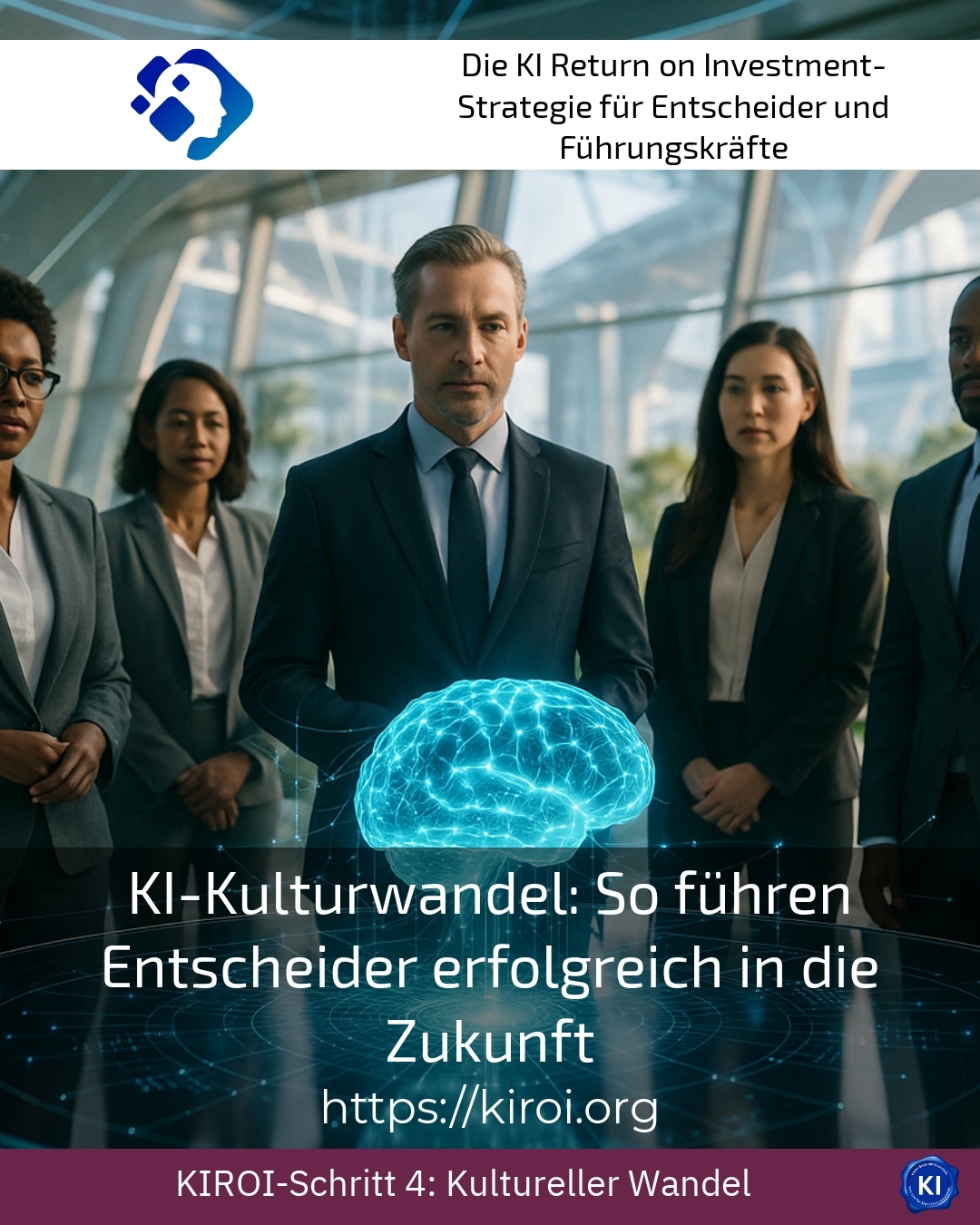
The digital revolution is fundamentally changing companies. Leaders face a crucial task. They must AI cultural change actively shape it. Many decision-makers feel uncertain about this. Technological possibilities are growing rapidly. At the same time, the pressure to remain competitive is increasing. Employees often react to change with scepticism. How can all stakeholders be brought on board? This question concerns managements worldwide. The following article provides concrete impulses and practical guidance.
Why the AI culture shift needs to start now
The speed of technological developments surprises even experienced managers. Companies of all sizes feel the pressure to transform. Those who wait too long lose valuable market share. However, integrating intelligent systems requires more than technical expertise. It demands a fundamental change in mindset at all levels. Leaders must act as role models in this process. They significantly shape the company culture through their own behaviour. Employees take their cues from the decisions of their superiors. Therefore, successful transformation always begins at the top. The willingness to change must be credibly demonstrated by those in leadership positions.
For example, a medium-sized mechanical engineering company introduced new analysis tools. The management communicated openly about their own learning processes. This transparency built trust among the employees. A financial service provider supported its teams with regular workshops. The participants were able to express concerns and ask questions. This gradually led to acceptance of new ways of working. A logistics company relied on pilot projects in individual departments. The positive results also convinced sceptical colleagues [1].
The role of leaders in AI cultural change
Decision-makers bear a special responsibility during transformation phases. They must combine strategic foresight with operational implementation expertise. This is not just about investment decisions, but rather centres on the development of a learning organisation. Leaders should foster a spirit of experimentation and view mistakes as learning opportunities. This attitude sustainably shapes the entire corporate culture. Employees feel encouraged to break new ground. Innovation arises where people can work without fear.
A trading company established so-called innovation time for all teams. Employees received two hours per week for creative projects. These windows of freedom led to surprising suggestions for improvement. A pharmaceutical company set up interdisciplinary working groups. IT specialists worked closely with researchers there. The different perspectives enriched everyone involved. An energy provider invested specifically in leadership development. The managers learned to support change processes empathetically [2].
Best practice with a AIROI customer
An internationally operating production company faced a particular challenge. The workforce showed considerable resistance to new digital tools. Many long-term employees feared job losses. Management recognised the need for a sensitive approach. Within the framework of transruption coaching, we jointly developed a multi-stage communication strategy. First, we conducted individual discussions with key individuals from various departments. These discussions revealed deeper-seated fears and concerns. Subsequently, we organised information events with interactive elements. Employees were able to ask questions there and received honest answers. The involvement of colleagues as internal ambassadors was particularly effective. These so-called Change Agents authentically reported on their own experiences. They shared both successes and initial difficulties with the teams. This openness created trust and noticeably reduced reservations. After six months, surveys showed a significantly increased acceptance. Productivity in the pilot areas improved measurably. Today, the company is considered a pioneer for successful transformation in its industry.
Communication as the key to success
Transparent communication forms the bedrock of any successful change. Employees want to understand why innovations are being introduced. They need clear information about goals and expected impacts. Ambiguity often leads to rumours and uncertainty. Therefore, managers should communicate proactively and regularly. It is important to use various channels. Some people prefer written information. Others appreciate personal conversations or video conferences.
An insurance group introduced weekly update meetings for all departments. Management answered questions directly and personally there. This practice significantly strengthened trust in the company leadership. A technology company used an internal blog for transparent updates. Employees could comment and give feedback there. The dialogue fostered a sense of co-determination. An automotive supplier organised roadshows at all its sites. Those responsible presented the transformation strategy on-site [3].
Skills development as a strategic investment
The qualification of employees deserves the utmost attention. New technologies require new skills and knowledge. Companies should develop systematic further training programmes. These programmes must be individually tailored to different target groups. Not every employee needs the same competencies. Tailored learning offers significantly increase motivation and learning success. Informal learning formats also play an important role in this.
A banking institution established an extensive digital skills mentoring programme. Younger employees supported more experienced colleagues in their learning. This knowledge exchange also fostered cohesion between generations. A retail company partnered with a university for certificate courses. Employees gained recognised qualifications alongside their day-to-day work. A media company set up internal academy structures. Here, internal experts shared their knowledge with interested colleagues [4].
The AI culture shift requires new ways of working
Agile methods are gaining importance in many organisations. They allow for rapid adjustments to changing circumstances. Teams work in a self-organised manner and take responsibility for results. This way of working requires a changed understanding of leadership. Managers become coaches and facilitators. They create the framework conditions for successful collaboration. Control is increasingly giving way to trust in the employees' abilities.
A software developer introduced Scrum methods across all project teams. The iterative approach significantly accelerated product development. A consulting firm experimented with holacratic organisational structures. Employees organised themselves into self-directed circles. An industrial company established cross-functional teams for innovation projects. Engineers, designers, and sales staff worked together from the outset [5].
Best practice with a AIROI customer
A long-established family business in the manufacturing sector approached us. The third generation wanted to make the company future-proof. At the same time, they wanted to preserve proven values and the special corporate culture. This balance between tradition and innovation presented a complex challenge. As part of the transruption coaching, we accompanied a comprehensive strategy process. First, we jointly analysed the existing strengths and potentials. In doing so, we identified cultural particularities as valuable resources. The long-standing staff loyalty proved to be a significant competitive advantage. On this basis, we developed a step-by-step transformation concept. Proven processes were carefully developed further rather than being radically replaced. New digital tools complemented the existing expertise of the skilled workers. The employees saw themselves as active shapers of change. Regular reflection sessions enabled course corrections as needed. After one year, a significantly increased innovative capacity was evident. The company was able to tap into new customer groups and gain market share. Employee satisfaction remained stable at a high level despite the changes.
Constructively use resistance
Skepticism towards change is a natural human reaction. Leaders should not view resistance as a disruption. Rather, critical voices often contain valuable insights. They can draw attention to overlooked risks or implementation problems. Constructive engagement with resistance requires patience and empathy. Employees must feel that their concerns are taken seriously. Only then will they be willing to engage with new things.
A telecommunications company introduced anonymous feedback channels. Employees could voice concerns there without fear of negative consequences. The collected feedback fed into project planning. A healthcare provider organised facilitated discussion formats between management and staff. The open conversations reduced tension and fostered mutual understanding. A construction company specifically included critical employees in project teams. Their constructive skepticism improved the quality of many decisions [6].
Performance measurement and continuous improvement
Transformation processes require clear success criteria and milestones. Without measurable goals, those involved lack direction. At the same time, key performance indicators should not become an end in themselves. They serve as tools for well-informed decisions and adjustments. Regular reviews allow for timely course corrections when needed. Successes should be celebrated and communicated together. This strengthens motivation and a sense of togetherness.
A logistics service provider developed a comprehensive key performance indicator (KPI) system for its transformation. The data was shared transparently with all departments. The teams jointly analysed deviations and developed countermeasures. A chemical company held company-wide quarterly retrospectives. The entire organisation reflected on progress and challenges there. A service company combined quantitative key figures with qualitative employee surveys. This holistic approach provided a meaningful overall picture [7].
My AIROI Analysis
Successfully designing profound change processes requires a holistic approach. Technological investments alone are not enough. People are at the heart of every successful transformation. Leaders must internalise this realisation and consistently implement it. Developing a learning organisational culture takes time and perseverance. Short-term successes must not delude us about long-term goals. At the same time, achieved milestones motivate everyone involved for further steps.
Transruptions-Coaching offers valuable support for complex transformation projects. Professional guidance helps to avoid common pitfalls. External perspectives enrich internal discussions and decision-making processes. This does not involve off-the-shelf solutions. Instead, companies develop their own transformation path with support. This individual approach significantly increases the sustainability of all measures. Clients often report increased clarity and confidence in their actions.
The future belongs to organisations that see change as an opportunity. Those who invest in people and culture today will secure competitiveness tomorrow. The AI cultural change It is not a one-off task, but rather an ongoing process. Companies that adopt this perspective actively shape their future.
Further links from the text above:
[1] McKinsey Digital Insights – Transformation and Cultural Change
[2] Harvard Business Review – Leadership and Change Management
[3] Gartner Insights – Digital Transformation in Companies
[4] PwC Germany – Digital Transformation and Skills Development
[5] Agile Alliance – Fundamentals of Agile Working Methods
[6] Prosci – Best Practices for Change Management
[7] BCG – Digital Technology and Data Transformation
For more information and if you have any questions, please contact Contact us or read more blog posts on the topic Artificial intelligence here.








 Deutsch
  English (UK)