
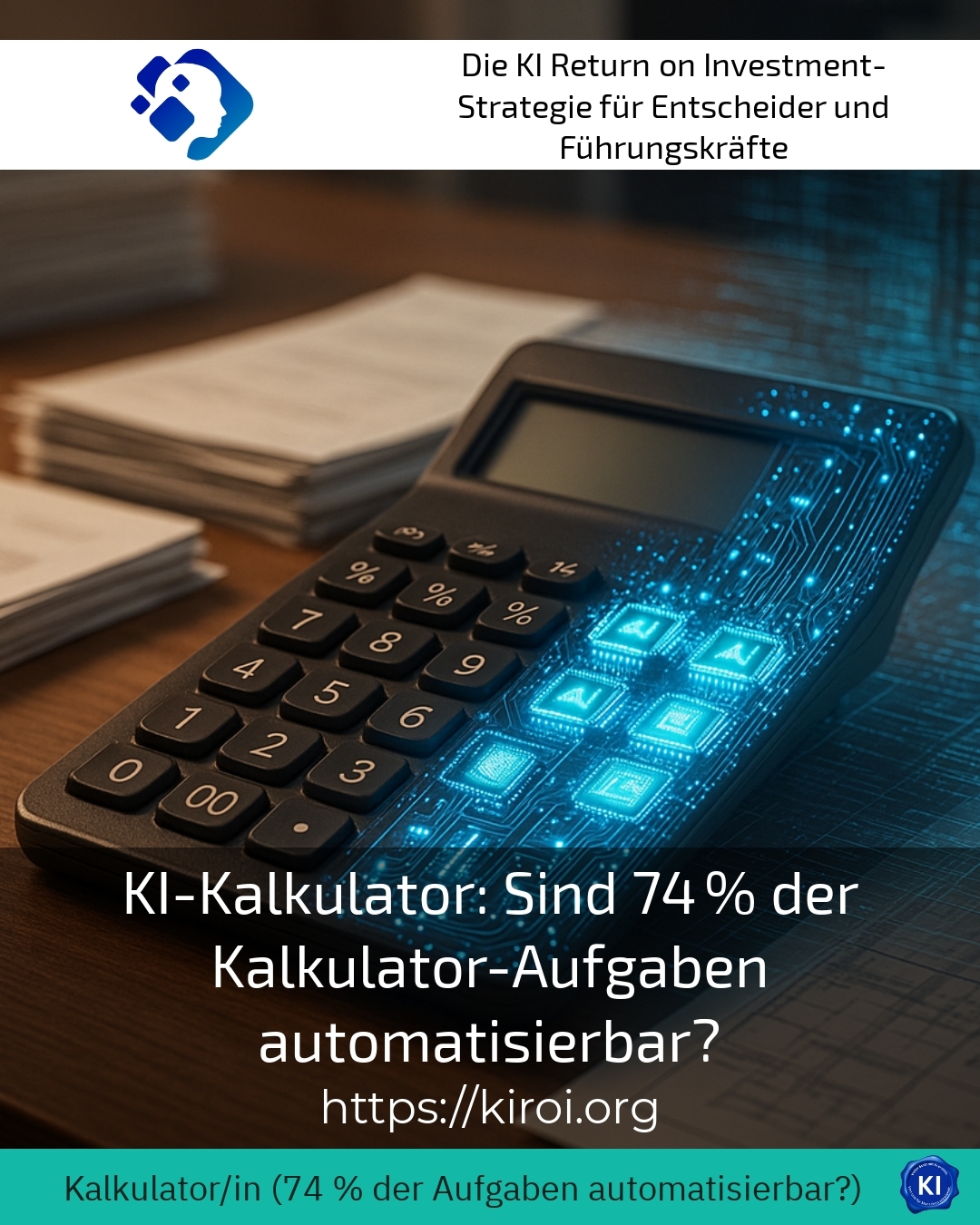
Will your professional expertise soon be replaced by algorithms, and have you ever wondered which of your daily tasks a machine could already take over? This question is currently occupying countless professionals in the finance and estimating sectors, because current studies reveal alarming figures regarding the automatability of activities that were long considered safe. The AI calculator is at the heart of this debate because intelligent systems can now perform complex calculations, cost analyses and forecasts with astonishing precision. The thesis that around three-quarters of all management accounting tasks can be automated is causing uncertainty and raising fundamental questions about the future of this occupational group.
These insights are based, among other things, on analyses by the Job-Futuromat [1], provided by the Institute for Employment Research, which delivers a scientifically grounded assessment of the substitutability of various professions. If you work in this field yourself and are wondering how to secure your position long-term, the AIROI seminars offer a practice-oriented solution that equips you with strategic tools. You can find current dates for these valuable events under the events calendar [2], where you can sign up for lectures, workshops and intensive seminars. The AIROI strategy not only imparts theoretical knowledge, but also actively accompanies you in the transformation of your professional competencies.
The technological revolution in the field of cost estimation
The development of intelligent systems has reached a remarkable speed in recent years, meaning that many traditional tasks are carried out completely differently today than just a decade ago. This change is particularly evident in the field of quotation preparation, as modern software analyses historical data and uses it to generate automated calculations. For example, a medium-sized construction company is already using systems that independently calculate material costs, working hours and risk surcharges while taking market developments into account. The situation is similar in the insurance industry, where premium calculations are increasingly being taken over by algorithms that assess the probability of claims more precisely than human experts. In retail, too, intelligent pricing systems are revolutionising work by analysing competitor prices, inventory levels and demand curves in real time.
The AI calculator in its modern form, however, goes far beyond simple arithmetic operations and integrates factors that traditionally required human judgement. For example, advanced systems take seasonal fluctuations, geopolitical risks and even weather forecasts into account when preparing cost estimates. A logistics company recently reported that its automated route planning and transport cost calculation was able to increase efficiency by over thirty percent. These developments make it clear that the automation rate of 74 percent is not an exaggerated estimate, but is based on real technological capabilities.
Best practice with a AIROI customer
A leading manufacturing company faced the challenge of future-proofing its estimating department while preserving the expertise of long-standing employees. The initial situation was characterised by manual processes where experienced specialists spent hours compiling material costs, production times and overhead components in order to prepare competitive bids. As part of the AIROI support, the team developed a strategy that combined intelligent automation with human expertise, leveraging the strengths of both approaches. Employees were not replaced, but were given new areas of responsibility that brought their analytical skills more to the fore. They now focus on special projects, customer consulting and the continuous improvement of the calculation models, while routine enquiries are processed automatically. The turnaround time for standard quotes was reduced from an average of three days to just a few hours, with no loss of quality. At the same time, employee satisfaction increased because repetitive tasks were eliminated and more demanding tasks came to the fore. This example impressively demonstrates how the AIROI strategy helps companies to seize technological change as an opportunity and actively shape it.
Which activities are particularly affected by the AI calculator?
The analysis of automatable tasks reveals a nuanced picture that by no means affects all areas of activity equally and certainly leaves room for human expertise. Particularly at risk are repetitive standard calculations where predefined parameters are inserted into fixed formulas and no individual customisation is required. The preparation of series calculations, such as those that occur in the automotive supplier industry for standard components, can now be almost fully automated. The same applies to variance analyses where actual costs are compared with planned figures and deviations must be systematically documented. In the banking sector, algorithms already take over credit assessments and calculate interest rates based on complex risk models.
The situation is different for activities that require creativity, negotiation skills or deep industry knowledge and cannot be translated into standardised processes. The costing of large-scale projects with numerous imponderables, as is typical in plant engineering or infrastructure projects, still requires experienced professionals. These experts assess risks, anticipate potential complications and adapt their calculations to specific customer requirements. Strategic pricing, which must take market positioning and competitive dynamics into account, also requires human judgement. Negotiations with suppliers regarding terms and discounts also remain a deeply human domain, because relationship management and intuition are crucial here.
Practical examples from various industries
In the trades, transformation is particularly evident because traditional working methods meet modern technology here, creating interesting hybrid solutions. A joinery business now uses software that automatically calculates material requirements from CAD drawings and generates time estimates based on historical project data. The roofers' guild reports on drone-based measuring systems which, combined with intelligent software, generate precise cost estimates for roof refurbishments. Electricians use apps that calculate installation costs based on building plans and regional wage rates whilst updating material prices in real time.
The hospitality industry is also experiencing profound changes in its costing practices, as cost of goods sold and staff costs are increasingly being digitally optimised. Intelligent POS systems analyse sales data and automatically calculate the optimal selling price for dishes, taking into account ingredient costs and preparation time. Hotel chains use dynamic pricing systems that automatically adjust room prices based on occupancy forecasts, competitor prices and event calendars. Catering companies use planning software that precisely calculates quantities, staff hours and logistics costs for events of various sizes.
The AI calculator as an opportunity for professional development
Instead of viewing technological development as a threat, professionals should understand it as an opportunity to reposition their skills and actively use them. The AIROI strategy offers a structured framework for this, which helps those affected to identify their strengths and develop them in a targeted manner. Anyone who is able to understand and configure intelligent systems today and critically evaluate their results will be indispensable tomorrow. These skills can be learned practically in the AIROI workshops and applied immediately in everyday working life.
The role of the cost estimation expert is shifting from an executive calculator to a strategic advisor who orchestrates technology and prepares decisions. In mechanical engineering, professionals are increasingly taking on quality assurance for automated estimations and identifying instances where human intervention is required. In the real estate sector, cost planners are evolving into project controllers who no longer primarily calculate, but rather manage and optimise processes. The pharmaceutical industry is upskilling pricing specialists into compliance experts who ensure that automated pricing systems meet regulatory requirements.
Best practice with a AIROI customer
A facility management services company recognised early on that its traditional method of quotation preparation was no longer up to date and urgently needed modernising. The pricing department, consisting of six experienced employees, spent the majority of their working time compiling cleaning areas, staff hours and material costs for potential clients. By participating in AIROI seminars, the team developed a completely new understanding of the possibilities of intelligent systems and began implementing them step by step. The employees learned how they could create even simple automation solutions themselves and how they should interact with more complex systems. After a transition period of six months, the way of working had fundamentally changed, with routine enquiries being processed automatically and the specialists concentrating on complex major contracts. The quality of quotes improved measurably because more time was available for individual customer advice and tailored solutions. It was particularly noteworthy that not a single job was cut; instead, all employees took on higher-value tasks and their satisfaction increased. This example illustrates how professional guidance through the AIROI strategy facilitates the transformation process and leads to positive results.
Strategies for successful adaptation to the AI calculator
The first step towards successful adaptation is to honestly analyse one's own activities and distinguish between automatable routines and value-adding core competencies. This self-reflection should take place regularly and can be guided by the structured methods of the AIROI strategy. In healthcare, for example, billing specialists realised that their expertise in complex diagnosis-related groups and individual case decisions remains irreplaceable. Logistics companies identified the negotiation of framework agreements as a human core competence, while standard freight cost calculations were automated. Advertising agencies found that creative budget planning and client consultation cannot be automated, whereas media price comparisons and reach calculations can.
Further training plays a central role in preparation for the changing world of work and should be specifically aimed at future-relevant competencies. The AIROI lectures not only impart technical knowledge, but also foster the development of soft skills such as critical thinking and adaptive learning. In the energy sector, tariff calculators upskill to data analysts who interpret consumption patterns and develop pricing models. The textile industry trains costing assistants to become sustainability experts who can integrate environmental costs into product prices. Event managers complement their budgeting expertise with digital skills that enable them to economically plan hybrid event formats.
My AIROI Analysis
The analysis of current developments in the field of accounting and calculation activities reveals an industry undergoing fundamental change, which harbours both risks and significant opportunities. The frequently cited automatability rate of 74 per cent is not a dystopia, but a realistic assessment that should serve as a guide for professionals. However, the decisive factor is not how many tasks can theoretically be automated, but how individuals and companies deal with this insight and what steps they take.
The AIROI strategy provides a proven framework to actively shape this transformation rather than passively suffering through it. Clients frequently report that participating in AIROI seminars has fundamentally changed their understanding of technological possibilities and opened up new career prospects for them. Guidance from experienced experts provides impetus that goes far beyond purely technical training and can positively influence their entire professional identity.
The future belongs to those professionals who see technology as a tool rather than a competitor, and who are ready to learn and adapt continuously. Intelligent systems will not replace human expertise, but rather complement and enhance it, provided humans actively shape this symbiosis. The AIROI workshops and lectures support you in successfully mastering this transformation and strengthening your position in the labour market over the long term. Take the opportunity to position yourself early on, rather than waiting and potentially falling behind.
Further links from the text above:
[2] AIROI seminars and live events
For more information and if you have any questions, please contact Contact us or read more blog posts on the topic Artificial intelligence here.







 Deutsch
 English (UK)