
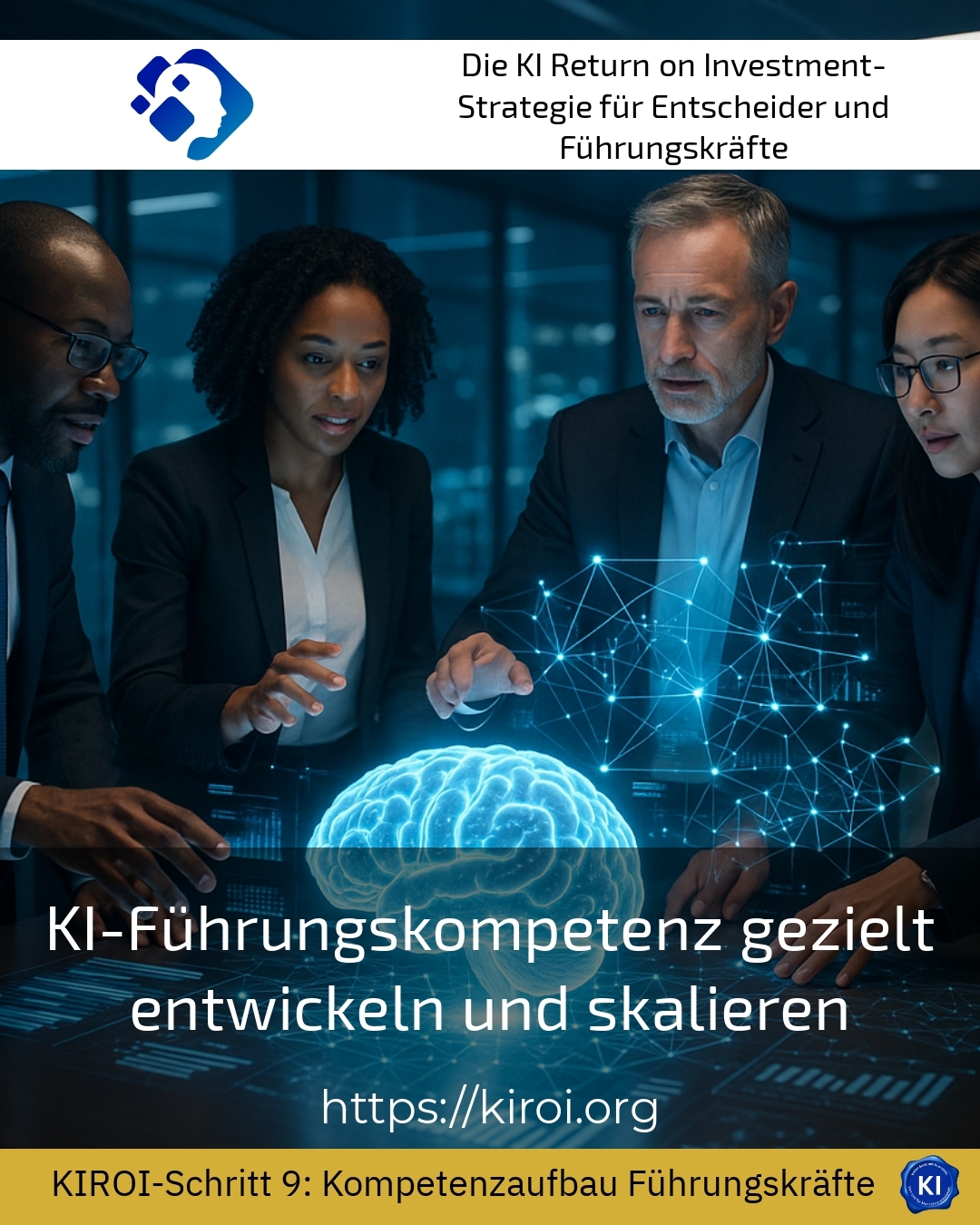
The digital revolution is transforming businesses at a rapid pace. Leaders face the challenge of understanding and strategically deploying intelligent systems. Today, those who Developing AI leadership competence with a targeted approach requires more than basic technical knowledge. It's about a fundamental transformation of one's own way of thinking and behavioural patterns. The ability to navigate teams through complex change processes determines long-term business success. The systematic development of competences plays a central role in this. This article shows you concrete approaches and proven methods.
The foundations of modern leadership excellence in the digital age
Today's modern leaders must master entirely new skills. They combine classic management competencies with technological understanding. The integration of intelligent systems into business processes requires strategic thinking. At the same time, leaders must support and motivate their employees. Change does not happen overnight, but through continuous development. Many decision-makers report uncertainties when dealing with new technologies. These uncertainties can be overcome through targeted support and structured learning processes.
The financial sector, in particular, is experiencing this transformation very clearly. Banks are increasingly relying on automated credit decisions and smart fraud detection. Insurance companies are using predictive models for risk assessment of their customers. Asset managers are integrating algorithmic trading strategies into their portfolio management processes. These developments demand a profound understanding of the underlying mechanisms from leaders. Those who don't keep up will quickly fall behind the competition.
Why traditional leadership models are no longer sufficient
Classical leadership theories were developed for a different working world. They assume linear processes and predictable market developments. However, today's reality is completely different. Decisions must be made in real-time. Data volumes are growing exponentially and require new analysis methods. Leaders must learn to productively deal with uncertainty and complexity. They need tools to quickly identify and interpret relevant information.
An example from the banking sector illustrates this challenge impressively. Branch managers today need to understand how chatbots complement customer advice. They coordinate the cooperation between human advisors and digital assistants. At the same time, they are responsible for the emotional connection of customers to the company. This multiple burden requires new competencies and supportive structures.
Developing AI leadership competence with targeted, structured learning pathways
The systematic development of leadership skills in the digital context follows proven principles. Firstly, it involves creating a solid fundamental understanding of technological contexts. Building on this, leaders develop strategic capabilities for integrating these technologies. The third step includes applying what has been learned in real project situations. Finally, there is reflection and continuous improvement of one's own practice. This iterative process leads to sustainable competence development.
In the insurance industry, particularly diverse fields of application are emerging. Claims processing is accelerated and refined by intelligent systems. Underwriters use algorithmic support for risk assessment of complex policies. Sales managers analyse customer behaviour with the help of predictive models. All these applications require a deep understanding of the capabilities and limitations of the technologies employed.
Best practice with a AIROI customer
A medium-sized financial services company faced the challenge of preparing its leadership level for digital transformation. The management recognised that technological knowledge alone was not enough. They opted for comprehensive support through transruptions coaching as part of a multi-month development programme. In the first step, we jointly analysed existing competencies and identified areas for development. The executives received individual learning paths tailored to their specific areas of responsibility. Regular reflection meetings supported the transfer of learning into their daily work. After six months, participants reported significantly increased confidence in dealing with technological topics. They made decisions faster and more informedly than before. The ability to reconcile technical and human aspects proved particularly valuable. The company was able to successfully implement several digitisation projects and strengthen its market position. Employee satisfaction increased measurably because managers could now better communicate why certain changes were necessary and what benefits they brought.
Practical exercises for everyday leadership in the finance sector
Developing leadership skills requires regular practical application. Theoretical knowledge alone does not lead to behavioural changes. Leaders should therefore actively seek out situations where they can apply new skills. The financial sector offers numerous opportunities for such learning experiments. Support from experienced coaches can significantly accelerate this process.
A proven exercise involves moderating project teams when introducing new technologies. This allows leaders to bring together different perspectives and constructively address resistance. For example, a department head in risk management at a bank could lead a pilot project for automated credit scoring systems. In doing so, they gain valuable experience in communication between technical experts and specialist departments. Another example is leading workshops for process optimisation in claims management. Here, leaders practice explaining complex technical issues in an understandable way.
Scaling leadership skills across the entire organisation
Individually well-trained leaders are not enough for a successful transformation. Companies need a critical mass of competent decision-makers at all levels. Scaling leadership skills therefore represents a central strategic task. It requires systematic programmes and supportive structures. Organisations must develop learning cultures that promote and enable continuous development.
The need for this scaling is particularly evident in investment banking. Traders at all levels must be able to understand and monitor algorithmic trading systems. Compliance officers require knowledge of automated monitoring systems and their limitations. Client advisors must be able to explain and convey data-driven investment recommendations. This broad development of expertise can only be achieved through structured and scalable learning formats [1].
Scaling AI leadership competence through multiplier concepts
A tried-and-tested approach to scaling expertise is the multiplier concept. This involves initially training and coaching selected managers intensively. These multipliers then pass on their knowledge and experience to colleagues. The advantage of this approach lies in its efficiency and its proximity to everyday work. Multipliers speak the language of their peers and are familiar with the specific challenges.
In the insurance industry, this could look like the following: Experienced underwriting managers will be trained as internal coaches. They will then support their colleagues in the integration of risk assessment algorithms. Similarly, sales managers can act as multipliers for data-driven customer engagement. This internal transfer of skills creates sustainable change [2]. It anchors new knowledge deeply within the company culture.
Best practice with a AIROI customer
A large direct insurer wanted to prepare its entire leadership team for working with intelligent systems. The company employed over two hundred managers at various hierarchical levels. Individual support for all individuals was not feasible due to resource constraints. Together, we developed a multiplier programme based on the principles of transruption coaching. Initially, we identified twenty particularly committed and eager-to-learn managers from different departments. These individuals underwent an intensive six-week development programme with in-person workshops and online modules. In parallel, they received tools and materials for sharing their knowledge. After completing their training, the multipliers began supporting their direct colleagues. They conducted workshops, facilitated learning groups, and were available as contact persons for questions. Within nine months, the programme reached all management levels of the company. The evaluation showed a significant improvement in digital competence across the board. Participants particularly praised the practical relevance of the content and the availability of internal contact persons.
Challenges and Approaches to Competence Development
Developing leadership skills in a digital context is not without its obstacles. Leaders often report a lack of time and competing priorities. Others struggle with self-doubt or the fear of making mistakes. Some organisations underestimate the effort required for sustainable change. These challenges can be overcome with the right strategies and support.
In private banking, these challenges manifest in a specific form. Experienced client advisors have built personal relationships with their clientele over years. The integration of digital analysis tools can be perceived as a threat to these relationships. Leaders must communicate sensitively here and take fears seriously. They must demonstrate how technology complements and enhances human advice. Another example is compliance departments, who are struggling with the pace of regulatory changes. Automated monitoring systems can provide relief here, but require new oversight competencies [3].
Dealing with resistance and fears within the organisation
Resistance to change is a natural reaction and should not be ignored. It contains valuable information about the concerns and needs of those affected. Leaders must learn to use this resistance constructively. Open communication and genuine listening create the foundation for trust. When employees feel heard and understood, their willingness to change increases.
In asset management, we often encounter concerns about the replacement of human expertise by algorithms. Experienced portfolio managers question whether their decades of experience are still in demand. Leaders can provide impetus here by emphasising the complementary nature of humans and machines. Robo-advisors take on routine tasks, creating space for complex advisory situations. The human capacity for empathy and creative problem-solving remains indispensable. Authentically conveying this message is among the most important tasks of modern leaders.
The role of accompaniment and coaching in the development process
Self-study and formal further education have their place, but they do have limitations. Guidance from experienced coaches can significantly accelerate and deepen the development process. Coaches offer a safe space for reflection and experimentation. They help leaders recognise blind spots and adopt new perspectives. transruptions-Coaching positions itself as a guide for projects focused on digital transformation.
In payment transactions and transaction banking, specific coaching topics arise. Leaders here must deal with enormous transaction volumes and the highest security requirements. The integration of real-time fraud detection systems requires new decision-making processes. Coaching can support the design and implementation of these processes. It can also help to address the emotional aspects of change.
My AIROI Analysis
The development and scaling of leadership skills in the context of intelligent systems is no longer an optional task. It is a decisive factor for the future viability of companies in the financial sector. My experience from numerous support projects shows that successful organisations have three things in common. Firstly, they invest systematically and in the long term in the development of their leaders. They understand that sustainable competency development requires time and resources. Secondly, they create structures that enable and encourage learning and experimentation. Mistakes are seen as learning opportunities, not as failures. Thirdly, they use external support to uncover blind spots and gain new impetus.
The financial industry is facing an unprecedented transformation. Banks, insurers, and asset managers must fundamentally rethink their business models. Intelligent systems will play a central role in this. Leaders shaping this change will require new skills and supportive structures. Those who invest now in the Developing AI leadership competence with a targeted approach invested, it lays the foundation for long-term success. Practical examples show that this path is feasible. With the right guidance and suitable methods, organisations can successfully transform their leadership level. The investment is worthwhile in multiple ways through higher employee satisfaction, better decisions, and sustainable competitive advantages.
Further links from the text above:
[1] McKinsey – Building AI Leadership Capabilities
[2] Harvard Business Review – Leadership Development
[3] World Economic Forum – AI Governance Alliance
For more information and if you have any questions, please contact Contact us or read more blog posts on the topic Artificial intelligence here.









 Deutsch
  English (UK)