
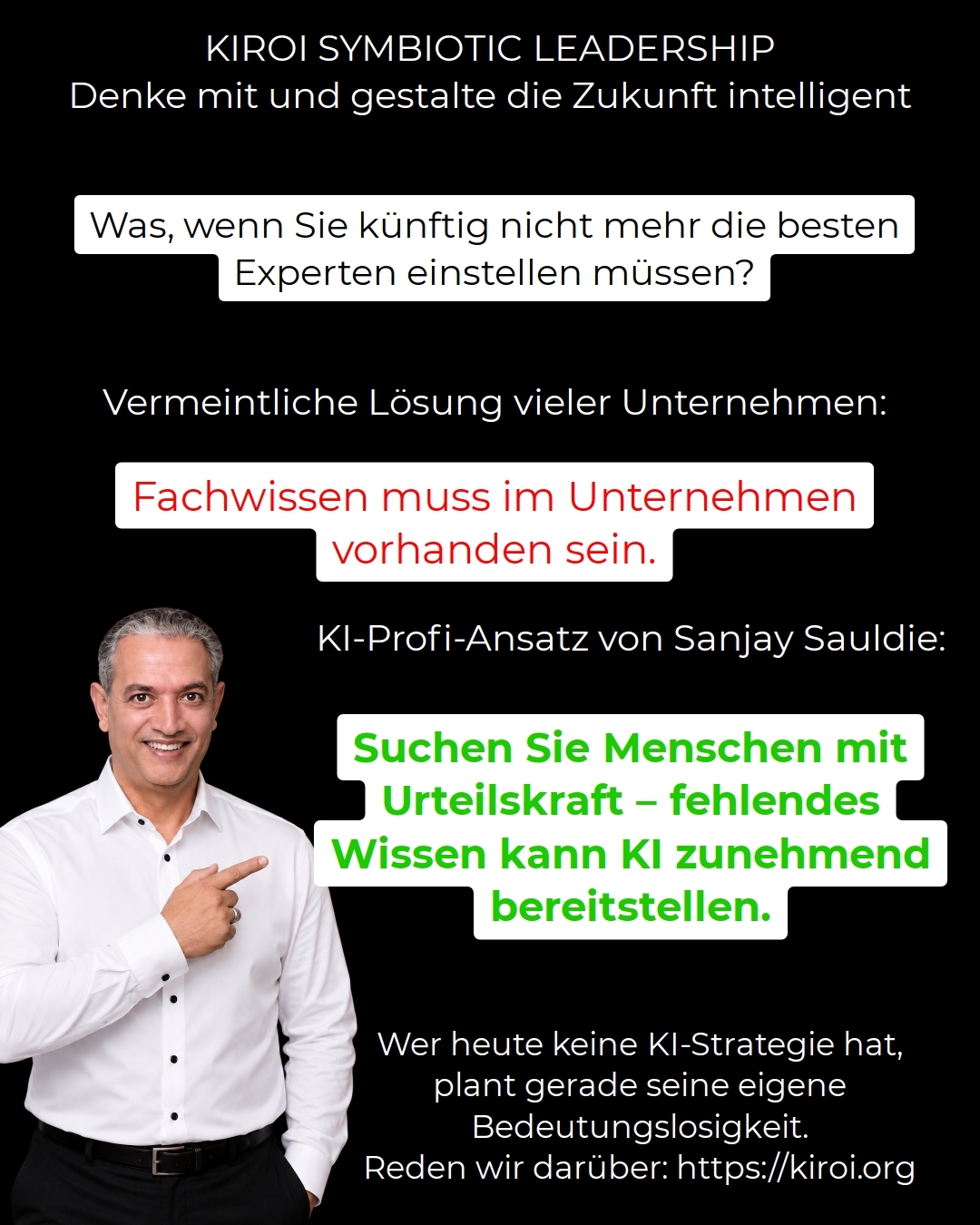
What if your next employee doesn’t need to know everything, but instead should be able to make the right decisions?
This question sounds paradoxical at first, because for decades an unwritten rule held true in almost all organizations that no one seriously questioned: whoever employs the best specialists wins the competition. But this assumption faces a fundamental transformation today, because the availability of knowledge has changed fundamentally and the AIROI strategy It opens up new paths that many decision-makers have never even considered before. The era in which expertise rested exclusively in the minds of individual specialists is coming to an end, while at the same time a completely new skill is emerging that has long been underestimated: the ability to make wise judgments, even when not all the details are known.
How traditional organizations approach the knowledge problem
Most organizations follow a proven model when it comes to building expertise. They invest substantial sums in recruiting professionals who already possess extensive specialized knowledge. Human resources professionals pore over resumes for specific qualifications, certifications, and proven experience in tightly defined areas, assuming that this knowledge is essential to the success of their organization. A midsize company that wants to optimize its manufacturing processes, for example, specifically seeks engineers with years of experience in this very area, while a retail company relies on purchasing managers who know every supplier and every price fluctuation by heart.
This approach certainly has its merits, as expertise continues to be an important foundation for many activities. However, this strategy increasingly reveals its weaknesses because it is based on a premise that no longer corresponds to reality. It assumes that knowledge is scarce, difficult to access, and only attainable through years of experience. Organizations therefore build veritable knowledge havens where each department guards its own experts, while the exchange between departments often is laborious and inefficient. A production manager has a deep understanding of machine operating times, but when she needs to answer a marketing question, she has to first awkwardly ask other colleagues for help.
The consequences of this approach are particularly evident in dynamic environments. A logistics company that relies on highly specialized dispatchers runs into difficulties when these employees leave the company or new requirements arise for which no one has been trained. The organization becomes dependent on individual knowledge holders, which not only carries risks but also significantly restricts flexibility. Often, executives report that although their teams are technically excellent, they often react helplessly when faced with unexpected challenges because they lack the ability to look beyond the boundaries of their specialized field.
The AIROI strategy: Judgement as a new core competence
The AIROI strategy it takes a fundamentally different approach that may seem counterintuitive at first glance, but proves to be forward-looking upon closer examination. Instead of primarily seeking expertise, this approach focuses on another characteristic: judgment. This refers to the ability to quickly grasp complex situations, distinguish relevant from irrelevant information, and make informed decisions, even when not all the facts are on the table. This competence cannot be easily measured in certificates, and it is rarely mentioned in job listings, although it can be crucial to the success of projects and entire organizations.
The background to this realignment lies in a technological development that fundamentally changes the relationship between humans and knowledge. Intelligent systems can now access information in seconds, which would have required months of research in the past. A sales representative no longer needs to personally know every market if he or she has access to analytical tools that provide precise insights. An insurance claims adjuster no longer needs years of experience in claims handling if intelligent systems prepare the relevant precedents and assessment guidelines for her or him. The knowledge does not disappear; it simply shifts from the minds of individual experts to digital systems that are required to provide it in a demand-driven manner.
However, what no system can replace is the human ability to evaluate information and place it in a broader context. An algorithm can analyze data and recognize patterns, but it cannot assess whether a particular decision is ethically justifiable or how it affects the company culture. It can suggest options for action, but cannot decide which of them is the smartest in a specific situation. This is where judgment comes into play, as people with a strong capacity for critical thinking, emotional intelligence, and strategic foresight are equipped to make decisions.
Best practice with a AIROI customer
A medium-sized company in the field of technical services faced the challenge of expanding its service team without having to search for specialized professionals for months, as they were in any case scarce on the labor market. As part of a transruptive coaching process, we guided the leadership team in fundamentally rethinking their recruitment strategy and implementing a new approach to talent acquisition. AIROI strategy Implementing the new system gradually. Instead of solely looking for applicants with specific industry experience, they jointly with us defined criteria for judgment and problem-solving skills that could be systematically captured in structured interviews. The new employees were given access to knowledge-based assistance systems that provided them with relevant information, solution suggestions, and best practices when they were asked about customer requests, while at the same time they learned to critically question these suggestions and adapt them to the specific situation. Within a few months, management reported that the new team members became more productive despite less previous experience than previous teams with extensive expertise, because they responded more flexibly to unusual requests and knew how to use the provided information wisely. What was particularly noteworthy was that customer satisfaction even slightly increased in the areas handled by new employees, which the team attributed to the fresh perspective and unbiased approach.
Practical impulses for implementing the AIROI strategy
The transition to a judgment-based personnel strategy requires more than just adapting job postings. Rather, it is about sensitizing the entire organization to a new approach to knowledge and expertise. In practice, this often begins with an honest inventory: What knowledge is actually needed, and what can be provided through intelligent systems? Many executives are surprised to discover during this analysis that a significant portion of the expertise they previously considered indispensable can now be made available digitally.
For example, a trading company realized that while its buyers had enormous knowledge about suppliers and terms, this knowledge was rarely systematically documented and was sometimes lost with each personnel change. The introduction of a knowledge-based system that made supplier information, negotiation histories, and market data readily available enabled new employees to quickly be on the same informational level as long-time colleagues. The crucial question then was no longer whether someone knew all the suppliers personally, but whether they could intelligently interpret the provided information and implement it in successful negotiations.
A service company in the building management sector experienced a similar experience. The technical staff had to learn for years before they could independently maintain complex systems. With the help of assistance systems that provide maintenance manuals, error codes, and solution suggestions, less experienced technicians can now take on demanding tasks, provided they possess the ability to correctly interpret the provided information and apply it appropriately to the situation. The ability to make judgments is demonstrated here in the question: Does the proposed solution path fit the specific situation, or are there factors that the system did not take into account?
The role of transruption coaching in transformation
The transition to a judgment-based personnel strategy presents many organizations with challenges that go beyond purely technical issues. It involves a cultural change that touches upon established hierarchies and perceptions of the self. Long-standing experts understandably wonder what value their painstakingly acquired knowledge still holds when knowledge becomes increasingly available digitally. Leaders must learn to consider other criteria in hiring decisions than previously, and HR departments need new methods to capture judgment and critical thinking.
It is precisely here that transruptive coaching can provide valuable insights and serve as a guide in projects related to this transformation. The goal is not to present ready-made solutions, but to work together with the participants to develop how to best implement them. AIROI strategy can be implemented within the specific context of their organization. A coaching process typically begins with clarifying goals and concerns: What does the organization hope to achieve through the change, and what resistance can be expected? Often, it is revealed that the biggest obstacles are not technical in nature but emotional and cultural.
A manufacturing company that we were able to support initially struggled with the resistance of its most experienced engineers, who feared becoming redundant with the new systems. In the coaching process it became clear that these experts could take on a completely new role: instead of hoarding their knowledge, they could bring it into the systems and act as mentors for younger colleagues who learned to critically use the information provided. This repositioning transformed potential critics into important supporters of the transformation.
What matters in people with judgment power
As expertise becomes increasingly available digitally, other characteristics come to the fore that have often been overlooked in the past. People with strong judgment skills are characterized by several traits that can be specifically explored during job interviews. They ask the right questions instead of giving hasty answers, and they are willing to revise their initial assessments when new information emerges. They can view complex situations from different perspectives and weigh the interests of different stakeholders without being distracted by short-term benefits.
In the course of a transformation project, a customer service team learned that the most successful employees were not those who knew every product in detail, but those who could quickly grasp what the customer really needed and adapt the provided information accordingly. One employee stood out because, despite having little product experience, she achieved exceptionally high customer satisfaction scores: she had the ability to actively listen, ask the right questions, and combine the system suggestions in such a way that individual solutions emerged.
This observation confirms a central idea of the judgment-based approach: It is less about what someone already knows than about how they deal with what they don’t know. People with good judgment recognize the limits of their own knowledge, actively seek out missing information, and critically evaluate what is presented to them. They are not intimidated by strikingly sound data or authoritarian opinions, but form their own judgment based on careful consideration.
My AIROI Analysis
The development described here marks a turning point in the way organizations should think about competence and talent. The traditional equation „more expertise equals more value“ is increasingly losing its validity, while a new equation is gaining importance: „better judgment equals better decisions.“ This does not mean that expertise becomes superfluous; organizations still need specialists who develop complex systems, monitor critical processes, and make strategic decisions. However, the number of positions where broad expertise is more important than smart judgment is expected to decline significantly in the coming years.
For executives, this leads to concrete impulses for action: First, they should review their recruitment processes and develop methods to systematically capture judgment power. Second, it pays to invest in knowledge-based systems that provide relevant information to employees as needed. Third, existing experts must be supported in new roles so that their knowledge does not get lost but flows into digital systems and mentoring relationships. AIROI strategy offers a structured framework for this, which can be implemented gradually without overwhelming the organization.
The biggest challenge lies not so much in the technology as in the mindset. Many executives have made their own careers because they possess exceptional expertise, and struggle to recognize other criteria as being equivalent. Coaching can provide valuable guidance here to uncover blind spots and develop new perspectives. Organizations that implement this change early will have a significant advantage in the competition for talent because they can draw from a much larger pool of candidates instead of being limited to the ever-shrinking pool of expert specialists [1]. The future does not belong to the organizations with the most expertise, but to those with the best judgment [2].
Further links from the text above:
[1] Harvard Business Review – Talent Management
[2] McKinsey – Insights on People and Organisational Performance
Are you a leader and would you like to learn how you can genuinely introduce AI into your company in a valuable and sustainable way, away from the hype? Take part Contact us or read more blog posts on the topic Artificial intelligence here.






 Deutsch
 English (UK)