
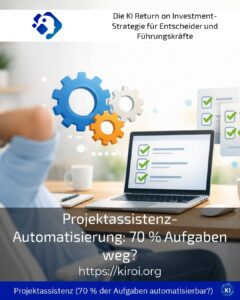
Will you still be needed in a few years, or will software take over your tasks completely? This question currently concerns numerous professionals who work in coordinating and supporting positions and are concerned with the future of their jobs. Project assistance automation Facing the future of work. According to the Job Future Observatory of the Institute for Labor Market and Occupational Research [1], the automation potential in this field of work is considerable at 70 percent, meaning that seven out of ten core activities could theoretically be replaced by technological solutions. This number may seem frightening at first, but upon closer examination, completely new perspectives open up for anyone willing to continue developing and actively participate in the transformation.
The reality behind the numbers: What does 70 percent really mean?
The Institute for Labor Market and Occupational Research systematically analyzes which professional activities could be performed by computers or computer-controlled machines. The Job-Futuromat does not show which professions will disappear, but which individual tasks can be automated. Among the coordinating and administrative roles are, for example, the creation of protocols, the coordination of deadlines, as well as the management of documents and databases. Also included in the tasks that intelligent systems can already perform today are compiling reports, sending standardized correspondence, and maintaining contact databases.
In the construction industry, companies have long been using digital tools for automated resource planning in complex construction projects. Insurance companies are deploying intelligent systems to sort through claims and process routine requests. In healthcare, algorithms coordinate patient appointments and optimize surgical plans. Often, professionals in these industries report that repetitive tasks are eliminated while new, more demanding tasks emerge.
Experiencing project assistance automation in practice
The transformation does not happen overnight, but rather gradually and sector-specific. In the logistics industry, systems are already taking on the coordination of supply chains and communication with suppliers. The retail sector relies on automated ordering processes and intelligent warehouse management. Financial service providers use chatbots for customer inquiries and automated reporting tools for management.
Best practice with a AIROI customer
A medium-sized company in the mechanical engineering sector approached us because the administrative workload for employees was steadily increasing and important strategic tasks were being neglected. Together, we analyzed the existing processes and identified areas with high potential for automation. Previously, coordination between different departments and external partners consumed several hours a day, and standardized reports were manually compiled from various sources. During the transruptive coaching, we supported the team in selecting suitable tools and gradually integrating them into their daily work routine. The employees received guidance on reorienting their role and independently developed ideas for value-adding activities. After six months, the colleagues reported that they now have more time for supplier negotiations, quality controls, and process optimizations. Team satisfaction increased measurably because monotonous tasks were eliminated and the expertise of the professionals was better utilized.
Which competencies are gaining in importance?
While machines process data and execute standardized processes, human abilities remain irreplaceable. Empathy in communication with stakeholders cannot be programmed. Creative problem-solving in unforeseen situations requires human judgment. The ability to understand complex relationships and prepare strategic decisions remains a domain of skilled professionals.
In the event industry, this development is particularly evident because planning tools can optimize logistics, but creative design and customer support require human intuition. Architecture offices are experiencing similar shifts as CAD software and BIM systems take on technical tasks, while conceptual and communicative services gain importance. Advertising agencies rely on AI-based analysis, but retain strategic advice and creative performance in human hands.
The role of transruptions coaching in realignment
Many people come to us with uncertainty and fears about the future because they do not know how to prepare for the changes. Some fear that they will be left behind by the changes. Project assistance automation They are looking to be replaced and are seeking guidance for their future career path. Others recognize the opportunities of transformation and wish to be supported in developing new skills. Transruptions coaching positions itself as structured support for anyone who wants to actively shape change.
In the pharmaceutical sector, we help teams combine regulatory expertise with digital competence. Municipalities benefit from our initiatives to modernize their administrative processes by involving their employees. Non-profit organizations develop sustainable strategies with our support to use limited resources more efficiently while simultaneously strengthening employee engagement.
Best practice with a AIROI customer
A tax consulting firm with over fifty employees faced the challenge of implementing digital accounting systems without jeopardizing the established trust relationship with long-standing clients. The professionals in the support department felt uncertain about the upcoming changes and feared losing their jobs. As part of the transruptive coaching, we developed a concept for the gradual transformation together with the team, which took into account both technical and human aspects. The employees were given the opportunity to further develop in areas such as client counseling and process optimization. Some discovered talents in the field of digital communication and took on the responsibility of managing the new customer portals. Others specialized in complex special cases that still require individual expertise. The law firm was able to increase its efficiency while retaining all its jobs because the transformation was viewed as an opportunity and actively managed.
Strategies for successful transformation
The key to success lies in proactively addressing your own job profile. First, analyze which of your current tasks could be automated. Then, identify the areas where your human skills are particularly in demand. Then, specifically develop the skills that will make your position future-proof.
In the hospitality industry, forward-thinking professionals are investing in expertise around guest experience and complaint management. The education sector is experiencing a shift towards individualized learning support and pedagogical concept development. Industrial companies are increasingly valuing employees who combine technical understanding with communication skills and serve as a liaison between different departments.
Understanding project assistance automation as an opportunity
Perspective makes the difference between fear and a sense of excitement. Those who see automation as a liberation from monotonous tasks gain the space to work in a meaningful way. The time saved can be used for strategic tasks, further training, or improved customer relationships. Many companies recognize the value of employees who embrace change and actively contribute to its implementation.
Energy providers are transforming their support functions into interfaces between technical departments and end customers. Media companies are further developing coordinating roles for content strategists who optimize editorial processes. Craft businesses benefit from skilled workers who master digital tools while maintaining personal customer contact.
Best practice with a AIROI customer
A company in the renewable energy sector experienced rapid growth and faced the decision to either increase its support team or adopt automation. The management decided on a hybrid approach and asked us to assist with implementation. Together with the existing team, we identified processes that would benefit from intelligent systems and those that still require human expertise. The employees were trained to become super users of the new systems and additionally took on tasks in quality assurance and supplier management. One colleague developed a special interest in data analysis and completed additional training in this area with the company’s support. Today she leads a small team that continuously optimizes business processes. The example impressively demonstrates how Project assistance automation This must not lead to job cuts, but can open up new development opportunities if all parties work constructively together.
My AIROI Analysis
The figure of 70 percent automated activities in the coordinating and supporting area should not be understood as a threat, but as a call to action. The data from the Job Future Index show potential, not inevitable developments. The actual implementation depends on numerous factors, including technical maturity, economic profitability, and societal acceptance. My experience from numerous accompanying projects shows that organizations and individuals have considerable leeway in their decision-making.
What is crucial is the willingness to continuously develop and the openness to new roles. Professionals who expand their analytical, communicative and creative skills will be in demand in the future as well. Automation creates new requirements and thus new opportunities for everyone who actively engages in the transformation. Transruptive coaching supports this realignment and provides impulses for individual career development.
The industries we support are consistently demonstrating positive developments when the transformation process is approached in a structured manner. Fear gives way to confidence as concrete action options become visible. The future of work is not shaped solely by machines, but by people who understand how to use technology meaningfully and bring their unique human strengths to the fore.
Further links from the text above:
[1] Job-Futuromat of the Institute for Employment Research
For more information and if you have any questions, please contact Contact us or read more blog posts on the topic Artificial intelligence here.







 Deutsch
 English (UK)