
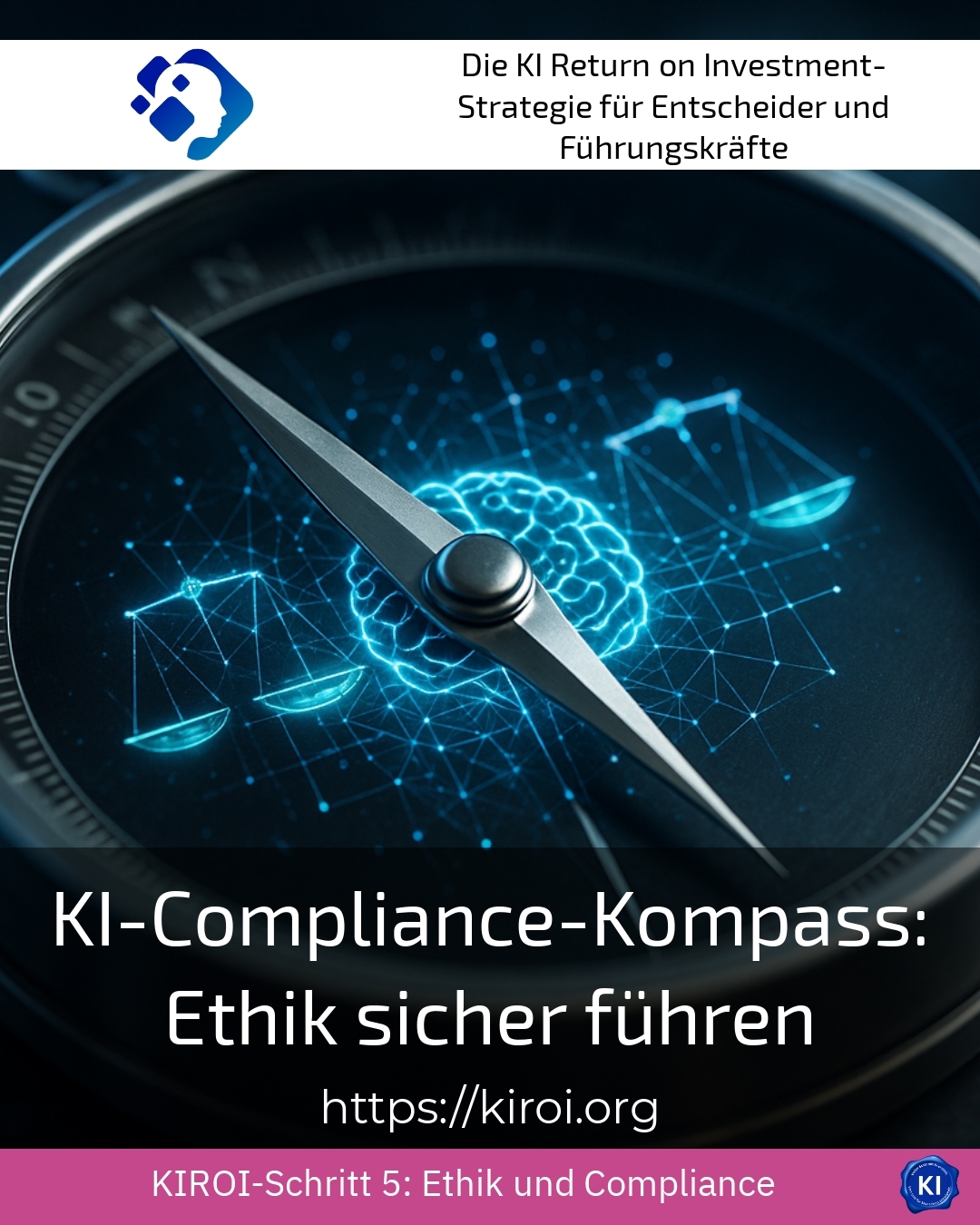
Imagine your company is facing a pivotal decision: you want to implement intelligent systems to optimise processes and create competitive advantages. However, at the same time, you're wondering how to uphold ethical principles and meet regulatory requirements. This is precisely where the AI Compliance Compass: Ethically Navigate serves as a strategic orientation framework that guides companies through the complex interplay between technological innovation and moral responsibility. In a time when algorithmic decisions increasingly shape business, the ability for ethical governance becomes a crucial success factor. This article demonstrates in a practical way how you can shape responsible technology integration.
The importance of ethical guardrails in modern business management
Companies across all sectors are today faced with the challenge of reconciling technological possibilities with social responsibility. The AI Compliance Compass: Ethically Navigate It offers a structured approach, supporting leaders in navigating ethical issues. Many clients report coming to transruption coaching with uncertainties regarding transparency and traceability. They seek guidance in implementing responsible systems. The complexity of regulatory requirements often overwhelms internal resources.
A medium-sized logistics company, for instance, implemented autonomous route planning systems. However, it discovered that the algorithms systematically avoided certain urban areas. Analysis revealed that historical data contained socio-economic biases. Without ethical review mechanisms, this would have led to discriminatory business practices. A financial service provider, in turn, implemented automated credit decisions. The systems, however, showed unintended disadvantages for certain population groups. It was only through systematic fairness audits that these biases could be identified. In healthcare, a clinic group used predictive analytics for patient management. The ethical dimension of the decision-making basis was initially underestimated. Transruption coaching supported the project in developing suitable governance structures.
Best practice with a AIROI customer
An internationally operating trading company faced the challenge of introducing automated pricing systems, but the ethical implications of dynamic pricing had initially not been sufficiently considered, which is why the company engaged transruption coaching to accompany this complex project. Together, we developed a comprehensive ethical framework that defined price caps for essential products and implemented mechanisms against algorithmic price discrimination, enabling the company to increase its competitiveness without disadvantaging vulnerable customer groups. The implementation included regular fairness audits, transparency reports for stakeholders, and training programmes for employees working with the systems, with particular emphasis placed on the traceability of algorithmic decisions. The result was a system that combined economic efficiency with social responsibility and sustainably strengthened customer trust, reflected in improved customer retention rates and positive media coverage.
AI Compliance Compass: Safely Navigating Ethics in Practice
The practical implementation of ethical guidelines requires more than mere declarations of intent. Companies need concrete tools and processes. In retail, for instance, a growing number of businesses are using personalised recommendation systems. These analyse purchasing behaviour and create individual product suggestions. But where does helpful personalisation end and manipulative influencing begin? A large fashion retailer therefore developed boundaries for persuasive techniques. It consciously avoided certain psychological triggers. The customer base appreciated this transparent stance.
Similar challenges are becoming apparent in the field of recruitment. Automated applicant screening systems promise more efficient processes, but they also carry risks for equal opportunities and diversity. One technology group discovered that its systems favoured certain qualification profiles, as historical hiring data reflected past inequalities. Conscious correction of these biases was necessary to enable fair selection procedures. In the insurance sector, companies use predictive models for risk assessment. However, the use of certain data points can have discriminatory effects, which is why ethical guidelines define which variables are permissible.
Transparency as a cornerstone of responsible innovation
Transparency forms the foundation of any ethical technology strategy. Stakeholders expect insight into algorithmic decision-making processes. An energy provider, for example, communicates openly about its intelligent consumption forecasts. Customers learn which data is used and understand how recommendations are generated. This sustainably strengthens trust. In the banking sector, institutions inform about automated credit decisions [1]. Rejected applicants receive comprehensible justifications. Regulation increasingly demands this explainability. Manufacturing companies, in turn, rely on transparent quality control systems. Suppliers and customers can view audit results. This builds trust along the entire value chain.
Best practice with a AIROI customer
A leading provider of mobility solutions implemented a comprehensive fleet management system with intelligent components, but initially, the ethical aspects of employee monitoring and data usage were not adequately addressed, leading to significant resistance from the workforce. Transruptions Coaching supported the project in developing a participatory governance model, actively involving employee representatives in the design of system parameters and defining clear boundaries for data usage. Together, we developed transparency guidelines that stipulated which information could be collected, who would have access, and how long data would be stored, consistently applying the principle of data minimisation. The outcome satisfied all stakeholders, as the system's efficiency gains were realised while simultaneously safeguarding employees' personal rights, leading to significantly higher acceptance and even suggestions for improvement from the workforce.
Governance structures for sustainable responsibility
Effective ethical governance requires institutional anchoring. Companies establish specific bodies and processes for this purpose. Ethics advisory boards bring diverse perspectives. They examine critical use cases. They provide impetus for responsible innovation. For example, a pharmaceutical company established an interdisciplinary committee. Medical professionals, ethicists, and technologists assess new applications there. Their recommendations feed into development decisions. In the media sector, a publishing house established editorial guidelines for automated content [2]. These define where human control remains indispensable. Quality assurance was adapted accordingly. Telecommunications providers, in turn, developed guidelines for predictive customer analytics. They limit the use of sensitive behavioural data. Privacy protection takes precedence over marketing interests.
Continuous Evaluation and Adaptation
Ethical compliance is not a one-off project but an ongoing process. Technologies evolve. Societal expectations change. Regulatory requirements are adapted. The AI Compliance Compass: Guiding ethics safely must take this dynamism into account. An automobile manufacturer regularly reviews its autonomous driving systems. Ethical dilemma situations are simulated and evaluated. The results are incorporated into software updates. In retail, a group evaluates its recommendation algorithms quarterly. Fairness metrics are systematically recorded. Deviations trigger immediate adjustments. A hotel chain, in turn, conducts annual audits of its booking systems. Pricing and availability management are checked for discrimination risks. External auditors ensure objectivity.
The qualification of employees plays a central role in this. Technical teams require fundamental ethical knowledge. Leaders must be able to assess risks. One software company integrated ethics modules into its developer training [3]. Engineers learn to reflect on the potential impact of their work. This awareness shapes the corporate culture sustainably. In the financial sector, risk managers undertake specific further training. They understand how algorithmic systems can produce biases. This knowledge significantly improves the quality of oversight.
Best practice with a AIROI customer
A prominent player in the food production sector faced the challenge of implementing intelligent quality assurance systems, initially underestimating the ethical implications of automated decisions regarding product releases, which led to conflicts between efficiency goals and quality standards. Transruption coaching supported the company in developing a balanced governance framework that defined clear escalation paths and retained final decision-making responsibility with human experts, while positioning the technical systems as supportive tools. Together, we implemented a system of continuous improvement, establishing regular feedback loops between production employees and the technology team, allowing practical experience to inform the ongoing development of the algorithms. The project impressively demonstrated that technological efficiency and human expertise are not mutually exclusive but can mutually reinforce each other when ethical principles are considered from the outset of implementation and all stakeholders are involved in the process.
My AIROI Analysis
The analysis of numerous projects clearly shows that ethical compliance does not hinder innovation, but rather forms its sustainable foundation, as companies that invest early in responsible structures avoid costly corrections and reputational damage, while simultaneously strengthening the trust of their stakeholders and positioning themselves as reliable partners. Experience with various industries and company sizes proves that the success of technological transformation is significantly dependent on the quality of ethical guidance, with the early involvement of all relevant perspectives being particularly crucial in order to avoid blind spots and develop viable solutions. Transruption coaching clearly positions itself as guidance for projects surrounding these complex challenges by providing impetus, initiating reflection processes, and supporting companies in finding their own paths without imposing ready-made solutions, as sustainable ethical orientation must grow from within and cannot be dictated from the outside.
The central finding of my work is therefore that ethics and efficiency are not opposites, but mutually dependent, because transparent, fair, and comprehensible systems generate trust, which in turn creates acceptance and reduces resistance, ultimately accelerating implementation and increasing usage intensity. Companies that understand and actively shape this connection will be more successful in an increasingly technology-driven economy than those that view ethics as an annoying chore, as the ability for responsible innovation will become the decisive differentiator in saturated markets with informed and demanding customers.
Further links from the text above:
[1] BaFin – Supervisory Perspectives on Algorithmic Systems in the Financial Sector
[2] German Press Council – Principles and Guidelines for Digital Media
[3] VDI – Engineering Ethics and Responsible Technology Development
For more information and if you have any questions, please contact Contact us or read more blog posts on the topic Artificial intelligence here.









 Deutsch
  English (UK)