
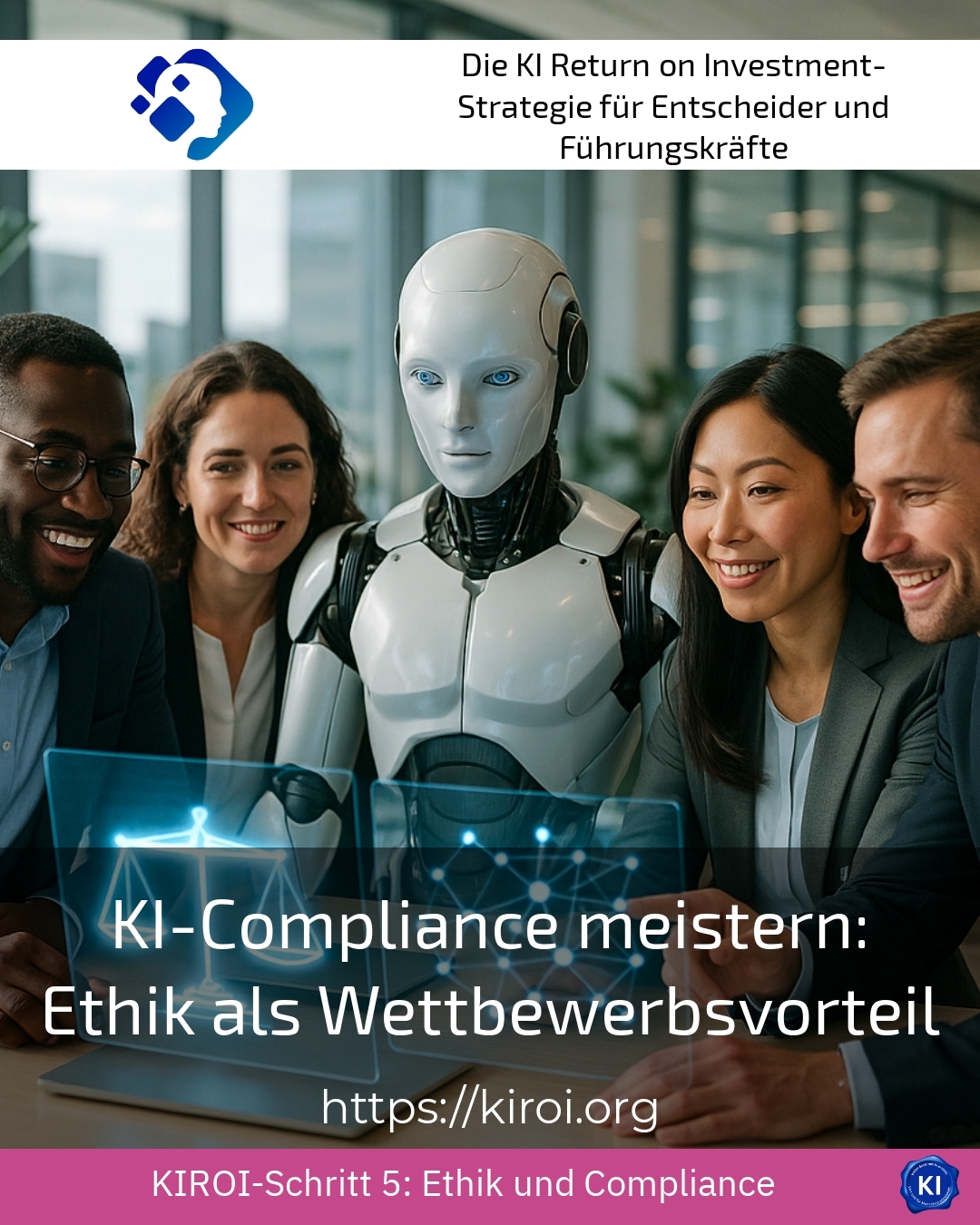
Imagine your company losing the trust of thousands of customers overnight because an algorithmic system made discriminatory decisions, and this news spreads across all social networks within hours, even reaching the evening news. It is precisely this scenario that many organisations are currently experiencing when it comes to the issue of Mastering AI Compliance did not place on their strategic agenda in time. However, the good news is that ethical principles in dealing with intelligent systems are no longer just a regulatory obligation, but have become a real competitive differentiator. Companies that act proactively today will secure decisive advantages tomorrow.
Warum ethische Standards zum strategischen Erfolgsfaktor werden
The days when technological innovation alone determined market success are increasingly becoming a thing of the past. Customers, business partners, and investors now expect transparent processes. They demand understandable decision-making paths in automated systems. A leading automotive manufacturer had to learn this lesson the hard way when its applicant management system systematically disadvantaged female candidates. The resulting media coverage caused measurable damage to its image. This immediately affected the recruitment of new skilled workers.
A similar experience was had by an international financial institution, whose credit scoring algorithm disadvantaged certain population groups without those responsible initially noticing. Subsequent regulatory investigations and fines far exceeded the costs that a thorough ethical review beforehand would have incurred. A telecommunications provider, on the other hand, used the early implementation of transparent guidelines as an active marketing tool, thereby demonstrably gaining market share in a highly competitive segment.
Mastering AI Compliance through Systematic Governance Structures
The establishment of robust control mechanisms initially requires a profound understanding of one's own process landscape. Many organisations underestimate the complexity of interconnected systems in this regard. For example, an energy provider discovered more than thirty different applications with algorithmic decision-making components during an internal analysis, only about half of which management had previously been aware of. These findings led to a complete realignment of the internal control systems. At the same time, the company established a cross-departmental committee for continuous monitoring.
Best practice with a AIROI customer
A medium-sized logistics company faced the challenge of conducting a systematic ethical review of its automated route planning systems and staff allocation algorithms for the first time, following repeated complaints from employees about shift allocations perceived as unfair. As part of a transruption coaching process lasting several months, we supported the project team in first conducting a complete inventory of all relevant systems and then defining clear criteria for fair algorithmic decisions. The biggest realisation for management was that supposedly neutral optimisation parameters such as efficiency and cost minimisation systematically disadvantaged certain employee groups in practice, which no one had noticed before. Together, we developed a governance framework that included regular audits, clear escalation paths, and a complaint management system for algorithmic decisions. Employee satisfaction increased by fifteen percent within six months. Additionally, the company's reputation as a fair employer in the region improved significantly.
The insurance group subsequently implemented a three-stage examination process for all new automated decision systems. This process includes a technical review, a legal assessment, and an ethical impact assessment. The investment in these structures had already paid for itself in the first year through avoided legal disputes.
Transparency as a cornerstone of trust in digital transformation
Customers want to understand how decisions that affect them are made. This expectation has significantly increased in recent years. An online retailer responded to this development by providing its customers with detailed explanations for personalised product recommendations. The conversion rate subsequently rose by eight percent. At the same time, complaints about unsuitable recommendations decreased by more than a third.
Traceability plays a particularly crucial role in healthcare, as patients and medical professionals alike need to understand how diagnostic support systems arrive at their assessments. A hospital operator therefore introduced so-called explanation modules, which translate complex algorithmic evaluations into comprehensible language. This significantly improved acceptance among the treating physicians. A pharmaceutical company also focused on maximum transparency from the outset when developing new analysis tools and integrated specialist personnel from various disciplines into the development process.
How businesses can master AI compliance and engage stakeholders
Successful compliance strategies are not created in a vacuum. They require continuous dialogue with all relevant stakeholders. A trading company established an advisory board for this purpose, bringing together representatives from customers, employees, academia, and civil society. This committee advises the management on ethically sensitive decisions. The resulting recommendations led to several concrete process improvements.
One media company went a step further and published detailed reports on its algorithmic recommendation systems, which were previously considered trade secrets. This radical openness initially met with internal resistance. However, it is now considered an important differentiator from less transparent competitors. A transport company used feedback from customer surveys to revise its automated pricing systems and define fair price corridors.
Best practice with a AIROI customer
An internationally operating trading company approached our team because it was having difficulty establishing uniform ethical standards for its algorithmic systems across different national markets, as cultural differences and divergent legal frameworks created significant complexity. Through transruption coaching, we guided the project team over several months to first identify common core values that are valid across cultures, and then to develop a flexible framework that allows for local adjustments. A particular focus was placed on involving local stakeholders in the various markets, because clients often report that well-intentioned central directives are perceived as impractical on the ground and thus generate resistance. The result was a modular governance system that makes common minimum standards binding, while at the same time allowing scope for culturally appropriate implementations. Employees in the various national subsidiaries reported significantly higher acceptance of the ethical guidelines. At the same time, coordination between the locations improved considerably.
Practical Tools for Sustainable Compliance Structures
The implementation of ethical principles requires concrete instruments and methods. A software company developed an internal checklist with more than fifty points for this purpose, which must be followed during every system development. This systematic approach reduced subsequent corrections by more than sixty percent. A mechanical engineering group supplemented its development processes with mandatory bias audits, which identify potential biases in training data early on.
Training programmes also play a central role in the sustainable embedding of ethical standards. Within a year, a consulting firm trained more than two thousand employees in the basics of responsible technology use. The investment paid off because employees can now independently identify and report potential risks. An industrial company integrated ethical issues into its existing quality management processes, thereby using established structures for new challenges.
Mastering AI compliance means continuous development
Technological and societal frameworks are constantly changing. Therefore, compliance structures must also be regularly reviewed and adapted. A technology group introduced quarterly reviews for this purpose, analysing current developments in regulation, technology, and society. This systematic environmental monitoring enables proactive action instead of reactive crisis management.
A financial service provider established a continuous improvement process that consolidises insights from internal audits, customer feedback and external assessments. The resulting measures are directly integrated into the further development of systems. A retailer uses simulations and stress tests to identify potential ethical risks of new applications in advance and to develop corresponding countermeasures.
My AIROI Analysis
The intensive engagement with ethical questions in the context of intelligent systems clearly shows that companies that invest in viable governance structures today will enjoy considerable competitive advantages tomorrow, while hesitant organisations are likely to come under increasing pressure [1]. The examples from various industries illustrate that there is no universal solution. Rather, each organisation must find its own way. The key here is the willingness to consider ethical considerations as an integral part of corporate strategy [2].
Approaches that actively involve different stakeholder groups and utilise transparency as a strategic differentiator appear particularly promising. Regulatory frameworks will continue to tighten in the coming years [3]. Companies that act proactively today will be able to leverage this development as an opportunity. Transruption coaching can provide valuable impetus for projects relating to the implementation of ethical standards and guide companies in developing their own answers to these complex questions. Investing in ethical excellence pays off not only in terms of avoided risks. It also creates new opportunities for innovation and growth [4].
Further links from the text above:
[1] EU strategy for artificial intelligence and regulatory framework
[2] Bitkom Information on Artificial Intelligence in Companies
[3] BSI recommendations for safe and trustworthy AI
[4] Platform Learning Systems – Shaping Germany's Future
For more information and if you have any questions, please contact Contact us or read more blog posts on the topic Artificial intelligence here.









 Deutsch
  English (UK)