
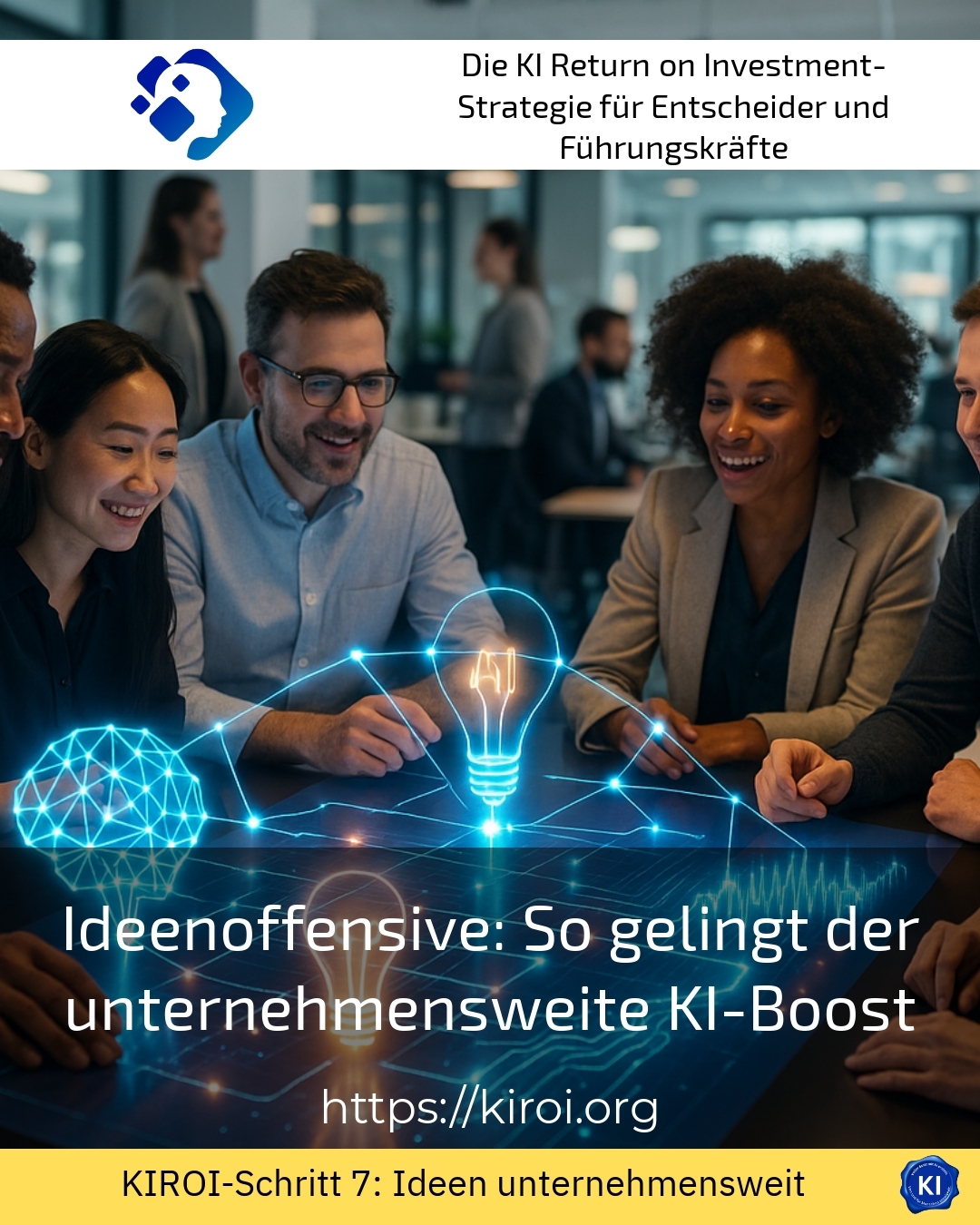
In a time when technological innovations are advancing at a breathtaking pace and companies must constantly reinvent themselves, the systematic use of intelligent systems gains crucial importance for long-term success. The Ideas offensive: How to achieve a company-wide AI boost is far more than a fashionable buzzword. Rather, it describes a comprehensive transformation process that permeates all departments, hierarchical levels, and business processes. Those who set the right course today secure a sustainable competitive advantage. Those who hesitate, on the other hand, risk falling behind in a rapidly changing economic world.
The strategic importance of a company-wide idea offensive for an AI boost
Many organisations are already experimenting with intelligent technologies in isolated projects or departments. However, such isolated initiatives rarely realise their full potential. Genuine synergies only emerge when a company involves the entire organisation in the transformation process. For example, a medium-sized mechanical engineering company might initially only use intelligent algorithms in quality control. But as soon as the same technology permeates logistics, sales, and human resources, the positive effects multiply. The various systems learn from each other and optimise processes across departmental boundaries.
A pharmaceutical company that merely uses intelligent analytics tools in research is missing out on valuable opportunities. The same technologies can also help with patient recruitment for clinical trials. They support the prediction of market developments and the optimisation of supply chains. An energy provider, in turn, benefits when intelligent systems do more than just control grid utilisation. They can simultaneously improve customer service and proactively plan maintenance intervals.
Experience shows that companies often come to disruption coaching with similar challenges. They report resistance among the workforce and unclear responsibilities. They struggle with a lack of data quality and a lack of strategic alignment. This is precisely where professional support comes in, providing impetus and structuring the process.
Cultural change as the foundation of the ideas offensive
Technology alone does not bring about sustainable transformation. The crucial factor lies in the corporate culture and the willingness of all parties involved. A retail group can implement the most modern forecasting systems, but if the buyers continue to rely solely on their experience, the investments will fizzle out. In an insurance company, claims handlers might use intelligent assistance systems, but the full benefit will only materialise when the management level also promotes data-based decisions.
An automotive supplier faces the task of getting its workforce enthusiastic about new working methods. Production workers must understand that intelligent systems support them and do not replace them. At the same time, engineers need room for experimentation and the freedom to test new ideas. A telecommunications company, in turn, must demonstrate to its customer advisors how intelligent analysis tools will help them. These tools enable personalised recommendations and faster problem-solving.
Best practice with a AIROI customer An internationally operating logistics company faced the challenge of rolling out intelligent technologies across the entire enterprise. Previous pilot projects in individual branches had shown promising results. However, scaling repeatedly failed due to cultural barriers and a lack of acceptance. As part of intensive support through transruptions coaching, the company initially developed a clear communication strategy. This strategy addressed the concerns and reservations of employees at all levels. Subsequently, a cross-functional team identified so-called Quick Wins. These rapid successes demonstrated the concrete benefits for everyone's daily work. For example, a dispatcher was able to save two hours of planning time daily through intelligent route optimisation. He subsequently used this time for more value-adding activities, such as personal customer support. Within six months, acceptance of the new systems rose from an initial thirty percent to over eighty percent. The company also recorded a measurable improvement in delivery accuracy and customer satisfaction.
Practical steps for successful implementation
The transformation begins with an honest assessment of the current situation. A medical technology manufacturer should first analyse what data is actually available. Where are the biggest bottlenecks in the processes? Which departments already show an openness to change? A financial service provider must understand which regulatory frameworks need to be considered. A retail company should examine which customer data can be used for personalisation.
The next step involves developing a clear vision. This vision describes how the organisation should look in three to five years’ time. For example, a construction company might set itself the goal of completing construction projects more punctually through forward-thinking planning. A food manufacturer might aim to reduce waste by fifty percent through intelligent quality forecasting. A media company may want to provide its users with tailored content in real-time.
The Ideas offensive: How to achieve a company-wide AI boost also requires bold investment in infrastructure and skills development. A chemical company needs high-performance data centres and secure cloud solutions. A tourism company needs to train its employees in the use of data-driven tools. A property manager needs interfaces between different portfolio systems.
The role of leaders in the idea offensive for the AI boost
Leaders significantly shape the success or failure of transformation. In a textile company, department heads must lead by example in valuing data-based decisions. They need to encourage experimentation and view mistakes as learning opportunities. In a bank, department heads should actively seek out use cases within their area of responsibility. In a hospital, chief physicians and nursing management must work together on integration.
Clients often report that the biggest hurdles lie within middle management. This level often feels squeezed between the strategic directives of senior management and operational realities. One software company solved this problem through regular innovation workshops. These workshops brought managers from different levels together. A utility company established a mentoring program. Experienced managers learned from younger, tech-savvy employees.
Guidance from transruption coaching can provide valuable impetus here. External perspectives help to break through ingrained thought patterns. They support the constructive addressing of resistance and building bridges between different stakeholders.
Best practice with a AIROI customer A medium-sized family company in the food sector wanted to fundamentally modernise its production planning. The management had formulated ambitious goals. However, implementation stalled because the department heads pursued different priorities. The production manager feared for the flexibility of his tried-and-tested processes. The sales manager wished for faster response times to customer enquiries. The IT manager was concerned about data security and system stability. Through structured support with transruption coaching, these different perspectives were successfully unified. In several moderated workshops, the managers jointly developed an integrated approach. This approach took into account both efficiency gains in production and the requirements of sales. The IT department was involved as a strategic partner from the outset. The result was a pilot project with clearly defined success criteria and broad support. After a successful test phase, the company gradually rolled out the solution to further production lines. Revenue per employee increased by twelve percent in the following year.
Typical stumbling blocks and how to overcome them
Experience from numerous projects reveals recurring patterns in challenges. For example, a transport company underestimated the effort required for data cleansing. Historical data from various systems exhibited inconsistencies. A fashion retailer launched too many initiatives simultaneously and became overwhelmed. A technology company neglected change communication, generating mistrust among its workforce.
Another common mistake lies in unrealistic expectations regarding the speed of transformation. A steel producer expected measurable productivity increases after just three months. However, reality showed that the integration into existing processes required more time [1]. A hotel group invested in state-of-the-art systems. However, it forgot that the reception staff required intensive training. A mechanical engineering company implemented a solution. However, this solution did not fit the actual workflows of the service technicians.
Successful companies are characterised by patience and perseverance. They celebrate small successes and communicate them widely. They learn from setbacks and continuously adapt their strategy. Ideas offensive: How to achieve a company-wide AI boost It's not a sprint, but a marathon.
Measurability and continuous improvement
Without clear key figures, progress cannot be objectively assessed. For example, a logistics company should compare delivery accuracy before and after implementation. A call centre measures average handling time and customer satisfaction. A manufacturing company tracks scrap rates and machine downtime.
However, the defined key figures must also be suitable for the respective use case. A consulting firm cannot measure success solely by the number of documents generated. The quality of the recommendations and their acceptance by clients are equally relevant [2]. A hospital operator must consider patient safety in addition to efficiency gains. An educational provider should not only look at cost savings. They should also evaluate the learning success of the participants.
Regular retrospectives help to correct course and identify new opportunities. An electronics manufacturer established monthly review meetings with all relevant stakeholders. A publishing house conducted quarterly innovation sprints. A craft business used weekly short briefings within the management team.
My AIROI Analysis
The company-wide implementation of intelligent technologies represents one of the most significant strategic challenges of our time. My analysis of numerous projects and mandates clearly shows that the technological aspect is only one part of success. The cultural, organisational and human factors are at least as important [3]. Companies that address these dimensions equally achieve more sustainable results.
The observation also shows that successful transformations must always be supported by senior management. At the same time, they require ambassadors and drivers at all levels of the organisation. Middle management plays a key role in this. They translate strategic visions into operational reality. Without their active support, even the most carefully thought-out concepts will fail.
From my perspective, the greatest leverage lies in the systematic networking of different initiatives. Isolated projects may show short-term success. However, the real added value only emerges through integration across departmental boundaries. Support from transruption coaching can help to break down silos and develop a common language. Companies that pursue this holistic approach often report surprising synergy effects. These effects were not originally planned but arose organically from improved collaboration.
The Ideas offensive: How to achieve a company-wide AI boost requires courage, perseverance and a willingness for continuous development. The journey is demanding, but the results justify the effort.
Further links from the text above:
[1] McKinsey Digital Insights on Corporate Transformation
[2] Harvard Business Review on Artificial Intelligence in Management
[3] Gartner Research on AI Implementation Strategies
For more information and if you have any questions, please contact Contact us or read more blog posts on the topic Artificial intelligence here.










 Deutsch
  English (UK)