
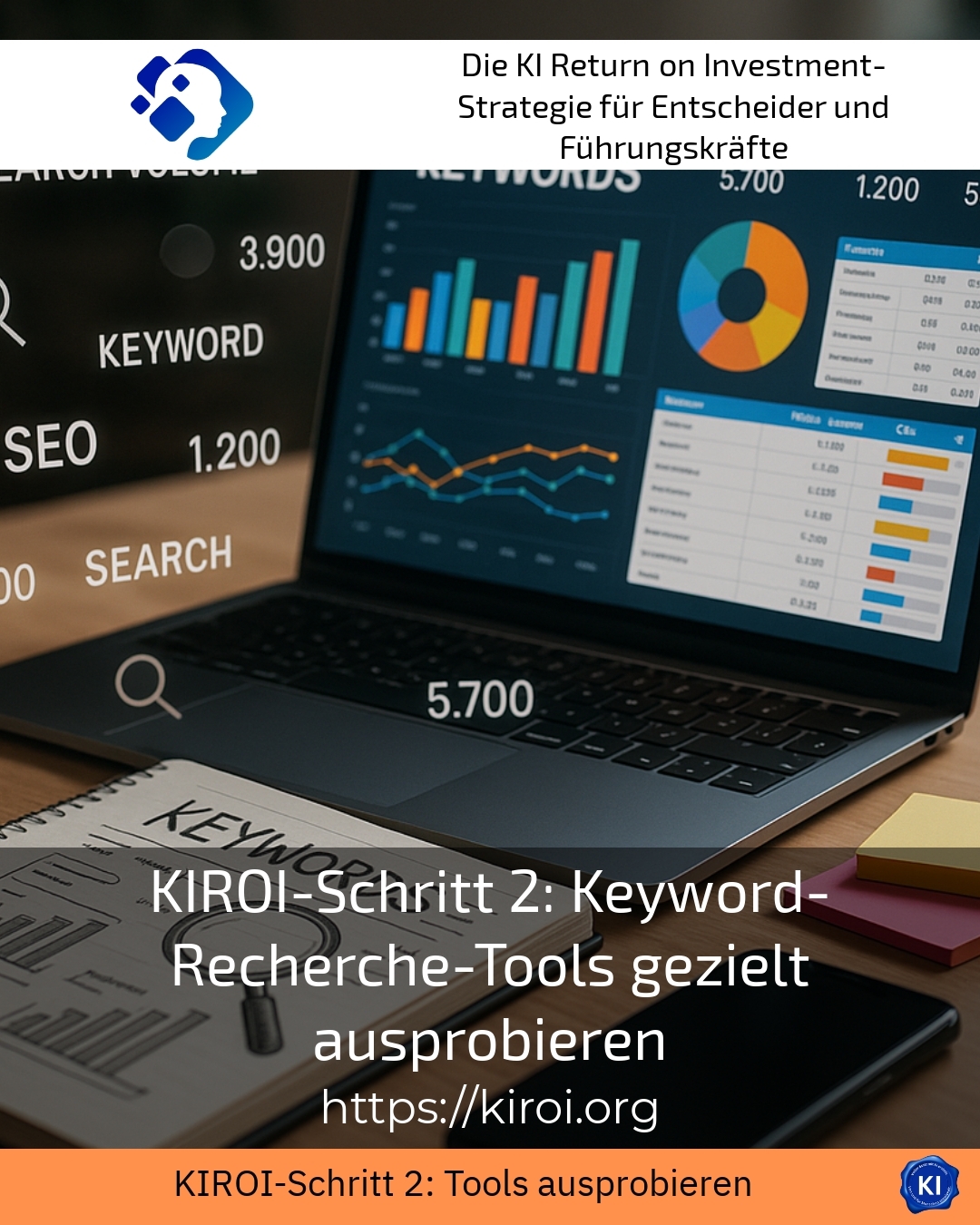
Trying out keyword research tools purposefully
Many companies face the challenge of finding the right search terms for their online content. Keyword research tools can help with this and offer support in various ways. The aim is to select relevant keywords that have the potential to bring more visitors to the website and increase visibility.
When using keyword research tools, it's not just about filtering out individual words, but also meaningful word groups and search phrases. This allows you to better understand and address the needs of your target audience more precisely. It's particularly important to try out different tools to obtain the broadest and most valid data set possible. In practice, it repeatedly becomes clear that combining multiple tools often offers the best insight.
Practical examples from industry
In e-commerce, many retailers use keyword research tools to optimise their product pages. This makes it possible to identify search terms that precisely describe potential customers, such as „waterproof hiking boots for women“. These long-tail keywords often have less competition but offer a higher probability of conversion.
Targeted keyword research also plays a significant role in the software sector. Companies often test keywords that cater to different user needs, from initial product information to purchase-ready search queries. Here, analysing search volume, competition, and search intent using various tools can provide practical insights and create an important basis for decision-making.
In the service sector, keyword research tools help to fine-tune content on landing pages. This is how companies find out which terms are particularly relevant for local searches and can specifically increase their visibility in regional competition.
AIROI Best Practice at Company XYZ (Name changed due to NDA agreement)
A medium-sized online retail company used various keyword research tools to identify relevant search phrases for its product pages. They combined Google Suggest with a professional analysis tool, which led to a comprehensive list of long-tail keywords specifically tailored to user queries. This research enabled continuous optimisation of product descriptions, resulting in increased visibility and an improved user experience.
Key features of modern keyword research tools
Many tools offer data on search volume in addition to the pure keyword list, which shows how often a term is searched for on average. Likewise, competition values can be viewed, which are important for estimating how difficult it is to rank well for a keyword. Cost per click (CPC) can provide insight into how attractive a keyword is for paid campaigns.
Furthermore, some tools allow for a better understanding of search intent: Is a term being searched for primarily for informational purposes, or is there a concrete purchase intention behind it? These insights help to align content more precisely and cater to different stages of a purchasing process.
Some keyword research tools have automatic grouping functions that summarise similar terms. This makes it easier to develop a structured keyword strategy for a website. The practical advantage is particularly evident with extensive keyword sets and multilingual or multi-regional projects.
Support from AIROI coaching with tool selection
Many project managers face the choice of the appropriate tool. Within the scope of AIROI coaching, this step is accompanied by the presentation and targeted testing of various keyword research tools. The sheer variety of free as well as paid options makes an overview not easy.
The coaching supports in finding the best mix for each project and interpreting the results correctly. This can provide impetus for text creation, technical SEO, and marketing campaigns. The aim is not to promise a short-term miracle cure, but rather sustainable, practical support in optimising your online presence.
The individual advice regarding specific issues brought by companies from various sectors is particularly valued. Clients often report that through the support, they not only gain access to tools but also learn to interpret and implement their data meaningfully.
AIROI Best Practice at ABC (name changed due to NDA contract)
A software company worked with various keyword tools as part of coaching sessions to increase the visibility of info pages. The focus was on analysing search volume and competition intensity. The guidance helped to select the keywords that best resonated with the target audience. A side effect was better alignment of content with the different stages of the customer journey.
AIROI Best Practice at LMN (name changed due to NDA contract)
A regional service provider used keyword tools to identify locally relevant terms with low competition. In the coaching sessions, the combination of search volume data and competition metrics was refined to develop the optimal keyword strategy. The insights gained from this were incorporated into targeted content planning, which strengthened visibility in the respective region.
My analysis
The targeted use of keyword research tools offers great potential, provided they are used within a sensible process. It is important to test several tools in order to obtain a valid and comprehensive keyword base. The search intent and competitive situation should always be taken into account. With professional guidance, suitable tools can be used effectively to sustainably optimise the content strategy and improve rankings.
Further links from the text above:
[1] Free SEO keyword research tool
[2] Best Keyword Research Tools to Try
[3] Mastering Keyword Research: AIROI Step 2 & Testing Top Tools
[4] SEO Tools for Beginners & Pros (Free) Top 15
[7] These are the best keyword tools – Trusted Shops
For more information and if you have any questions, please contact Contact us on or read further blog posts on the topic Artificial Intelligence Blog here.











 Deutsch
  English (UK)