
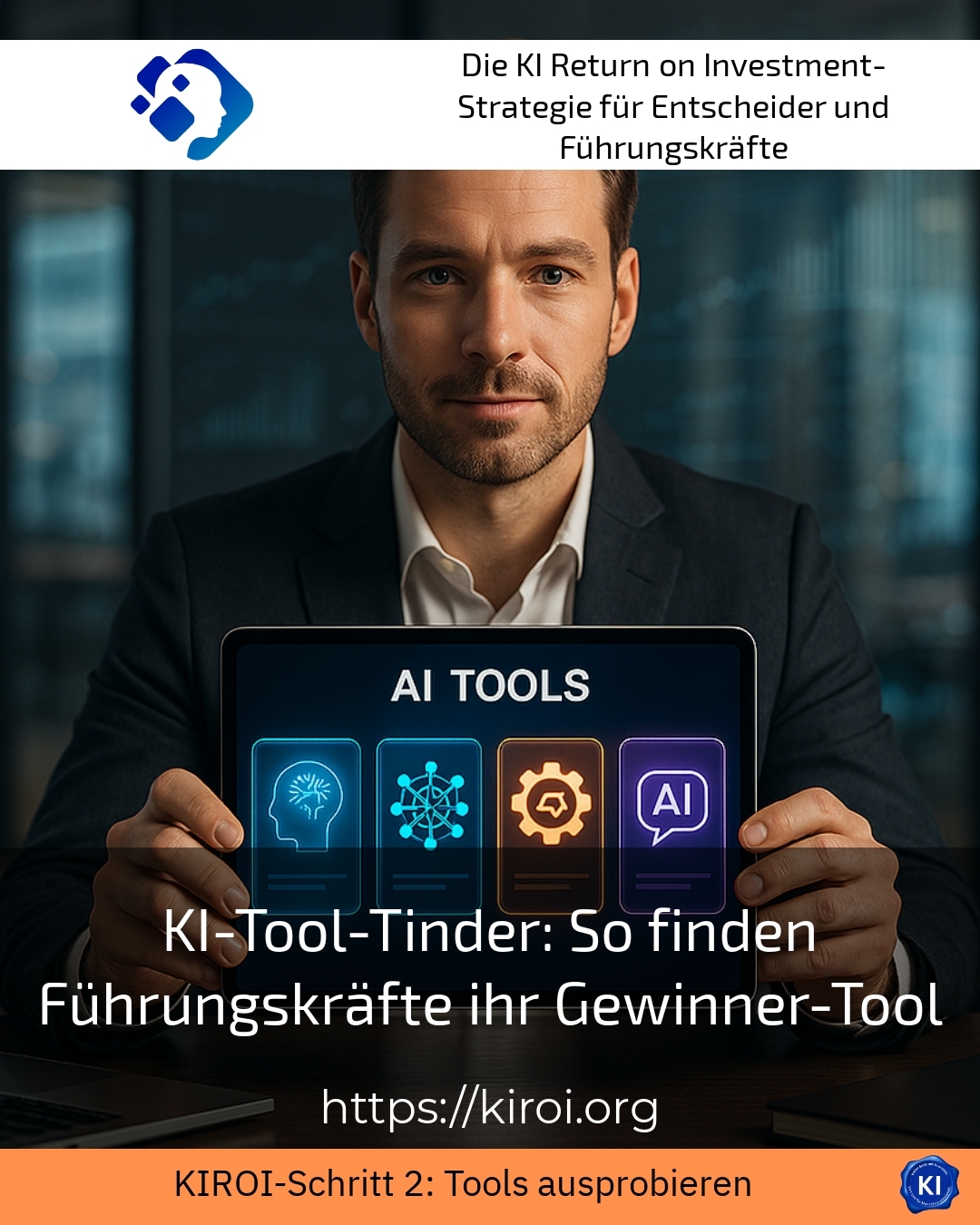
Imagine standing before a digital shelf stocked with over five thousand different tools, all promising to revolutionise your work processes and propel your business into the future. That's precisely how the search for the right intelligent solution feels for many decision-makers today, which is why the concept AI Tool Tinder: How leaders find their winning tool is gaining more and more importance and offers a structured approach to this overwhelming selection. The challenge is no longer to find technological support at all, but rather to filter out exactly that application from the sheer mass of possibilities that fits individual requirements, existing infrastructure, and company culture. In this post, you will learn how to proceed systematically to identify your perfect digital partner without falling into the typical pitfalls that many organisations experience when introducing new technologies.
The Art of Digital Headhunting in the Corporate Context
The comparison with a dating platform might seem humorous at first, but it surprisingly accurately gets to the heart of the challenge. Just as with the search for a life partner, choosing an intelligent solution involves assessing long-term compatibility, distinguishing superficial promises from genuine added value, and knowing your own needs precisely. Many executives report being blinded by marketing promises. They invested significant resources in solutions that ultimately weren't a good fit for the company. Others, meanwhile, hesitated for so long in making a decision that competitors gained a crucial advantage. AI Tool TinderThis approach helps to avoid these extremes and find a balanced path.
Let's first consider the process of self-reflection that should precede any successful match. For instance, an insurance company realised it didn't need the latest and most exciting solution. Instead, it needed a robust system for automated claims assessment. A logistics company, in turn, found that while route optimisation was important, the real challenge lay in communication with end customers. A medium-sized manufacturing firm, through intense analysis, identified that quality control was the area where intelligent support would provide the greatest leverage.
Best practice with a AIROI customer An established retail company with over two hundred branches approached us with a common challenge that affects many organisations and highlights the core issue of tool selection. Management had already launched three different pilot projects with various suppliers, investing significant financial resources without any of the projects yielding satisfactory results. In the transruption coaching process, we initially worked on defining the actual requirements and separating them from perceived needs. It turned out that the company did not require a comprehensive platform solution. Rather, a specialised application for inventory optimisation was needed. Through structured guidance, the team was able to identify a suitable solution within eight weeks. The integration proceeded significantly more smoothly than in previous attempts. Clients often report similar experiences where clarity about their own requirements was the decisive factor for success.
AI Tool Tinder: How executives find their winning tool through systematic evaluation
The systematic evaluation begins with the creation of a detailed requirements profile that goes far beyond functional aspects and also considers cultural and strategic dimensions. A financial service provider, for example, must meet particularly strict regulatory requirements, which is why compliance functions must be of the highest priority. A creative company, on the other hand, may place greater emphasis on flexibility and adaptability. A healthcare provider, in turn, requires the highest standards of data privacy and data security, which significantly limits the choice. These different starting points show why there can be no universal recommendation and why individual support is so valuable [1].
The AIROI approach provides a structured framework for this evaluation. It doesn't just consider the technical functions of a solution. It also analyses the organisational prerequisites for successful implementation. In doing so, it asks questions that initially surprise many managers: What is the state of the company's data quality? What competencies are already in place, and which need to be developed? How high is the willingness to change in the affected departments? These factors often determine success more than the technical specifications of the chosen solution.
For example, an energy provider implemented a state-of-the-art load forecasting solution but failed due to a lack of acceptance among grid planners. A retailer invested in advanced price optimisation, but lacked the data infrastructure to utilise it effectively. A mechanical engineering company purchased a powerful predictive maintenance solution but did not have the sensors to capture the necessary data [2]. All these cases show: choosing the right tool is only half the battle.
The matching criteria in the AI tool Tinder process
What criteria should managers consider when making a selection? The answer to this question is more complex than it may seem at first glance, as in addition to obvious functional requirements, numerous soft factors play a crucial role in the long-term success of an implementation. Firstly, scalability must be examined. Can the solution grow with the company? A law firm with ten employees today might be planning to expand to fifty. A regional bank might want to merge or develop new business areas. A tech start-up anticipates exponential growth. All these scenarios require different solution approaches.
The second central aspect concerns integration capability. The best standalone solution is of little use if it cannot communicate with existing systems. A pharmaceutical company must be able to connect its intelligent solution with the laboratory information system. A supplier to the automotive industry requires seamless integration into the ERP system. A media company expects compatibility with the content management system. Understanding and evaluating these technical interfaces requires expertise that is often not available in-house.
Best practice with a AIROI customer A family-run manufacturing company approached us with the question of how to design a structured selection process, after several departments had presented different preferred solutions and management was unable to decide between the competing proposals. As part of the transruption coaching process, we collaboratively developed a catalogue of criteria that considered both quantitative and qualitative aspects and involved all relevant stakeholders. The introduction of weighting factors, which took into account the differing priorities of the departments, proved particularly valuable. The production manager placed the greatest emphasis on reliability and ease of maintenance, while sales management prioritised speed and user-friendliness. The finance department, in turn, focused on costs and return on investment. The structured process not only enabled the company to make a well-informed decision, but also achieved broad acceptance for the selected solution, as all participants found the selection process to be fair and transparent.
From theory to practice: implementation as a critical phase
The selection of the right tool marks only the beginning of a long journey. It is not the end. Implementation presents many organisations with unexpected challenges. These go far beyond technical aspects and touch upon fundamental questions of corporate culture and change management. A consulting firm found that the chosen solution, although technically flawless, was not used by the consultants because they feared it would make their expertise obsolete. A hospital implemented a diagnostic system that was perceived by doctors as a threat to their professional autonomy. A call centre introduced a call analysis solution that triggered massive surveillance anxieties among employees [3].
These examples illustrate why the AI Tool Tinder: How leaders find their winning tool-approach must also take the human dimension into account. The best technical solution will fail if it is not adopted by the people who are supposed to work with it. That is why, within the AIROI framework, we emphasise the importance of communication, training, and support during the implementation phase. A winning tool is ultimately one that is not just functionally convincing. It must also be adoptable by the organisation.
How can acceptance be increased? A chemical company trained internal ambassadors who acted as multipliers and carried enthusiasm into their teams. A telecommunications provider started with a voluntary pilot group whose positive experiences were communicated organically within the company. A publishing house chose a playful approach and gamified the introductory phase, so that the employees were intrinsically motivated to explore the new solution.
Avoiding pitfalls: What can go wrong
Experience shows that certain mistakes recur and can be avoided with appropriate preparation. One of the most common mistakes is choosing a solution that the CEO saw at a conference without checking if it fits specific requirements. Another classic mistake is overestimating features that are rarely used in everyday life while neglecting critical basic functions. Underestimating the training effort also regularly leads to problems when employees are left alone with a complex solution [4].
For instance, a textile company opted for a solution with an English-language user interface. This presented an insurmountable hurdle for many production staff. A tourism company chose the cheapest provider, but they ceased operations after two years, leading to significant migration costs. A construction company underestimated the complexity of data preparation, delaying the project by more than a year. These case studies show that careful selection saves time and money in the long run.
Best practice with a AIROI customer An internationally operating service company came to us after several unsuccessful implementation attempts. It sought support in realigning its digitalisation strategy and was frustrated by its previous experiences. The analysis of past projects revealed a clear pattern: each time, the selection had been made under time pressure. The evaluation had been limited to technical data sheets, and the organisational prerequisites had been ignored. In transruption coaching, we developed a new process that included explicit timeframes for each phase and defined clear criteria for go/no-go decisions. Particularly important was the introduction of reference visits, where the selection team visited other companies that already had the potential solutions in use. These practical insights proved invaluable and prevented at least two incorrect decisions that would have been made based on the providers' presentations. The company was thus able to make an informed decision and the implementation was significantly more successful than previous attempts.
The role of the manager in the selection process
Leaders bear a special responsibility in the selection process that goes beyond merely rubber-stamping recommendations and requires active shaping. They must set the strategic direction. However, they must also remain open enough to benefit from the insights of specialist departments. For example, the CEO of an electronics retailer realised he had to overcome his own prejudices regarding certain suppliers. A hospital director learned that his medical expertise did not automatically mean he could identify the best technical solution. A bank executive accepted that the younger employees had a better instinct for user-friendly interfaces.
The balance between delegation and personal involvement is crucial. Those who delegate the selection process entirely lose oversight and the opportunity for strategic control. Those who interfere in every detail slow down the process and demotivate the team. The AI Tool TinderThis approach recommends an active role in key moments: when defining strategic requirements, evaluating finalists, and making the final decision. Operational research and pre-selection can and should be delegated.
My AIROI Analysis
The search for the right digital tool is indeed similar to the search for a partner in many respects. It requires self-reflection, patience, and the willingness to ask difficult questions. The structured approach offered by the AIROI framework can help leaders tackle this complex task systematically. At the same time, it avoids the typical pitfalls that cost many organisations dearly. What continually impresses me in the support of numerous companies is the realisation that the technically best solution is not necessarily the right solution. The right solution is one that fits the company. It fits its culture, its processes, and its people. Finding this fit requires more than a comparison of feature lists. It requires a deep understanding of one's own organisation and its direction of development.
The examples in this post show that there are no shortcuts, but there are certainly proven paths that have helped other organisations reach successful decisions. Input from external guidance can open up valuable new perspectives that would otherwise be lost to internal tunnel vision. Transruption coaching supports leaders in asking the right questions. It helps to identify blind spots and shape a process that is both efficient and thorough. In the end, it's not about finding the perfect tool – because perfection is an illusion. It's about finding the tool that offers the best support for organisational goals today and tomorrow, while being flexible enough to evolve alongside the company [5].
Further links from the text above:
[1] AIROI Methodology for AI Strategy and Implementation
[2] McKinsey: The State of AI
[3] Gartner: Artificial Intelligence Trends
[4] Harvard Business Review: AI and Machine Learning
[5] Contact for individual advice
For more information and if you have any questions, please contact Contact us or read more blog posts on the topic Artificial intelligence here.









 Deutsch
  English (UK)