
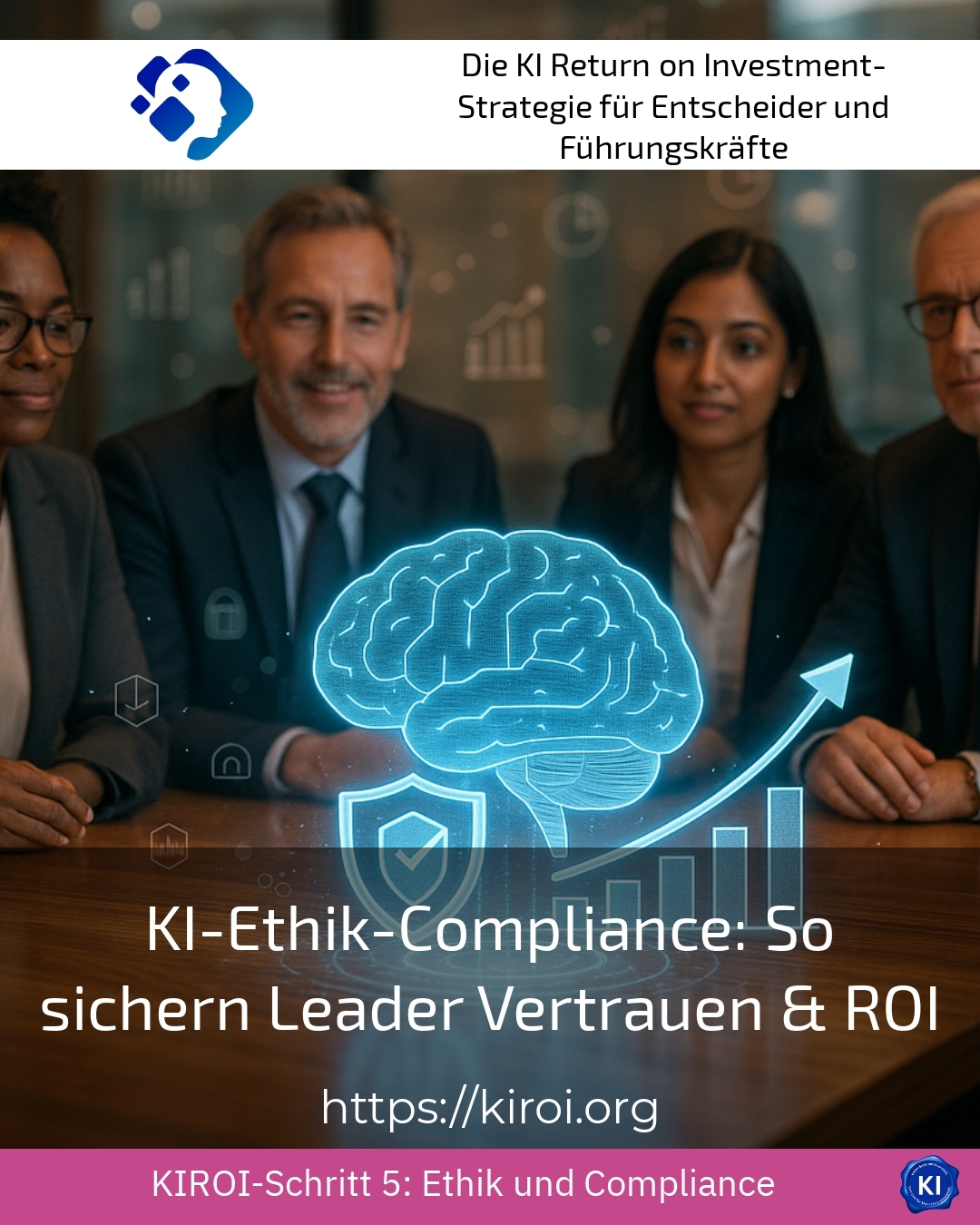
In a world where algorithmic decision-making systems increasingly influence our working lives, our finances, and even our healthcare, leaders face one of the most significant challenges of our time: how to use innovative technologies profitably while maintaining the trust of all stakeholders. The answer lies in a strategic approach that goes far beyond mere regulatory compliance and touches upon the core of what responsible corporate action means in the digital age. AI Ethics Compliance: How Leaders Secure Trust & ROI – this area of tension currently occupies boards of directors, supervisory boards and managing directors alike, as the balance between economic success and social responsibility requires a completely new understanding of leadership that combines technological competence with ethical reflection.
The strategic dimension of responsible technology leadership
Leaders in businesses of all sizes are increasingly recognising that the implementation of intelligent systems raises not just technical, but primarily strategic questions. For instance, a medium-sized manufacturing company implemented a predictive maintenance system designed to forecast machine failures. The technical implementation went smoothly. However, employees then raised valid questions about data usage. The management had failed to communicate transparently. The workforce's trust eroded significantly. This scenario highlights why ethical considerations must be factored in from the outset and why leaders should understand their role as bridges between technological innovation and human needs.
Another example can be found in the logistics sector. A large freight forwarding company introduced an automated route planning system. The system significantly optimised fuel consumption and delivery times. However, the algorithm's logic led to unequal workloads for the drivers. Some employees consistently received difficult routes. The works council successfully intervened. Management then revised the fairness parameters of the system. Such situations show that economic optimisation alone is not sufficient and that consideration of human factors is essential for sustainable success.
These challenges are also clearly evident in the retail sector. A supermarket chain tested automated staff scheduling software in selected branches. The software analysed customer footfall and dynamically adjusted shift schedules. Employees reported uncertainty and stress regarding their schedules. Their work-life balance noticeably deteriorated. Following intensive discussions, management modified the system. Minimum notice periods and employee preferences were now incorporated into the calculations. This example vividly illustrates the importance of a human-centric perspective when introducing technological innovations.
Understanding AI ethics compliance as a competitive advantage
Companies that authentically integrate ethical principles into their technology strategy often report positive effects across various business areas. Customer loyalty can improve. Employer branding becomes more attractive. Regulatory risks are addressed early on. However, these benefits only arise from consistent action. Lip service is not enough. A financial services provider implemented an algorithmically supported credit assessment system. The company invested significantly in transparency measures. Customers were able to understand the reasons for decisions. The rejection rate actually fell. At the same time, customer satisfaction increased measurably. This result surprised even those in charge of the project.
Best practice with a AIROI customer
A long-established insurance company with several thousand employees faced the challenge of modernising its claims processing while preserving decades of customer trust. Management decided to implement an intelligent claims assessment system that would automatically process routine cases and forward complex cases to experienced claims handlers. As part of the AIROI support, we collaboratively developed a comprehensive governance framework that defined not only technical requirements but also ethical guidelines and escalation processes. The involvement of employees from the outset was particularly important, as their expertise contributed to the quality assurance of the training data, and their concerns were taken seriously and addressed. The company also implemented a monitoring system that continuously monitors and reports potential biases in claims assessment. Following the implementation, both customers and employees reported an improved experience, with processing times decreasing by almost thirty percent and the complaint rate also falling significantly. The return on investment exceeded initial forecasts because the careful work on ethical foundations prevented later rectifications and reputational damage, which often occur in similar projects without appropriate support.
Establish governance structures for sustainable value creation
Establishing effective governance structures presents leaders with a variety of challenges that extend far beyond traditional corporate organisation. A manufacturing company in the mechanical engineering sector set up an interdisciplinary advisory board. This board included technicians, legal experts, works councils, and external specialists. The advisory board assesses all major technology projects before implementation. This structure creates legitimacy and acceptance. The investment in the advisory board paid for itself through avoided poor decisions. Similar approaches are also proving successful in other contexts.
In healthcare, governance requirements are particularly evident. A clinic group introduced a diagnostic support system for radiological images. The system was intended to relieve doctors of their diagnostic burden. The introduction was accompanied by intensive training. Furthermore, the clinic management defined clear responsibilities. Doctors always retain the final decision-making authority. The system serves exclusively as a supportive tool. Patients are informed about its use. This transparency strengthens trust in the treatment.
Automated systems also require well-thought-out governance approaches in human resources. A large retail company used algorithms for pre-screening applications. Initial analyses revealed unintended patterns in candidate selection. Certain applicant groups were systematically disadvantaged. The HR department reacted promptly. External auditors reviewed the system. The training data were revised. Regular fairness checks are now standard. The example highlights the need for continuous monitoring.
Achieve measurable success through responsible leadership
The link between ethical action and economic success can be seen in concrete key figures. Companies frequently report reduced legal risks. Compliance costs can decrease in the long term. Employee satisfaction increases with transparent communication. A telecommunications provider investigated these connections in an internal study. The provider had implemented an intelligent customer service system. The foundational ethical work initially cost time and resources. However, the training time for new employees was significantly reduced. Customer complaints about automated decisions were rare. Management documented a positive overall effect. Such results support the argument for responsible approaches.
These benefits are also clearly evident in the energy sector. A municipal utility implemented an intelligent grid management system. The system optimises energy distribution in real time. The introduction was accompanied by comprehensive public communication. Concerns regarding data protection were proactively addressed. Public acceptance was correspondingly high. There was no political resistance. The project is now considered a role model in the region. Other utility companies are orienting themselves towards this approach.
Best practice with a AIROI customer
An international logistics company with complex, multi-continental supply chains approached us with an urgent concern. Management realised that the planned introduction of a comprehensive supply chain optimisation system carried significant ethical implications. The system was intended to intelligently manage supplier selection, transport routes, and stock levels, requiring the consolidation of data from various countries with differing data protection standards. Together, within the framework of transruption coaching, we developed a multi-layered compliance approach that fulfilled the strictest European data protection requirements while also taking cultural differences in the various markets into account. Executives received intensive support to sensitise their teams to the changes and address resistance constructively. Particular focus was placed on supplier selection, as the system was not intended to systematically disadvantage suppliers from specific regions, while simultaneously giving appropriate weight to sustainability criteria. After nine months of intensive collaboration, the company now has a robust system that combines economic efficiency with ethical integrity, serving as an internal reference project for further digitalisation initiatives. The documented ROI exceeded expectations by fifteen percent.
Cultural change as the foundation for AI ethics compliance
Technical solutions and governance structures only achieve their full effect in a suitable cultural environment, which is why leaders should increasingly invest in the development of an ethically considered corporate culture. A medium-sized mechanical engineering firm initiated regular ethics dialogues at all hierarchical levels. Employees can express concerns anonymously. An ombuds team handles submitted cases confidentially. These measures signal that ethical concerns are welcome. The threshold for reporting potential problems is lowered. Errors are detected and corrected earlier. The company benefits from this open climate.
In the banking sector, the cultural shift requires particular attention. A regional credit institution implemented training programmes for all managers. The programmes teach the fundamentals of algorithmic decision-making. Managers learn to ask critical questions. They understand the limitations of automated systems. This competence enables informed decisions. The quality of technology projects demonstrably improved. Employees report an increased sense of security. The institution plans to expand the programmes to further employee groups.
The importance of cultural factors is also evident in the media sector. A publishing house is experimenting with automated content production. The editorial team formulated its own ethical guidelines. Algorithmically generated content is clearly labelled. Journalists retain editorial control. Readers appreciate this transparency. The medium's credibility is maintained. The experiment is considered a successful integration of innovation and commitment to values.
Consider trust & ROI as complementary key performance indicators
The supposed tension between economic success and ethical action often proves to be a false conflict upon closer examination, as management oriented towards the long term increasingly recognises the complementarity of these objectives. An automotive supplier invested in fundamental ethical work for its quality assurance system. Initial additional costs were compensated in the second year. Rejection rates decreased measurably. Customer satisfaction increased. Long-term supply contracts were extended. The managing director reported a changed understanding of quality. The company is now positioning itself as a pioneer in the industry.
These connections are also confirmed in the tourism sector. A hotel chain introduced a price optimisation system. The system dynamically adjusts room prices to demand and competition. Management defined ethical boundaries. Extreme price surges in emergencies are excluded. Regular guests receive price guarantees. These measures protect customer relationships. Short-term additional revenue is limited in favour of long-term loyalty. The strategy proves particularly effective in times of crisis.
My AIROI Analysis
My intensive engagement with projects integrating intelligent systems across various industries and company sizes has solidified my conviction that responsible technology leadership is not an optional extra, but a strategic necessity that is critical to the long-term success of organisations. The numerous conversations I have with executives reveal a recurring pattern: initially, concerns about the cost and time involved in ethical considerations often dominate, but as projects progress, this scepticism regularly transforms into an appreciation for the clarity and certainty gained. I experience particularly vividly how structured guidance enables companies to move from a defensive stance towards regulation to proactively shaping their technology strategy, with the shift in perspective from compliance as an obligation to ethics as a competitive advantage marking the crucial difference [1]. The AIROI methodology supports executives in navigating the complexity of algorithmic decision-making systems while simultaneously fulfilling their inherent responsibility to employees, customers, and society [2]. Clients frequently report an increased confidence in their own technological expertise and more constructive dialogues with technical experts, works councils, and regulatory authorities after completing our collaboration. In my experience, the combination of economic success and social responsibility is best achieved when leaders understand their role as active shapers rather than passive implementers of external requirements [3]. Transruption coaching accompanies precisely this development process and provides impetus for leadership practices that combine technological innovation with ethical reflection, thereby creating the foundation for sustainable business success.
Further links from the text above:
[1] Federal Ministry for Economic Affairs - Artificial Intelligence Dossier
[2] European Commission – Artificial Intelligence Strategy
[3] Bitkom – Artificial Intelligence Topic Area
For more information and if you have any questions, please contact Contact us or read more blog posts on the topic Artificial intelligence here.







 Deutsch
  English (UK)