
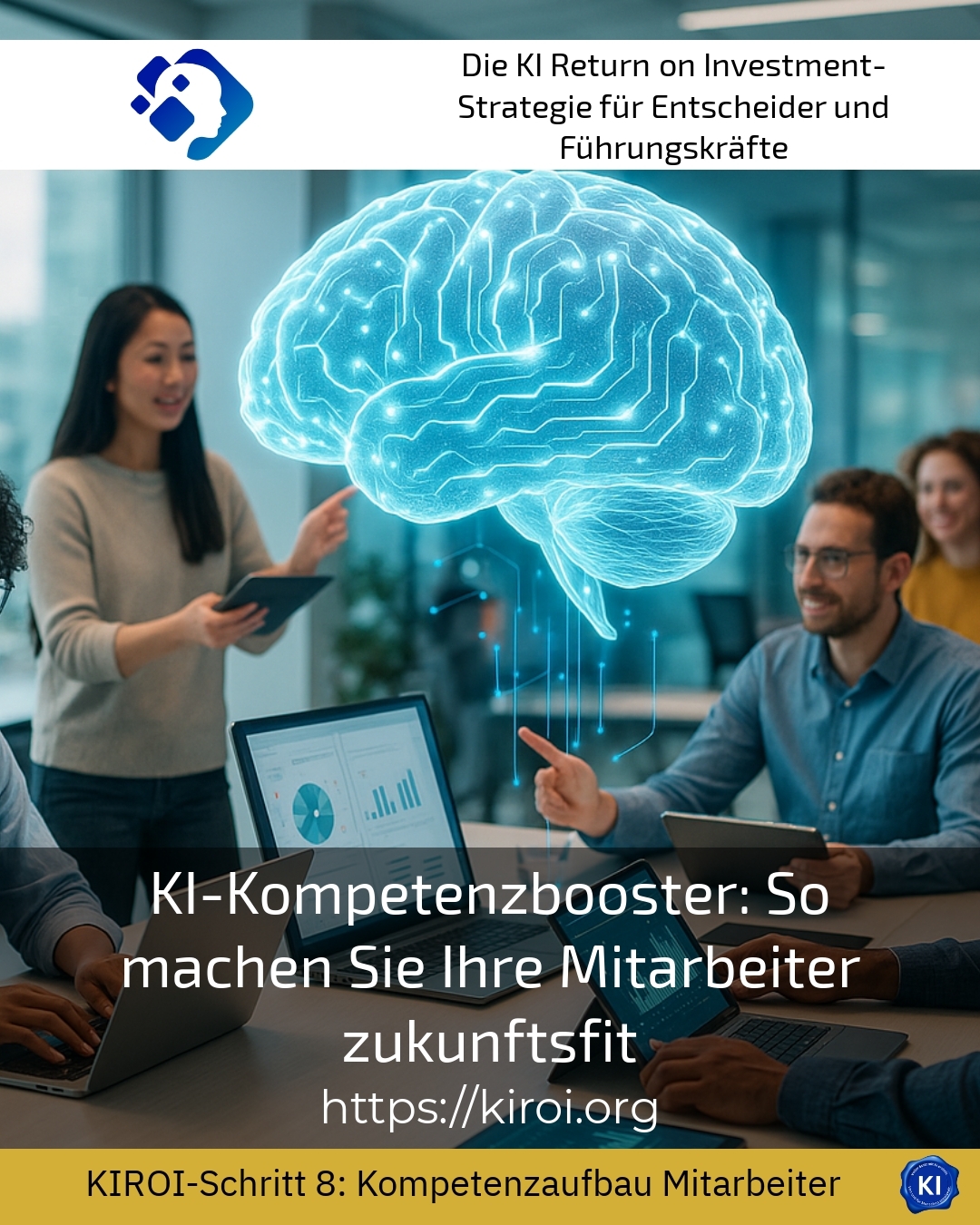
Imagine your teams navigating digital transformation with confidence, while other companies still hesitate and wait. The crucial difference lies not in the technology itself, but in the people who use it. AI Skills Booster can bridge precisely this gap and prepare your workforce for the demands of tomorrow. Because those who invest in training today will soon reap measurable competitive advantages in a rapidly changing market. The following sections show you practical ways to shape this transformation together with your employees.
Why the AI Skills Booster is becoming indispensable
The world of work is undergoing fundamental change. Automation and intelligent systems are increasingly taking over repetitive tasks. At the same time, entirely new fields of activity are emerging, requiring different skills. For example, a manufacturing company experienced quality inspectors being supported by visual recognition systems. These employees had to learn to monitor the systems and evaluate exceptions. Logistics service providers also frequently report similar challenges. Warehouse workers are suddenly working with predictive planning tools. They interpret forecasts and make independent decisions based on the recommendations. In turn, finance departments use intelligent analyses for budget planning and risk assessment. Accountants become data interpreters who must recognise and communicate connections.
This development clearly shows that technical training alone is not enough. People need a deeper understanding of how intelligent tools work and where their limitations lie. That's why transruptions-Coaching supports companies with projects concerning these qualification challenges. This is not about superficial training, but about sustainable competence development. Employees should be able to think critically, question results, and deal responsibly with new opportunities.
The most common topics that businesses come to us with
Many managers report uncertainty within their teams. Employees fear being replaced or falling behind. These anxieties often hinder their willingness to embrace new things. For instance, a mechanical engineering firm described how experienced skilled workers initially reacted negatively, feeling their expertise was threatened by automated recommendations. It was only through accompanying workshops that this attitude gradually changed. In the retail sector, meanwhile, companies are grappling with how sales staff can effectively use personalised recommendation systems. The technology exists, but its application in customer conversations remains challenging. Healthcare facilities are also approaching us with similar questions. Nurses are expected to understand diagnostic support systems without abandoning their human judgment.
Best practice with a AIROI customer
A medium-sized manufacturing company faced the challenge of preparing its production employees for new ways of working. Management had invested in predictive maintenance systems, but acceptance on the factory floor remained low. Experienced technicians preferred to rely on their hearing and feel for the machines rather than the data analyses on their tablets. As part of the accompanying coaching, we jointly developed a qualification programme that valued employees' expertise while imparting new skills. The technicians learned to link their experience with the system forecasts and became true experts in human-machine collaboration. After six months, supervisors reported significantly improved maintenance planning and fewer unplanned downtimes. However, what was particularly important was the increased confidence of the employees, who now saw themselves as competent partners of the new technology.
Strategies for sustainable skills development
Effective qualification begins with an honest assessment of the current situation. Where do your employees stand today? What skills are already present, and where are there gaps? These questions cannot be answered with standardised questionnaires. Instead, we recommend in-depth discussions and practical exercises for assessment. For example, an insurance company conducted "competence workshops". Claims handlers there tested new tools for damage analysis and reflected on their experiences together. These insights formed the basis for tailor-made learning paths. In the education sector, an organisation has adopted similar approaches. Teachers experimented with adaptive learning platforms and regularly exchanged information on successes and difficulties. Local authorities are also now using such participatory formats for their digitalisation projects.
The AI competence booster as a holistic concept
Successful qualification programmes combine technical knowledge with transferable skills. Employees must not only understand how algorithms work, but also learn to ask ethical questions and consider data protection aspects. A media company therefore integrated discussion rounds on responsibility topics into its programme. Editors not only learned to use automated text generation, but also reflected on when human creativity remains indispensable and where transparency towards readers is necessary. In the recruitment industry, agencies are training their recruiters in the critical use of matching algorithms. The professionals now better understand why certain suggestions appear and can identify biases. Pharmaceutical companies also report positive experiences with holistic approaches in their research departments.
The role of leaders should not be underestimated in this regard. They act as role models and multipliers. If managers themselves show reservations, this transfers to their teams. This is why disruption coaching often begins at the leadership level. Only when decision-makers understand the potential and limitations can they credibly guide their employees. An energy provider illustrates this approach particularly well. The management team first completed an intensive programme. Afterwards, the leaders passed on their knowledge in team discussions, thereby creating a learning-friendly culture throughout the company.
Practical methods for different target groups
Not everyone learns in the same way. That's why we focus on diverse formats and approaches. Some employees benefit from structured online courses that they can complete at their own pace. Others prefer practice-oriented workshops with concrete tasks from their daily work. Still others learn best through peer exchange and mutual support. A retail company therefore combined digital learning modules with regular practical days. Buyers there tested new forecasting tools for assortment planning and received immediate feedback. In the construction industry, a project developer introduced so-called learning partnerships. Experienced site managers worked closely with younger colleagues, exchanging ideas on the use of new planning tools. Catering companies are also experimenting with innovative learning formats for their service staff.
Best practice with a AIROI customer
A hotel chain with multiple locations wanted to modernise its reservation management while also bringing its staff along. The reception teams were to learn to work with dynamic pricing recommendations and occupancy forecasts. Initially, there was considerable resistance, as many employees feared losing their decision-making freedom. Together, we developed a programme that gradually built new competencies while respecting the expertise of the employees. In monthly workshops, the teams jointly analysed where the system recommendations were helpful and where human judgment delivered better results. These feedback loops led to a nuanced understanding and significantly higher acceptance. After one year, the hotel managers reported increased guest satisfaction and more efficient resource planning, as the employees now confidently used the new tools and meaningfully integrated them into their workflows.
Impetus for continuous further development
One-off training sessions are not enough. Technological development is advancing so rapidly that continuous learning is becoming the norm. Companies must therefore create structures that enable and promote ongoing development. For example, an automotive supplier has established learning time as a fixed component of working hours. Every employee can regularly engage with new topics and receives the necessary support for this. Telecommunications companies are experimenting with internal knowledge networks where employees share their experiences. Such communities promote exchange and accelerate the dissemination of best practices. Social institutions are also now using similar formats for their specialists.
Documenting learning successes also plays an important role. When employees see how far they've come, their motivation increases. A logistics company therefore introduced personal skills portfolios. Dispatchers documented their newly acquired skills there and regularly reflected on their development with their supervisors. These discussions provided valuable impetus for further training and simultaneously strengthened their commitment to the company.
Cultural change as a success factor
Technical competence alone doesn't make an organisation future-proof. What's crucial is a corporate culture that fosters innovation and sees mistakes as learning opportunities. A credit institution impressively illustrates this connection. The bank had invested significantly in new analytical tools for credit assessment. However, it was only when management established a culture of open feedback about mistakes that employees truly embraced the new possibilities. They dared to experiment, shared their experiences, and thereby continuously improved their working methods. Similar patterns can be seen in the advertising industry with agencies that support creative processes through intelligent tools. Architectural firms also frequently report on the importance of cultural factors for successful digitalisation projects.
Appreciation and recognition play a central role in this. Employees who embrace new ways of working deserve special attention. For this reason, an industrial company introduced innovation awards for teams that had successfully integrated new tools into their daily work. This recognition motivated other departments to also try new things. Such positive reinforcement supports the desired cultural change more sustainably than any regulation from above.
My AIROI Analysis
The experiences from numerous support projects paint a clear picture. Companies that invest early and systematically in the skill development of their workforce gain significant advantages. They react more quickly to market changes and exploit new opportunities more effectively than their competitors. The AI Skills Booster proves to be an effective instrument that goes far beyond technical training. It combines technical knowledge with cross-disciplinary competencies and creates a foundation for self-determined work in a changing world. Those organisations that put people at the centre and see technology as a tool that complements rather than replaces human capabilities are particularly successful.
The AIROI methodology offers a structured framework for this, which can be flexibly adapted to different industries and company sizes. The crucial element is the connection between strategic planning and concrete implementation support. Theoretical knowledge alone does not change an organisation. Only when employees gain practical experience and reflect on it does true competence emerge. Therefore, we recommend an iterative approach with short learning cycles and regular feedback. Leaders should lead by example and actively promote a culture of continuous learning. Investing in employees is not a one-off measure, but an ongoing process that pays off in the long term. Those who start today actively shape the future of their company.
Further links from the text above:
[1] AIROI Methodology for Business Transformation
[2] Competence Development Consulting
[3] Transruptions Coaching for Digital Projects
For more information and if you have any questions, please contact Contact us or read more blog posts on the topic Artificial intelligence here.







 Deutsch
  English (UK)