
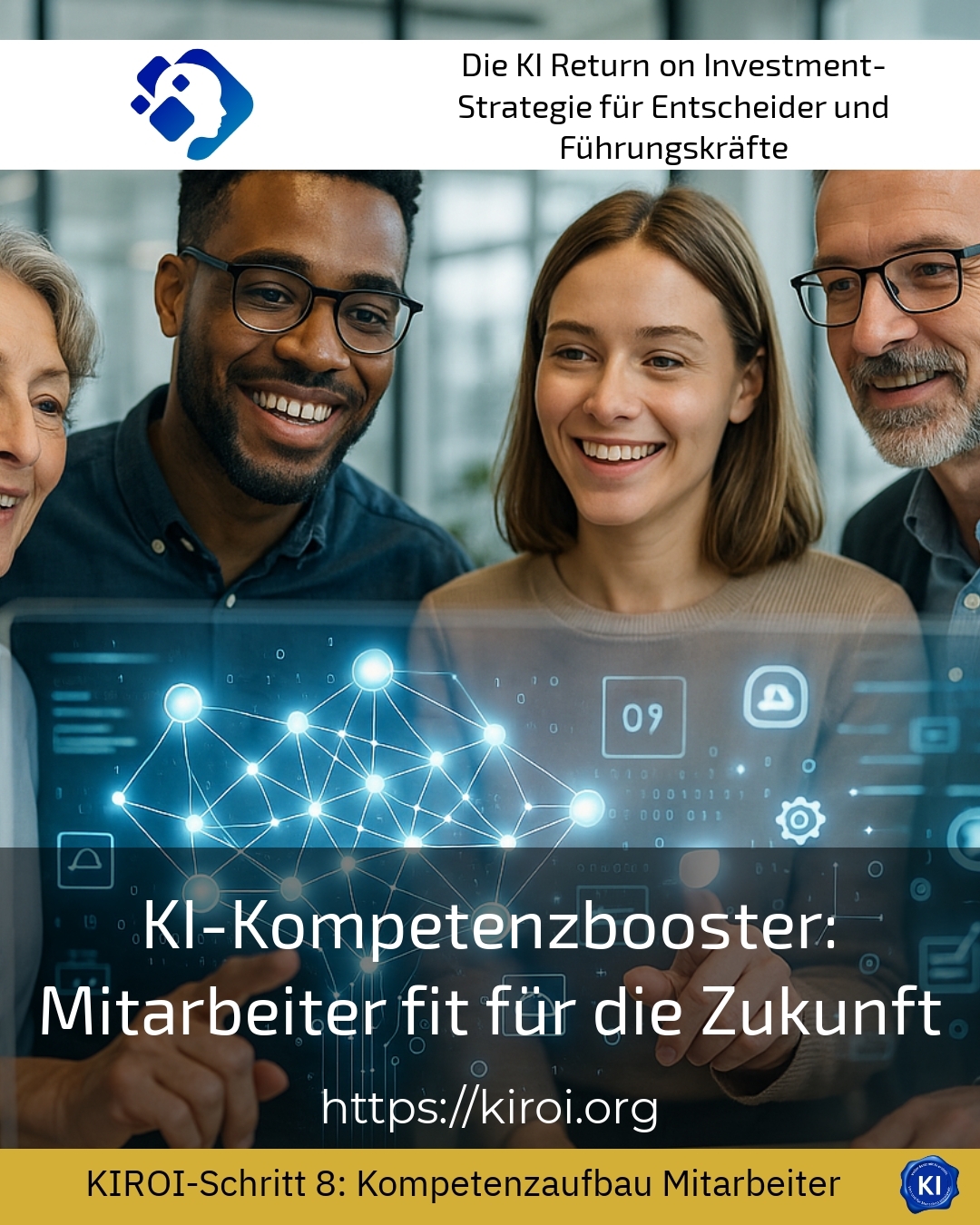
Digital transformation is fundamentally changing our working world and presenting companies with entirely new challenges. Those who don't act today risk losing out tomorrow. AI Skills Booster: Staff Fit for the Future is therefore becoming the decisive success factor for organisations of all sizes. But how can teams be systematically prepared for the new requirements? Which skills are actually needed and how can they be imparted sustainably? These questions concern managers and HR professionals alike, because they know that technological investments alone are not enough. The human factor remains the key to success, and that is precisely why the topic of skills development deserves the highest attention.
Why the AI Skills Booster Has Become Indispensable
The pace of technological change repeatedly surprises even experienced industry experts. Intelligent systems are taking over tasks that only a few years ago were exclusively reserved for human specialists. At the same time, entirely new fields of activity are emerging that require special competences and are fundamentally changing traditional job profiles. In manufacturing companies, for instance, intelligent algorithms are automating quality control and detecting errors faster than human inspectors. Logistics companies are optimising their routes with the help of real-time data analysis, thereby saving considerable resources. Financial service providers are relying on automated risk analyses that can identify patterns in large volumes of data. These examples demonstrate that almost every sector can benefit from intelligent technologies.
Clients often report uncertainty when dealing with new technologies and a certain overwhelm given the multitude of possibilities. Many employees feel insufficiently prepared and wish for structured support in developing new skills. Transruption Coaching supports companies with precisely these challenges and provides important impetus for shaping learning processes. The support covers both strategic aspects and practical implementation issues, so that organisations can benefit holistically.
Best practice with a AIROI customer
A medium-sized mechanical engineering company faced the challenge of preparing its workforce for the integration of intelligent systems. Management recognised early on that technological investments would not yield the desired success without corresponding skills development. Together with AIROI, the company developed a multi-stage training programme that involved all hierarchical levels. Initially, we analysed the current skill level and identified critical gaps in various departments. Subsequently, we designed tailor-made learning modules that imparted both theoretical knowledge and practical application scenarios. Production employees learned to collaborate with intelligent assistance systems and to critically evaluate their recommendations. Managers received training on the strategic integration of new technologies into existing business processes. After six months of intensive support, the company recorded a significant increase in acceptance and usage intensity. The initial scepticism of many employees gave way to constructive curiosity and a willingness to experiment. The participants particularly appreciated the practical approach and the opportunity to apply what they had learned immediately.
Core competencies for the digital world of work tomorrow
Employee requirements are changing rapidly, necessitating a rethink of corporate training. While technical understanding forms an important foundation, it is not sufficient on its own for sustainable success. Critical thinking is gaining enormous importance because intelligent systems deliver results that people must evaluate and categorise [1]. For example, a sales employee should understand why an algorithm makes certain customer recommendations and be able to question these suggestions. An HR manager must be able to assess whether automated pre-selections are genuinely identifying suitable candidates or if there are systematic biases.
Communication skills also remain indispensable and are even gaining relevance in technology-driven work environments. Collaboration between humans and machines requires new forms of interaction and coordination. Teams must learn to communicate technical findings comprehensibly and make decisions together. In healthcare, doctors increasingly collaborate with diagnostic support systems and must discuss findings with patients. Architects use generative design tools and must be able to explain their suggestions in client discussions. Lawyers rely on automated document analysis and must be able to contextualise and interpret the results.
The AI Skills Booster as a Strategic Instrument
Successful companies view competence development not as a one-off measure, but as a continuous process. They create frameworks that enable lifelong learning and foster a culture of openness to change. The AI competence booster: preparing employees for the future requires a systematic approach and clear responsibilities. Managers play a central role as role models and must demonstrate a willingness to learn themselves. They should create space for experimentation and view mistakes as learning opportunities.
In the insurance sector, progressive companies are already implementing innovative learning formats with considerable success [2]. Customer service employees are training in the use of intelligent chatbots and learning to handle complex queries. Claims adjusters are working with image recognition systems and need to be able to validate their assessments. Underwriters are using data-driven risk models and require a deep understanding of the underlying methodologies. These examples demonstrate that industry-specific adaptations are crucial for learning success.
Practical implementation strategies for organisations
The implementation of effective qualification programmes begins with an honest assessment of existing competencies. Companies should first analyse which skills are already present and where there is a need for development. It is important to include all groups of employees and consider their specific needs. A craft business has different requirements than a software company or a hospital. The qualification measures must therefore be individually tailored and take industry-specific characteristics into account.
Transruptions-Coaching supports organisations in developing tailored learning concepts and accompanies their implementation over extended periods. The support includes regular reflection discussions and adjustments based on collected experiences. Clients often report that external support helps them to recognise blind spots and adopt new perspectives. Within the retail sector, for example, companies benefit from intelligent inventory management systems and automated price optimisation. Employees need to understand how these systems work and when human intervention is sensible. Branch managers require competencies in interpreting sales data and strategic product range planning.
Best practice with a AIROI customer
A logistics company with several hundred employees wanted to modernise its dispatch operations and introduce intelligent route-planning systems. The existing dispatchers had decades of experience and initially had reservations about the new technology. They feared that their expertise might be devalued and that their jobs were at risk. AIROI supported the company in designing a participatory implementation process that took their concerns seriously. We organised workshops where the dispatchers could contribute their experiential knowledge and were actively involved in system configuration. The company recognised that the implicit knowledge of experienced employees was essential for fine-tuning the system. The dispatchers became experts in human-machine collaboration and took on mentor roles for younger colleagues. They learned to critically question the system and make manual adjustments when necessary. This combination of algorithmic optimisation and human expertise led to better results than either solution alone. The initial scepticism transformed into pride in their own role in the modernised work process.
Employees fit for the future through personalised learning paths
Standardised training programmes often reach their limits because they do not sufficiently consider individual prior knowledge and learning styles. Modern qualification approaches therefore focus on personalised learning paths that are oriented towards the needs of individual employees. Adaptive learning systems analyse progress and dynamically adjust content [3]. An accountant with a technical affinity needs different learning content than a colleague who is encountering digital tools for the first time.
In the banking sector, institutions are experimenting with innovative qualification formats and gaining valuable experience. Customer advisors are practising how to handle and explain automated investment recommendations in simulated conversations. Compliance officers are learning to interpret suspicious transaction patterns identified by monitoring systems. Credit analysts are deepening their understanding of data-driven credit checks and their limitations. These industry-specific examples highlight the diversity of application areas and qualification requirements.
Cultural change as the basis for sustainable competence development
Technical training alone is not enough to successfully lead organisations into the digital future. A fundamental cultural change is needed, establishing learning as a natural part of the daily work routine. Leaders must create spaces where experimentation is permitted and mistakes are understood as learning opportunities. A corporate culture that promotes curiosity and rewards knowledge sharing forms the foundation for sustainable competence development. In the pharmaceutical industry, researchers are increasingly collaborating with intelligent systems that support drug discovery. Laboratory technicians use automated analysis equipment and must be able to interpret its results. Quality managers rely on predictive maintenance systems and learn to deal with probabilistic statements.
The AI Skills Booster: Getting employees fit for the future also requires a rethink by managers regarding their own roles. They are increasingly becoming learning facilitators and enablers rather than purely controlling authorities. This change in role requires new skills and the willingness to question familiar patterns of behaviour. Transruption coaching provides important impetus and supports managers in their personal development.
My AIROI Analysis
The systematic development of competencies for the digital working world presents one of the biggest challenges for organisations. My experience from numerous support projects shows that technical training alone rarely leads to the desired success. Rather, a holistic approach is needed that considers cultural, organisational, and individual factors equally. Companies that invest early in the development of their employees gain sustainable competitive advantages and increase their adaptability to future changes.
Organisations that actively involve their employees in transformation processes and value their expertise are particularly successful. The combination of technological possibilities and human experience often achieves better results than purely automated solutions. Leaders play a key role as role models and enablers of learning processes. They must themselves demonstrate a willingness to learn and create a culture that promotes openness to new ideas.
Guidance from experienced partners can make the difference between superficial qualification and sustainable competence development. External perspectives help to identify blind spots and adapt best practices from other industries. At the same time, it is important to consider industry-specific peculiarities and to adapt solutions individually. Ultimately, success depends on whether learning can be established as a natural part of everyday work and continuously adapted to changing requirements.
Further links from the text above:
[1] McKinsey: The State of AI
[2] World Economic Forum: Future of Jobs Report
[3] Gartner: Future of Work Trends
For more information and if you have any questions, please contact Contact us or read more blog posts on the topic Artificial intelligence here.







 Deutsch
  English (UK)