
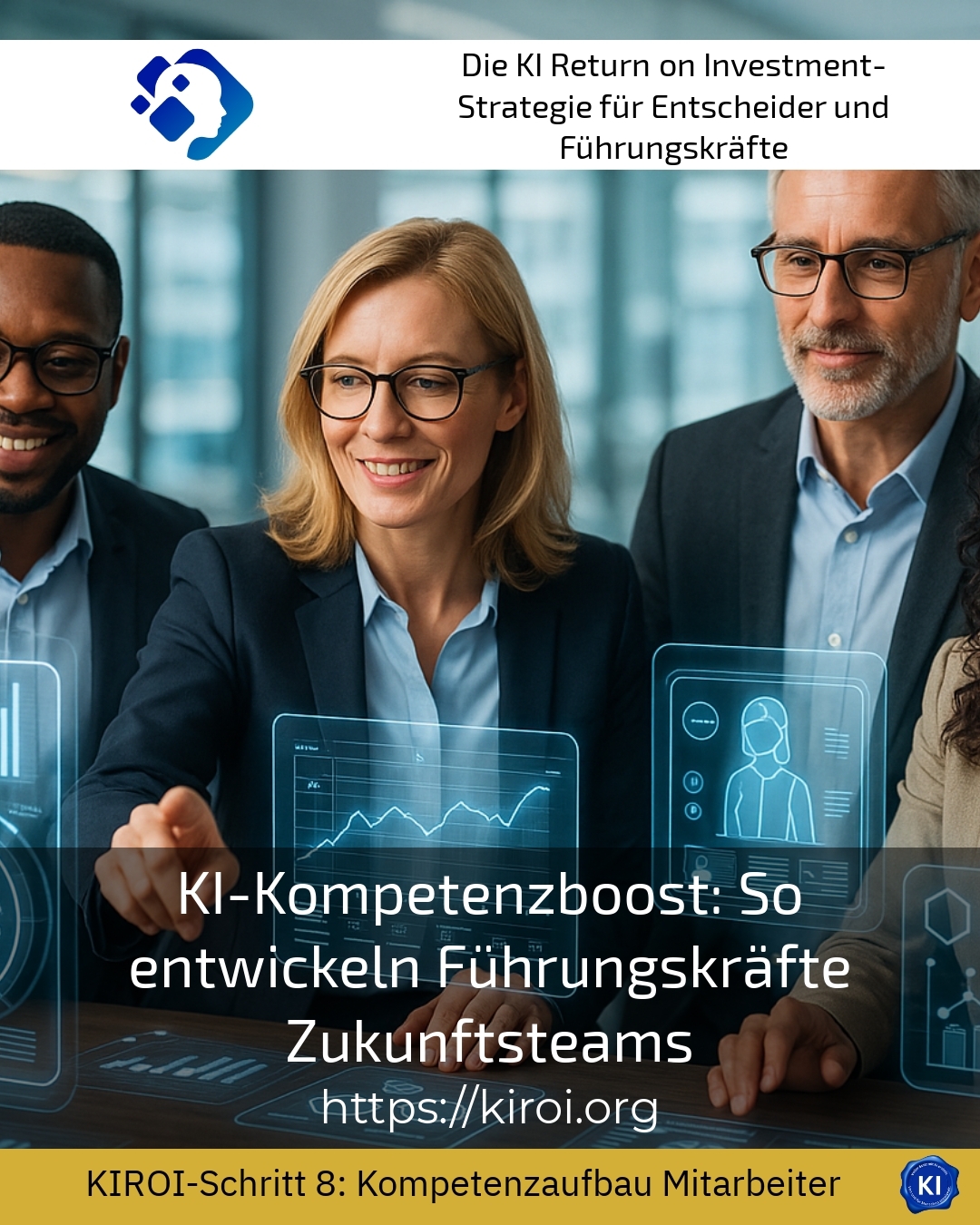
The future of the world of work is already knocking at the door. Managers face the challenge of making their teams fit for the digital age. The AI Skill Boost: How Leaders Develop Future Teams This is not an empty promise, but a tangible strategy. Many responsible individuals wonder how they can actively shape the transformation. The answer lies in the systematic development of skills and mindsets. This is not just about technical knowledge. Rather, the focus is on the connection between people and technology. In this article, you will learn which concrete steps lead to success. You will receive practical examples and proven methods. Furthermore, we will show you how transruption coaching can support the process.
Understanding the new reality of the world of work
The world of work is changing faster than ever before. Automated processes are increasingly taking over repetitive tasks. This creates new demands on human competencies. Leaders must not only observe this development. They must actively shape it and prepare their teams for it. In a medium-sized mechanical engineering company, department heads have started introducing weekly learning circles. These circles promote the exchange of ideas about new technologies and their applications. A logistics company has gradually introduced its warehouse staff to intelligent systems. Employees now confidently operate complex control software. In an insurance company, teams have learned to interpret data analyses independently. They now make informed decisions based on automatically processed information.
Change requires a new attitude towards transformation. Employees who previously performed routine tasks are developing into creative problem-solvers. However, this transformation does not happen by itself. It needs conscious leadership and clear structures. Leaders who successfully shape change create spaces for experimentation. They allow for mistakes and foster a culture of continuous learning. A retail group has established so-called innovation labs. There, employees test new tools in a protected environment. The results then flow into everyday work.
AI Skills Boost: How Leaders Develop Future Teams Through Systematic Learning
Systematic learning forms the foundation for sustainable skills development. It is not enough to offer one-off training sessions. Instead, a well-thought-out concept is needed that combines various learning formats. A manufacturing company has established a mentoring programme that pairs experienced employees with newcomers. The mentors pass on their knowledge of digital tools in a practical way. In a financial services company, teams regularly attend microlearning sessions. These short, fifteen-minute units focus on imparting new skills. An energy provider relies on simulation-based training. Employees practise complex scenarios there before working in the live system.
The selection of the correct learning content is crucial. Leaders should define which competencies are needed together with their teams. This participative approach increases acceptance and motivation. In a pharmaceutical company, teams developed learning paths themselves. They identified knowledge gaps and suggested suitable formats. The manager moderated the process and provided resources. This approach strengthens employees' self-responsibility. They feel like active contributors to their professional development.
Best practice with a KIROI customer
A medium-sized manufacturing company faced the challenge of preparing its workforce for new technologies. Management recognised that traditional training formats were insufficient to achieve the necessary skill development. In collaboration with transruptions-coaching, a comprehensive development programme was designed, integrating various learning levels. Initially, the consultants analysed the current skill levels of all departments. Based on this analysis, individual development plans were created for each employee. Management received special coaching to effectively guide their teams through the change. The establishment of peer-learning groups, where employees learned from one another, was particularly valuable. After six months, evaluation results showed a significantly increased acceptance of technology. Employees frequently reported a greater confidence in using digital tools. The productivity of individual departments improved measurably. Management is now planning to expand the programme to further locations. The close support from transruptions-coaching proved to be a crucial success factor for this transformation project.
Using practical tools for everyday leadership
Leaders need concrete tools for their daily work. Abstract concepts alone are not enough to implement change. A proven tool is the skills matrix, which visualises their development level. In a consulting firm, team leaders use this matrix for development discussions. They identify strengths and development areas together with employees. A telecommunications provider relies on digital skills portfolios. Employees document their acquired skills and certificates there. In a healthcare company, skills champions have been appointed. These employees are points of contact for specific subject areas and support colleagues.
Another important tool is regular reflection sessions. Here, teams discuss experiences with new ways of working and technologies. These sessions create space for open exchange and joint learning. A car parts supplier has introduced weekly reflection meetings that last only twenty minutes. The short duration promotes focus on essential insights. The results are documented and made accessible to other teams. This creates an organisation-wide knowledge pool that grows continuously.
The role of the manager as a development facilitator
Modern leadership is more than just giving instructions and controlling. Leaders are becoming development coaches who foster their employees' potential. This change in role requires new skills and a different attitude. In a chemical company, leaders have completed coaching training. They now conduct regular development discussions that go beyond traditional employee reviews. A media company has introduced the concept of servant leadership. Here, leaders see themselves as enablers who remove obstacles. In a construction company, leaders are measured by the development of their teams. This metric is incorporated into the annual performance review.
The AI Skill Boost: How Leaders Develop Future Teams This only works with authentic role models. Leaders must learn and develop themselves. They should speak openly about their own learning processes and challenges. This transparency creates psychological safety within the team. Employees are then more likely to dare to ask questions and admit mistakes. A retail company encouraged its leaders to share their learning journeys in internal blogs. The response was extremely positive and inspired many employees. The resulting learning culture reinforces itself through such initiatives.
Boost AI competence through individual support
Not every employee learns in the same way or at the same pace. Individual support takes different learning types and starting situations into account. A software company offers various learning formats that employees can choose from. Some prefer video training, others practical workshops or one-to-one coaching. An industrial company has introduced learning buddies who support colleagues with their learning. This informal support lowers inhibitions and promotes exchange. In a service company, employees receive personal learning budgets. They decide for themselves which further training they wish to attend.
Transruption coaching can offer valuable insights and guide the process. External coaches bring fresh perspectives and proven methods. They support leaders in fulfilling their role as development facilitators. Clients often report breakthroughs after intensive coaching sessions. The combination of strategic planning and personal development makes the difference. Coaches also help to understand resistance and deal with it constructively. This ability is particularly valuable during times of profound change.
Best practice with a KIROI customer
An international services group wanted to prepare its executives for the demands of digital transformation. The challenge was to reach over two hundred executives in various countries. Transruptions Coaching developed a hybrid programme that combined in-person workshops with virtual coaching sessions. Each executive first received an individual assessment of their digital competencies. Based on this, personal development plans with concrete milestones were created. The executives met monthly in virtual learning groups to exchange experiences. Accompanying individual coaching sessions supported them with specific challenges. After one year, participants reported significantly increased confidence in dealing with new technologies. Many had begun passing on what they had learned to their own teams. The group observed a measurable improvement in the innovation capacity of the involved departments. The executives became multipliers of change within the organisation. The programme received an award as an exemplary case of executive development. The long-term support provided by transruptions Coaching ensured the sustainable success of the project.
Cultural change as the basis for sustainable development
Skills development alone is not enough. It must be embedded in a comprehensive cultural change. Only when the corporate culture fosters learning and development will measures have their full impact. A technology company has established learning time as a fixed part of working hours. Employees are allowed to use twenty percent of their time for further training. A consumer goods company celebrates learning successes publicly on internal communication channels. This appreciation motivates and inspires other employees. A transport company has established a 'fail culture' that learns from setbacks. Regular retrospectives analyse what can be improved.
Cultural change begins with the leaders themselves. Their behaviour shapes the norms and values of the organisation. If leaders demonstrate curiosity and a willingness to learn, employees will follow their example. One financial company has developed leadership guidelines that explicitly describe behaviour conducive to learning. Leaders are regularly surveyed on how well they are implementing these guidelines. The results are incorporated into development programmes. This creates a continuous improvement process at all levels of the organisation.
Measurable results through structured evaluation
Investments in skills development must deliver measurable results. Structured evaluation helps to assess the success of measures. An industrial company has defined key figures that map skills progress. These are regularly collected and presented in management reports. A retail company conducts before-and-after surveys with all training participants. The results show which formats are particularly effective. In an IT company, learning successes are correlated with business results. This allows the return on investment of development measures to be demonstrated.
Qualitative methods meaningfully supplement quantitative measurements. Interviews and focus groups capture the experiences and assessments of those involved. These insights provide valuable pointers for the further development of programmes. A healthcare provider uses storytelling to document development successes. Employees share how they apply new competencies in their daily work. These stories are shared internally and inspire others. The combination of different evaluation methods provides a comprehensive picture of development progress.
My KIROI Analysis
Developing future teams is one of the most important tasks for modern leaders. My analysis shows that successful transformations rest on several pillars. Firstly, a clear understanding of changing requirements is needed. Leaders must know which skills will be in demand in the future. Secondly, systematic learning is indispensable. One-off training sessions are not enough to bring about sustainable change. Thirdly, corporate culture plays a crucial role. People can only develop their potential in a learning-conducive environment.
My experience shows that individual guidance makes the difference. Transruption coaching can support leaders in successfully guiding their teams through change. The combination of strategic planning and personal development creates a sustainable impact. I often observe that organisations underestimate the cultural aspect. Technology alone does not change working methods; it requires a changed mindset. AI Skill Boost: How Leaders Develop Future Teams is best achieved through a combination of different approaches.
Leaders should be pioneers of learning themselves. Through their behaviour, they shape the development culture of their teams. Investing in their own competence development pays off multiple times over. External support from experienced coaches can provide valuable impulses. The examples presented show that successful transformations are possible. It requires commitment, perseverance, and the willingness to break new ground. The future belongs to those organisations that invest in their people. This investment is not an expense, but a strategic necessity.
Further links from the text above:
[1] McKinsey – Future of Work
[2] World Economic Forum – Artificial Intelligence
[3] Harvard Business Review – Leadership
[4] Gartner – Future of Work Trends
For more information and if you have any questions, please contact Contact us or read more blog posts on the topic Artificial intelligence here.






 Deutsch
  English (UK)