
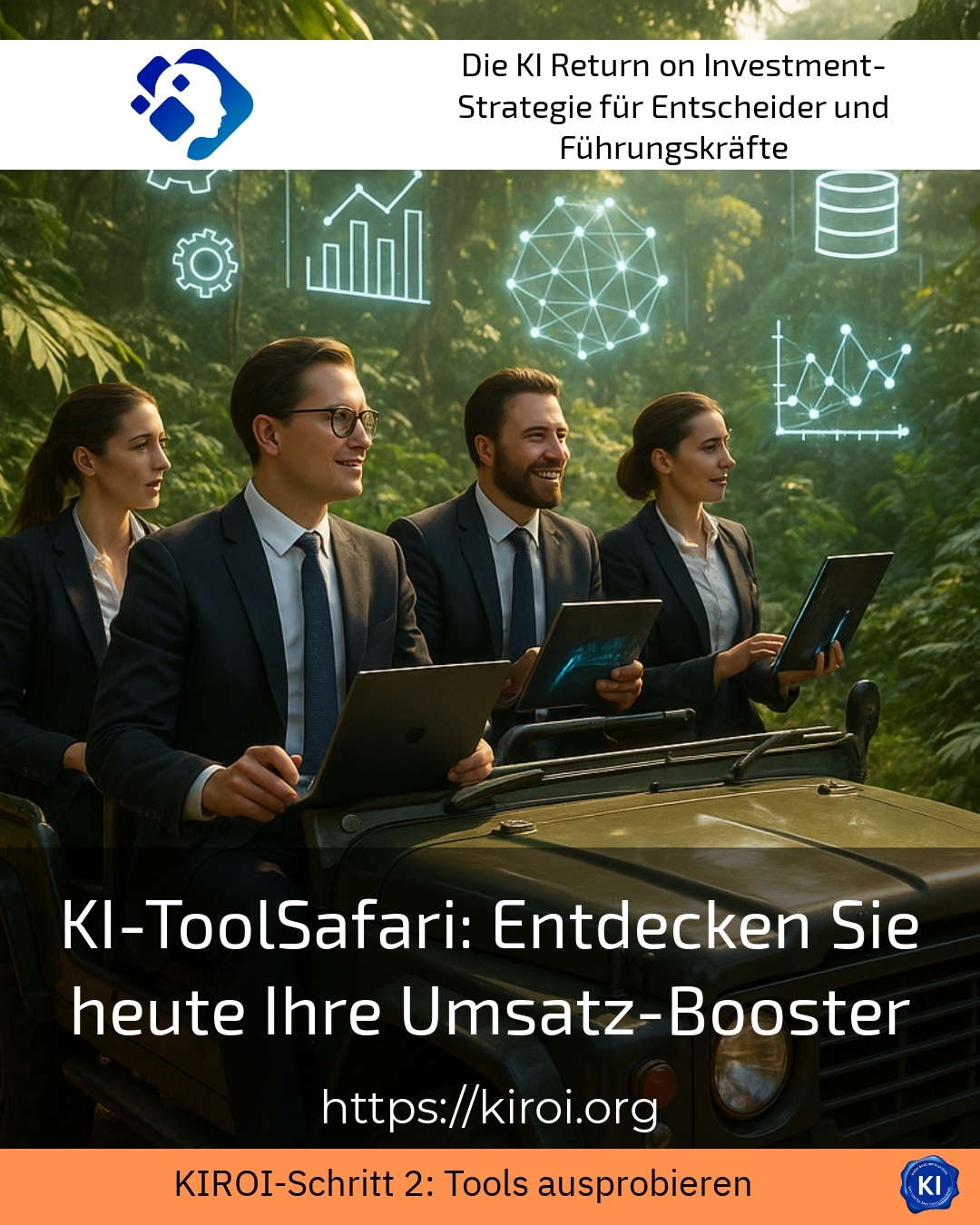
Imagine being able to roam through a digital jungle full of intelligent tools, discovering precisely the solutions that will take your revenue to the next level. That's exactly what an AI Tool Safari enables you to do: discover your revenue boosters today by systematically exploring the diverse possibilities that modern technologies hold for your business. Many entrepreneurs today face the challenge of filtering out the truly relevant tools from an overwhelming abundance of digital aids. Clients often report feeling overwhelmed and lost. This article guides you on a structured expedition through the landscape of intelligent technologies, showing you how to sustainably improve your business results with the right impulses.
The strategic importance of a systematic AI tool safari for modern businesses
In an era where digital transformation is no longer just a buzzword but an existential necessity, the targeted selection of technological tools takes on a whole new dimension. Companies that still rely on traditional methods today risk falling behind their competitors. At the same time, blindly experimenting with every available solution leads to wasted resources and frustration for all involved. Therefore, a structured approach that considers both technical possibilities and individual business requirements is recommended.
Let's first take a closer look at the area of customer analysis and target group addressing. Intelligent systems can today recognise behavioural patterns that would remain hidden to human analysts. For example, a retail company uses such tools to precisely predict purchase probabilities and generate personalised offers. A service provider in the financial sector uses similar technologies to anticipate customer needs and proactively offer solutions. In healthcare too, analytical systems support better coordination of patient flows and more efficient use of resources [1].
Best practice with a AIROI customer
A medium-sized company in the technical services sector faced the challenge of fundamentally modernising its sales processes. The previous approach was based on manual data analysis and the gut feeling of experienced employees. Within the framework of a guided analysis, we jointly identified several tools that met the company's specific requirements. First, we implemented a system for automated lead qualification, which prioritised incoming enquiries based on their probability of success. Subsequently, we integrated a tool for call analysis, which provided sales representatives with concrete suggestions for improvement after each customer contact. The results positively surprised even the most sceptical team members. Within six months, the conversion rate increased by a remarkable forty percent, while at the same time, the average processing time per lead decreased by a third. Particularly valuable was the realisation that technology did not replace human expertise, but rather meaningfully complemented and strengthened it. The *transruptions*-coaching accompanied the entire change process and helped the team overcome resistance and establish new ways of working.
Discovering sales boosters in content and communication
The way companies communicate with their target audience has fundamentally changed. Modern tools now enable a level of personalisation that seemed unthinkable just a few years ago. For example, a media company uses intelligent systems to tailor news content individually to the interests of each reader. An e-commerce provider uses similar technologies to automatically adapt product descriptions to different customer segments. In the education sector, such tools help to individualise learning materials and demonstrably increase learning success [2].
The quality of the generated content has reached a level that genuinely impresses professional copywriters. However, practice shows that the best results arise when human creativity and machine efficiency work together. Clients often report that they initially had exaggerated expectations of fully automated solutions. After a realistic assessment of the possibilities and limitations, a productive collaboration between humans and machines then emerges.
Practical tools for daily communication work
In everyday life, solutions that can be seamlessly integrated into existing workflows prove particularly effective. For example, an insurance company implemented a system for automatically answering frequent customer queries, with more complex issues still being forwarded to human advisors. A tour operator uses intelligent tools to generate personalised travel suggestions, thereby increasing booking rates. A software company employs relevant technologies to automatically translate technical documentation into multiple languages while maintaining technical accuracy [3].
On the AI Tool Safari: Discover your revenue boosters today by looking closely at which tools fit your specific communication needs. Not every solution is suitable for every business, and careful evaluation of different options will save you time and resources in the long run.
Process optimisation and efficiency improvement through intelligent automation
Beyond the obvious application areas, the greatest potentials often lie dormant in the optimisation of internal processes. Many companies underestimate how much time and energy is tied up by repetitive tasks that could at least be partially automated. For example, a logistics company reduced its fuel consumption by fifteen percent through the use of intelligent route planning. A recruitment agency significantly accelerated its application process through automated pre-selection, without compromising the quality of decisions. A manufacturing company implemented a predictive maintenance system that virtually eliminated unplanned machine downtime [4].
Best practice with a AIROI customer
A long-established family business in the manufacturing sector approached us with the aim of securing its competitiveness through technological modernisation, without fundamentally changing its corporate culture. Management had already had some negative experiences with overly ambitious digitalisation projects that had failed due to a lack of employee acceptance. Together, we developed a phased approach that began with small, quickly visible successes, thereby building trust in the new technologies. The first step was the introduction of an intelligent ordering system that automated recurring material procurement and identified supply bottlenecks early on. We then implemented a quality control system that performed high-speed, high-precision optical inspections. Employees experienced how technology took over tedious routine tasks and created time for more valuable activities. Transruptions coaching accompanied every implementation step and helped to alleviate fears and generate enthusiasm for the new possibilities. After one year, those in charge reported significantly improved productivity and a surprisingly positive atmosphere in the company.
The right balance between automation and human expertise
A key insight from many consulting projects is that full automation should rarely be the goal. Instead, it’s about optimally combining the respective strengths of humans and machines. For example, one consulting firm uses intelligent tools for data analysis, while the strategic interpretation and recommendations continue to come from experienced consultants. An architecture firm uses generative systems to quickly create various design options, with human expertise required for creative selection and refinement. A law firm accelerates document review with technological support, but keeps the legal assessment in human hands [5].
AI Tool Safari in practice: Approach systematically and profit sustainably
The success of a systematic exploration of available tools depends significantly on the approach taken. Firstly, an honest assessment of current processes and their associated pain points is recommended. Many companies approach the task with the desire to increase their revenue without first analysing exactly where the biggest leverage points lie. In transruption coaching, we therefore first work on a clear definition of goals before collectively evaluating suitable technological solutions.
The choice of the right tools then follows several criteria that go beyond pure functionality. How well can the solution be integrated into existing systems? What amount of training is required for the employees? How flexibly can the tool be adapted to changing requirements? For example, a retail company deliberately opted against the most feature-rich system on the market because the simpler alternative could be implemented more quickly and found greater acceptance within the team. An engineering firm, on the other hand, chose the more complex solution because the specific requirements allowed for no compromises. A catering business found its ideal partner in a specialised industry solution that more general tools could not offer [6].
Measurable successes and continuous optimisation
Anyone embarking on an AI tool safari should define clear success criteria from the outset. Only then can it be objectively assessed later whether the investment in new tools delivers the expected results. For example, a telecommunications company set the reduction of average processing time per customer request as a target metric and achieved it within a few weeks. An online retailer focused on increasing the average shopping cart value and saw a twenty percent increase through personalised recommendations. A consulting firm measured success by the time consultants could dedicate to value-adding customer discussions and noted a doubling [7].
The optimisation never ends, as both the available tools and business requirements are constantly evolving. Regular reviews and adjustments are therefore part of a professional approach to technological solutions. Clients often report that it is precisely this continuous support that makes the decisive difference.
My AIROI Analysis
After intensive consideration of the diverse possibilities offered by intelligent tools today, a clear picture is emerging. The biggest mistake companies can make is either complete restraint or uncritical activism. Both extremes lead to suboptimal results and waste valuable potential. The wise middle ground consists of a systematic yet open approach that aligns technological possibilities with business requirements.
Experience from numerous consulting projects shows that the human factor is often underestimated. Even the most powerful tools only reach their full potential when the people in the company can understand, accept, and use them competently. Therefore, I strongly recommend always combining technological implementations with professional change management.
Transruption coaching has proven to be a valuable support that goes beyond mere tool selection. It addresses the deeper questions of corporate culture, leadership, and individual development, which are crucial for sustainable success. Those who are willing to adopt this holistic perspective will be able to reap the rewards of their technological investments much more quickly and comprehensively. The journey through the digital toolbox is worthwhile for everyone who is ready to move forward with open eyes and a clear mind.
Further links from the text above:
[1] McKinsey: The Economic Potential of Generative AI
[2] Harvard Business Review: Artificial Intelligence Insights
[3] Gartner: Artificial Intelligence Research and Insights
[4] Forbes: Artificial Intelligence Coverage
[5] IDC: AI Everywhere Research Programme
[6] PwC: Artificial Intelligence Global Analysis
[7] Accenture: Artificial Intelligence Research
For more information and if you have any questions, please contact Contact us or read more blog posts on the topic Artificial intelligence here.











 Deutsch
  English (UK)