
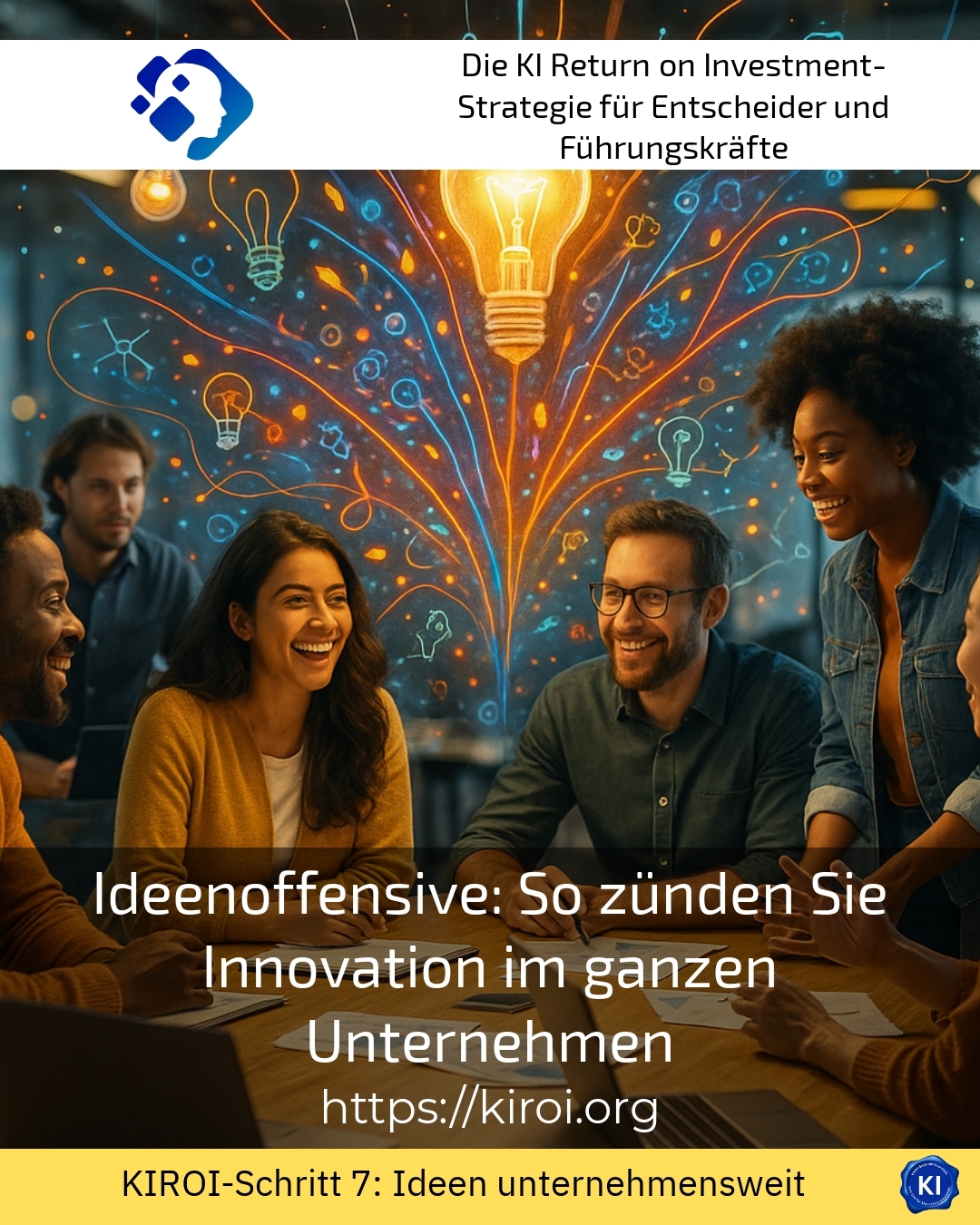
Have you ever wondered why some companies seemingly effortlessly produce one ground-breaking innovation after the other, while others tread water despite enormous efforts? The answer often lies in a systematically planned Innovation Offensive: How to Ignite Innovation Throughout the Company – an approach that unleashes creative energies and empowers all employees to become active shapers of the future. At a time when markets are changing rapidly and technological breakthroughs can render entire business models obsolete overnight, the ability to continuously reinvent oneself is becoming the decisive competitive advantage. It is no longer just a matter of maintaining a research and development department that works away in isolation. Rather, organisations must learn to activate the collective potential of all employees and channel it productively.
Why traditional structures hinder creative breakthrough
Many organisations have spent decades building structures that prioritise efficiency and predictability. This orientation made complete sense in stable markets and has helped numerous companies achieve sustained success. However, these very same structures often act today like invisible barriers that stifle the free flow of ideas and creative impulses. Rigid hierarchies mean that bottom-up proposals peter out before they ever reach the decision-making level. Departmental silos prevent the cross-fertilisation of ideas between different disciplines and perspectives. For instance, clients frequently report that promising approaches get lost in the thicket of bureaucratic processes.
For example, a manufacturing company in the engineering sector realised that its engineers developed brilliant technical solutions. However, these never reached sales or marketing because no communication channels existed between the departments. A financial services provider discovered that its client advisers gathered valuable insights into changing customer needs on a daily basis. Yet this information did not feed into product development because formal reporting channels were lacking. A retail company, in turn, noticed that employees on the front line of sales developed innovative selling concepts. Head office only found out about this when a competitor successfully implemented similar ideas.
Best practice with a AIROI customer
A medium-sized technology company with around 800 employees approached transruptions coaching with a specific challenge. The management team had recognised that, despite a highly qualified workforce, barely any new product ideas were being generated. During the support process, it emerged that a strictly hierarchical approval system was stifling every creative impulse. Employees had to complete a multi-page application for even the smallest proposal and route it through several levels. The average processing time was four months, and the rejection rate was over 85 percent. Together, we developed a completely new system based on rapid experimentation and iterative improvements. Smaller budgets were approved directly, without having to go through lengthy approval processes. Larger projects were first given a test phase before decisions were made on further investments. Within eight months, the number of submitted proposals increased sevenfold. Three of these ideas resulted in market-ready products that now make a significant contribution to revenue.
The Ideas Offensive: How to ignite innovation through cultural transformation
A successful Ideas offensive doesn't start with new processes or tools, but with a fundamental shift in company culture. Employees need to feel that their contributions are valued and can actually make a difference. This conviction doesn't arise from lip service by management, but through concrete, visible action. Leaders must model that they are open to new approaches and ready to question established practices. They must create spaces where creative thinking is not only permitted, but actively encouraged.
A pharmaceutical company established so-called „experimentation Fridays“, where teams were allowed to pursue their own projects. An automotive supplier set up cross-departmental creative circles that met regularly. An energy supplier introduced a mentoring programme in which experienced managers supported younger talent in implementing their ideas. All these measures sent a clear signal: creativity and personal initiative are valued and encouraged here.
Transruptions coaching specifically supports organisations in developing bespoke cultural programmes. These take into account the specific circumstances, historical background and strategic goals of the respective company. This is because a standardised off-the-shelf solution rarely meets the complex demands of modern organisations.
Psychological safety as the foundation for creative development
Research findings clearly show that psychological safety represents a key prerequisite for top-tier creative performance [1]. People only contribute their best ideas when they do not have to fear negative consequences. They need to dare to express unconventional thoughts without fear of ridicule or career disadvantages. This requires an atmosphere of mutual respect and appreciation for diverse perspectives.
An insurance group began celebrating mistakes as learning opportunities instead of punishing them. A logistics company established anonymous idea platforms where critical suggestions could also be made. A telecommunications provider systematically trained its managers in appreciative communication and constructive feedback. These measures helped to reduce anxieties and strengthen the willingness for open communication.
Practical methods for a sustainable ideation offensive
The transformation of the corporate culture forms the foundation, but on its own it is not enough. Organisations additionally require concrete methods and structures that channel the flow of ideas and direct them into productive paths. These tools must suit the respective organisation and cannot simply be copied. Nevertheless, there are proven approaches that have proven helpful in various contexts.
Design thinking workshops make it possible to view complex problems from the users' perspective. This often results in surprising approaches to solutions that break through conventional thinking. A medical technology company used this method to develop a revolutionary patient monitoring system. A consumer goods manufacturer identified unoccupied market niches through design thinking. A construction company used this method to find ways to significantly accelerate construction processes [2].
Agile working methods such as Scrum or Kanban enable rapid iterations and continuous improvements. They break down large projects into manageable units and allow for early feedback. A software developer reports that through agile methods, their team was able to halve the time-to-market. A retail company uses sprints to test new store concepts in record time. A tourism provider develops innovative travel formats in close coordination with customers using agile approaches.
Best practice with a AIROI customer
A traditional family-owned business in the food industry was looking for ways to strengthen its capacity for innovation. The owners had recognised that consumer habits were changing rapidly and new competitors were entering the market. As part of our collaboration with transruptions-Coaching, we implemented a multi-stage innovation programme. First, we conducted company-wide workshops in which employees at all levels were able to contribute their observations and ideas. This resulted in over 200 concrete proposals, which we categorised and prioritised together. The most promising approaches received dedicated resources and budgets for implementation. Particularly successful was a proposal from production that led to an entirely new product line. An employee had observed that leftover quantities of certain raw materials regularly had to be disposed of. His idea to transform these into a premium product was a hit and now generates significant additional revenue. This example impressively demonstrates the potential that lies dormant in the minds of employees when they are given the space to develop.
Digital tools to support the ideas offensive
Modern technologies can significantly accelerate and democratise the innovation process. Idea management platforms make it possible to centrally collect, evaluate and further develop suggestions [3]. Collaboration tools promote cross-departmental exchange and joint work on projects. Analytical tools help to recognise trends and identify potentials at an early stage.
A chemical company uses an internal platform where employees worldwide can submit ideas. A fashion retailer relies on virtual collaboration spaces where designers from different locations create together. An industrial group uses artificial intelligence to automatically derive potential areas for improvement from customer feedback. These digital tools complement personal interaction and significantly expand the radius of possible collaboration.
Leaders as catalysts of the idea offensive: How to ignite innovation through role modelling
The success of any transformation initiative depends significantly on the behaviour of leaders. Through their decisions and daily actions, they shape the culture of the company. When leaders themselves dare to experiment and speak openly about their own failures, they encourage others to do the same. If, on the other hand, they avoid risks and defend established practices, they signal that change is unwelcome.
A bank board member made a habit of spending one day a month in various branches. There, he listened to the employees and personally received their suggestions for improvement. A female managing director of a medium-sized company regularly presented failed projects in town hall meetings and explained the lessons learned from them. A divisional head of a technology corporation set up monthly „idea consultation hours“ in which every employee had direct access to him.
These examples illustrate how leaders can drive cultural change through concrete action. They provide impetus that goes far beyond formal programmes and processes. They create a climate in which creative engagement is taken for granted.
My AIROI Analysis
From my experience across numerous advisory projects, several key success factors emerge that make the difference between successful and failing transformation initiatives. First of all, the seriousness of the commitment at the highest level is crucial. If the managing directors or the executive board do not make the issue a personal priority, all subsequent efforts will come to nothing. Employees have a keen sense of whether change rhetoric is meant seriously or merely serves external positioning.
Secondly, it consistently transpires that patience and persistence are required. Cultural transformation does not happen overnight, but rather demands continuous attention over a period of years. Setbacks are inevitable in this process and should be regarded as part of the learning curve. Organisations that give up after initial difficulties forfeit the potential that only unfolds in the medium term.
Thirdly, it has proven effective to make successes visible and celebrate them. When employees experience that their ideas are actually implemented and make a difference, a positive dynamic is created. These experiences of success are infectious and motivate others to become active as well. They provide proof that commitment pays off and change is possible.
Fourthly, I recommend considering external support if internal resources or expertise are insufficient. An impartial external perspective can uncover blind spots and provide new impetus. It also helps to break through entrenched patterns and bring a breath of fresh air into ingrained structures. transruptions coaching offers precisely this support and accompanies organisations on their path towards a sustainable innovation culture.
Further links from the text above:
[1] Harvard Business Review: Psychological Safety in Teams
[2] IDEO Design Thinking resources
[3] Gartner: Innovation Management Definition
For more information and if you have any questions, please contact Contact us or read more blog posts on the topic Artificial intelligence here.










 Deutsch
  English (UK)