
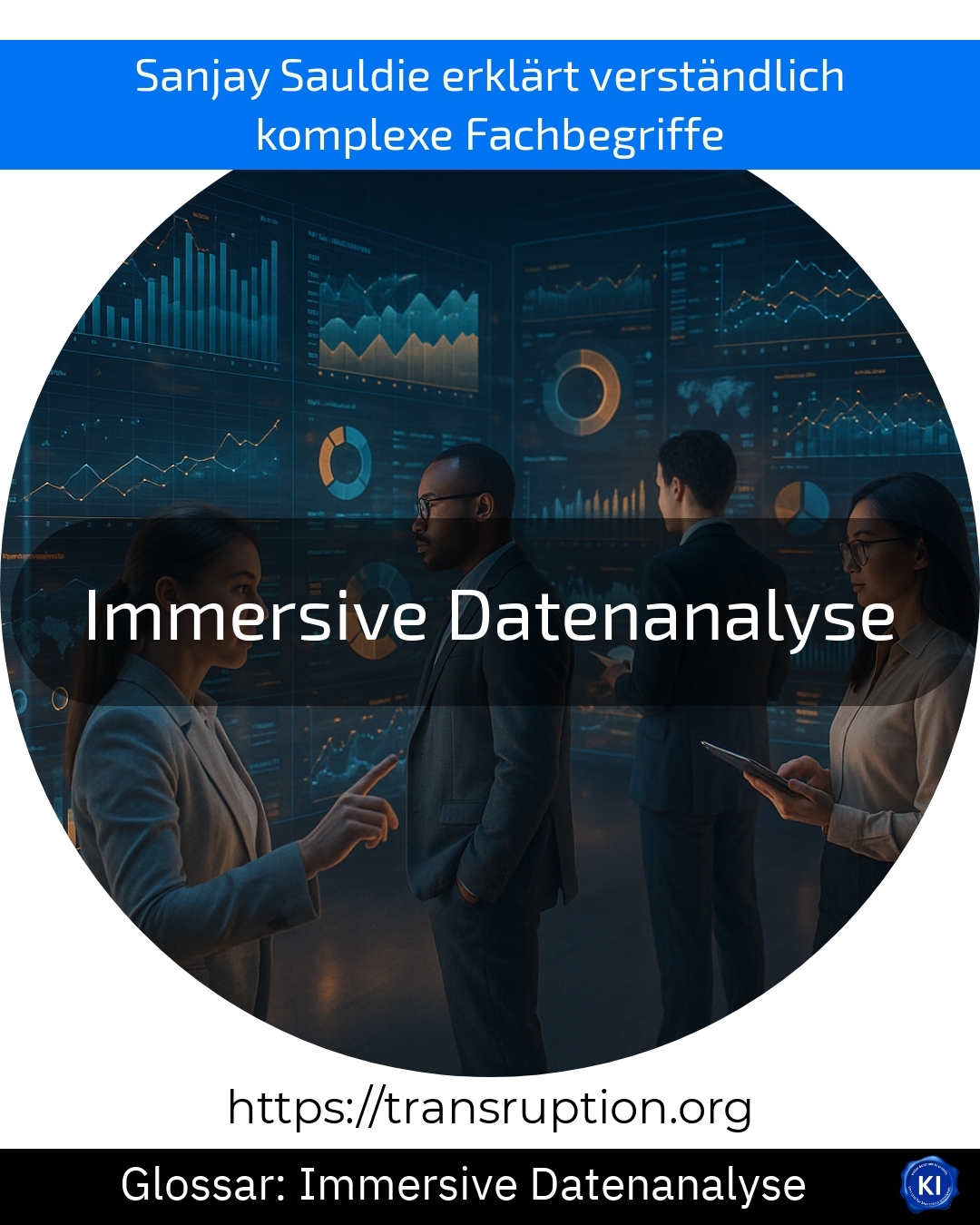
Immersive data analysis finds its place primarily in the categories of Big Data and Smart Data, Artificial Intelligence, and Virtual and Augmented Reality. The term describes a new, particularly vivid form of data analysis, in which data can be experienced three-dimensionally using modern technology such as Virtual Reality (VR) or Augmented Reality (AR).
Instead of just seeing numbers and graphics on a screen, users can immerse themselves in virtual data worlds. This allows large and complex datasets to be grasped and understood much more intuitively. With specially developed glasses or projection systems, users move through interactive diagrams, recognise trends better and can grasp correlations more easily.
A vivid example: In a manufacturing company, management wants to identify bottlenecks in the supply chain. Using immersive data analysis, the team can experience the entire process as a navigable, virtual 3D landscape. This makes delayed deliveries, production stoppages, or unreliable suppliers immediately visible. Decisions can thus be made significantly faster and with more confidence.
Immersive data analysis consequently offers companies an innovative way not just to see data, but to truly understand it.











 Deutsch
  English (UK)