
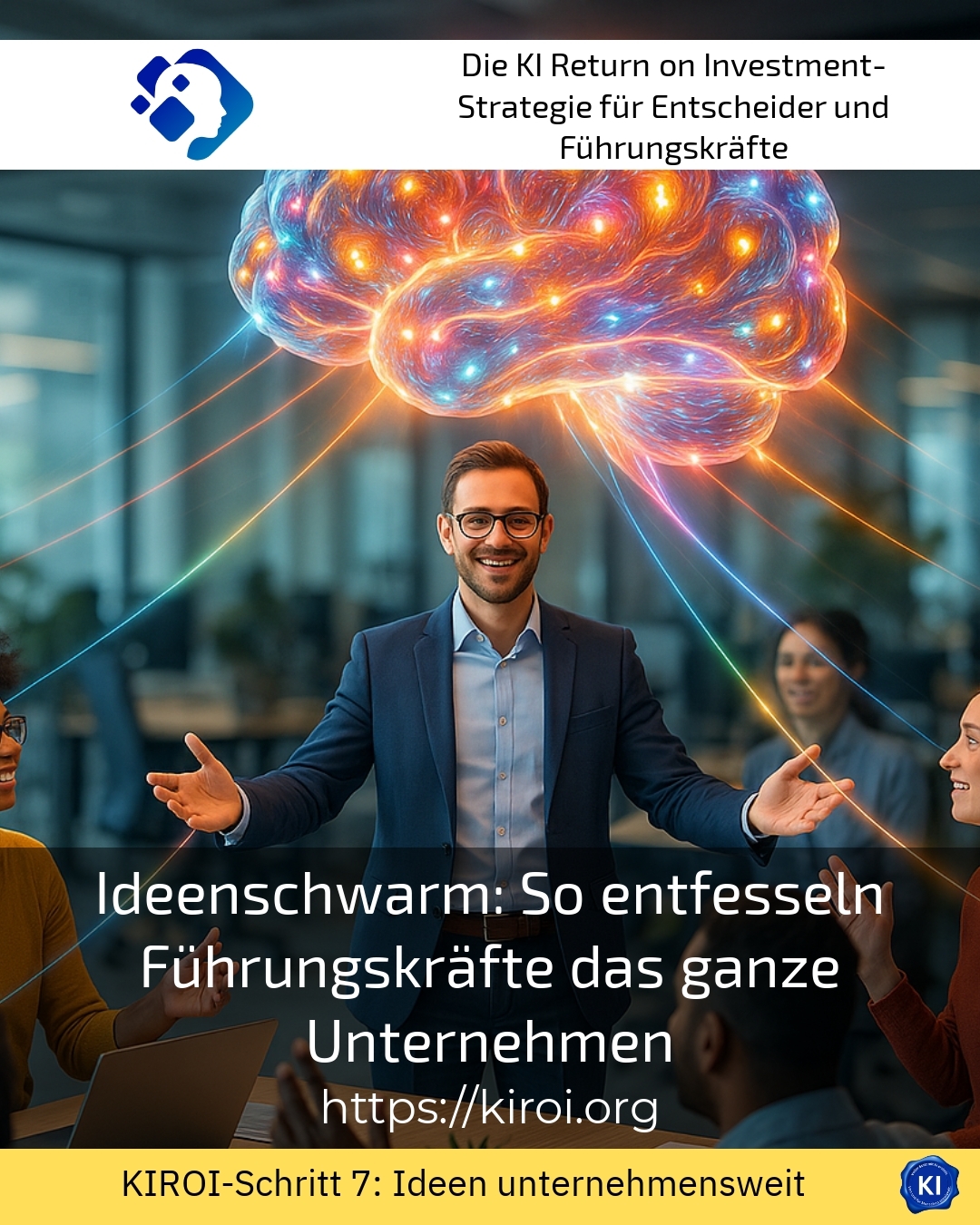
What if you came into the office tomorrow morning and there were hundreds of brilliant improvement suggestions waiting for you, coming directly from the people who experience and shape your processes day in, day out? The Idea-seekers It describes exactly this phenomenon, where collective intelligence is unleashed in companies as soon as leaders create the right framework conditions and abandon hierarchical thinking. Many decision-makers underestimate the creative potential that lurks within their teams and is waiting to be awakened. transruptions coaching accompanies organizations precisely during this transformation, because the path from traditional top-down management to a participatory innovation culture requires not only new methods but also a fundamentally changed attitude towards the valuable knowledge of all employees.
Why traditional hierarchies block creative energy
In many companies, the perception still exists that good ideas must come exclusively from the top management and that employees merely serve as implementing forces. This mindset stems from a time when information flows were slow and expertise was concentrated in a few individuals. Today, however, employees possess expertise that supervisors often cannot possess at all because they do not work on the front lines on a daily basis. A production worker recognizes inefficiencies in processes that remain hidden from an department manager. A customer consultant understands needs that no market research can capture so precisely. If management does not actively tap into these sources of insight, they are squandering valuable potential that competitors may have already exploited long ago.
The consequences of such blockages often only become apparent with delay, but then all the more clearly in the form of declining employee motivation, increased turnover and missed market opportunities. Employees who repeatedly experience that their suggestions are ignored or rejected withdraw internally and no longer contribute. According to studies, this phenomenon of internal resignation affects a significant portion of the workforce and costs companies enormous sums of money annually [1]. The Idea-seekers On the other hand, it re-activates precisely these withdrawn employees by giving them a real voice and the opportunity to shape things themselves.
For example, a medium-sized machine manufacturer realized that its engineers were technically brilliant but provided little impetus for process optimization. After an analysis, it emerged that previous proposals had always been bogged down in bureaucratic processes. The introduction of weekly innovation rounds fundamentally changed the situation. A automotive supplier observed a similar situation with its quality inspectors, who documented defects daily but were never asked about the causes. A logistics company, in turn, discovered that drivers had recognized optimization potential in routes for years, which no one had systematically captured.
Best practice with a AIROI customer
A manufacturing company in the industrial components sector turned to transruptive coaching because the rate of innovation had stagnated for years despite a highly skilled workforce. The analysis showed that there existed a highly hierarchical communication pattern in which ideas had to go through multiple approval stages. Together we developed a system that enabled employees to submit suggestions directly and transparently. Within six months, over three hundred concrete improvement ideas were submitted, a significant portion of which was implemented. Production costs decreased measurably, while employee satisfaction significantly increased. Particularly noteworthy was that many of the ideas came from long-time employees who had previously been considered unmotivated. These individuals simply stopped contributing because their contributions had never been acknowledged. The project vividly illustrated how quickly wasted creativity can be unleashed when the conditions are right and leadership demonstrates genuine interest.
The ideational swarm as a catalyst for sustainable change
The term “swarm” originally originated in biology and describes the fascinating phenomenon that groups of individuals act more intelligently together than each individual member acting alone. Fish swarms navigate complex waters, bee colonies make collective optimal decisions, and ant colonies solve logistical challenges that even the most advanced algorithms can only approximate. These principles can be applied to organizations when leaders understand that their role must shift from that of the all-knowing decision-maker to that of the enabling coordinator.
In practical business practice, this initially means creating safe spaces where employees can express their thoughts without fear of negative consequences. Clients often report that even well-intentioned idea management systems fail because employees fear being disliked or labeled as troublemakers due to critical comments. Creating this psychological safety takes time, consistency, and above all an authentic example by the leadership level.
For example, one pharmaceutical company implemented anonymous idea channels that were initially used sparingly. Only when management began publicly praising and implementing critical suggestions did participation noticeably increase. A financial services provider, however, relied on complete transparency and experienced similar positive effects. A retail company combined both approaches and allowed employees to decide for themselves whether to contribute anonymously or on a personal basis.
Concrete methods for activating the idea swarm
Practical implementation often begins with structured formats that create regular opportunities for idea exchange and consciously dismantle hierarchical barriers. So-called reverse mentoring programs, where younger or lower-ranking executives advise senior leaders, can provide valuable insights and at the same time promote mutual understanding. Design thinking workshops bring different departments together and often generate surprising solutions that would never have emerged in traditional silo thinking.
One telecommunications provider introduced monthly innovation cafes where employees of all levels worked together on current challenges. One energy provider used digital platforms to involve employees working remotely and to leverage their local knowledge. One insurance company established hackathons where mixed teams developed prototypes for new services within a few days.
The Idea-seekers However, its full effect is not realized until the collected suggestions actually make their way into the company’s reality and employees experience that their commitment bears fruit. Nothing demotivates more than the feeling of being left in the dark and receiving no response whatsoever. Therefore, when coaching transruptions, we always recommend installing transparent feedback loops that recognize every contribution and communicate how to proceed with it.
Re-defining leadership roles in the age of collective intelligence
Perhaps the biggest challenge in establishing participatory innovation cultures lies in the transformation of leadership itself. Many managers have learned that their position is based on superior knowledge and decision-making skills. Suddenly, if all employees are to be treated as equal contributors of ideas, this can raise existential questions and create resistance. This is where coaching comes in, helping leaders reinterpret their role and recognize its value in enabling rather than controlling.
A chemical company accompanied its executives with intensive workshops that initially focused on self-reflection and then on the dissemination of methods. A media company invested in individual coaching sessions because resistance at the personal level was too deep. A construction company chose the path of pilot projects that initially only involved interested executives and later served as best-practice examples.
Best practice with a AIROI customer
A senior executive from a technology company came to transruptive coaching with the goal of making their department more innovative without jeopardizing their own position. This ambivalent situation is typical and deserves open recognition, because change always also creates uncertainty. Together, we first developed a new understanding of leadership that defined strength not as omniscience but as the ability to bring together diverse perspectives. The person began to regularly share their own uncertainties and open questions within the team, which initially triggered irritation but then led to a palpable openness. Employees also began to express incomplete ideas because they experienced that this was not a weakness. The department’s rate of innovation increased significantly within a year, and other executives became aware of the changed atmosphere as well. The example vividly demonstrates how individual courageous steps can trigger chain reactions that go far beyond the original intent.
Support the idea swarm with technology
Digital tools can significantly facilitate the collection, evaluation, and implementation of employee ideas, provided they are not misunderstood as a substitute for genuine human interaction and neglect the interpersonal dimension of innovation. Modern platforms enable the capture of suggestions, their evaluation by the workforce, and the transparent tracking of their implementation status. Artificial intelligence can help identify patterns and cluster similar ideas, allowing for synergies to emerge and avoiding duplication of effort [2].
A consumer goods manufacturer implemented an app through which employees could submit observations and improvement suggestions at any time, which was particularly valuable for field workers. A healthcare provider used gamification elements to increase participation while simultaneously enabling playful competitions between departments. A retail company relied on integration into existing communication systems to avoid additional hurdles and maximize the barrier of entry.
My AIROI Analysis
The observations from numerous accompanying projects clearly show that the Idea-seekers It does not represent an abstract concept, but can be concretely experienced in organizations that are seriously committed to change. The key success factors lie less in the choice of the right methods or technologies than in the authentic attitude of the leadership level and their willingness to share power and relinquish control. Companies that take this step often report surprising side effects such as increased employee engagement, improved employer branding, and a noticeably more positive overall atmosphere in the entire organization.
At the same time, the challenges cannot be underestimated, because cultural changes require time, patience, and the ability to perceive setbacks as learning opportunities. Not every idea is feasible, not every proposal is meaningful, and leaders must learn to communicate rejection in a way that values the contribution of those involved without damaging the motivation of those involved. transruptions coaching accompanies these processes with the knowledge that sustainable transformation never proceeds linearly but is always characterized by loops, detours, and occasional setbacks. However, the investment in collective intelligence pays off in the long run because it creates organizations that are more adaptable, resilient, and ultimately more human than their hierarchically rigid competitors.
Further links from the text above:
[1] Gallup Workplace Engagement Studies
[2] Harvard Business Review – Innovation Topics
For more information and if you have any questions, please contact Contact us or read more blog posts on the topic Artificial intelligence here.










 Deutsch
  English (UK)