
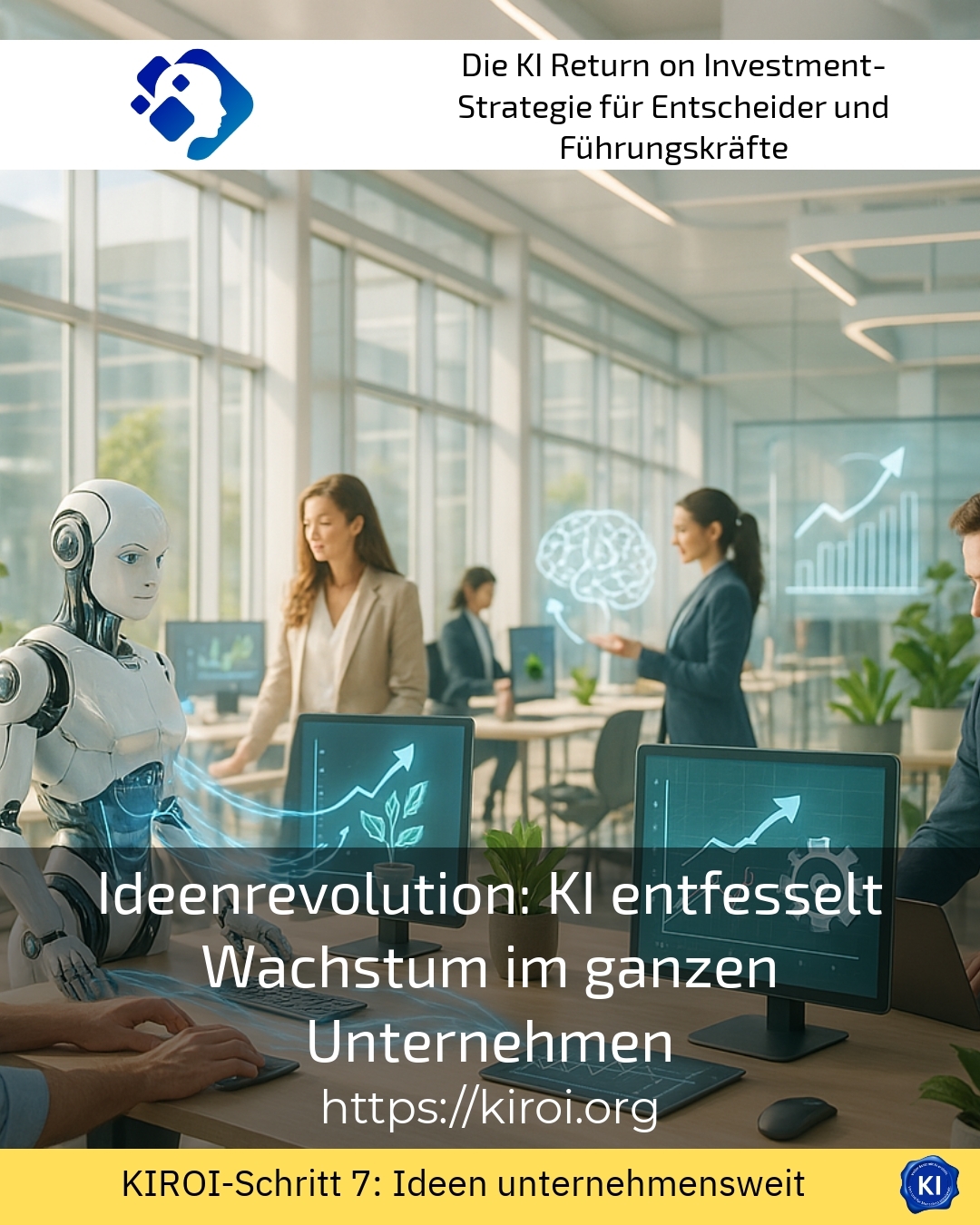
Imagine if every department in your company could simultaneously generate innovations that transform the entire business model. The Ideas Revolution: AI Unleashes Growth Across the Entire Company is no longer a vision of the future, but a tangible reality that is already bearing fruit in numerous organisations today, creating competitive advantages that many leaders have only dreamed of until now. In a time when traditional methods of idea generation and process optimisation are reaching their limits, intelligent systems are opening up entirely new horizons for sustainable growth and genuine transformation. What does this mean for your company in concrete terms, and how can you harness this development for yourself?
The transformation begins in the small
Many businesses initially underestimate the far-reaching impact of algorithmic support in their daily operations. However, practical reports repeatedly show that even small adjustments can have a significant effect. Clients often report how initial pilot projects quickly led to comprehensive changes. For example, a medium-sized company in the manufacturing sector implemented an intelligent system for quality control. Within a few months, the error rate improved significantly. At the same time, employees gained time for more creative tasks. A retail company used similar technologies to optimise its warehouse management. The results exceeded all expectations of the management. Such examples illustrate how broad the range of applications has become.
The Ideas Revolution: AI Unleashes Growth Across the Entire Company manifests itself particularly clearly in the way teams collaborate and solve problems. Instead of hours of meetings, analysis tools can prepare relevant data. Decision-makers are therefore provided with a solid basis for their resolutions. Creative processes are supported by automated research. This leaves more room for strategic thinking. A service company used intelligent assistants for customer communication. Satisfaction levels increased measurably. At the same time, service employees were able to handle more complex requests personally. This synergy between humans and technology creates sustainable added value.
Best practice with a KIROI customer
An internationally active company in the consumer goods sector approached us with the challenge of fundamentally modernising its innovation processes. The previous methods of idea generation were lengthy and often led to results that missed the market demand. As part of transruption coaching, we intensively supported the project team over several months in introducing intelligent analysis tools. First, we jointly identified the relevant data sources that had previously remained unused. We then developed a strategy for integrating this information into the product development process. Employees received training on how to effectively use the new tools. It was particularly important to convey an understanding of the possibilities and limitations of the technology. Following implementation, the teams reported significantly increased efficiency in concept development. Ideas could be validated more quickly and brought to market readiness. Collaboration between different departments noticeably improved because everyone could access the same data basis. The company was able to significantly shorten its time-to-market while simultaneously increasing the accuracy of its product innovations. [1]
How the idea revolution overcomes departmental boundaries
Traditionally, company departments often worked in isolation from each other. Marketing, sales, production, and finance pursued their own objectives. These silo structures significantly hindered the flow of information. Today, networked systems enable a seamless exchange of relevant insights. For example, a car parts supplier linked its production data with sales forecasts. This allowed capacities to be planned proactively. A pharmaceutical company used similar networking between research and clinical trials. The results flowed more quickly into the further development of active ingredients. Impressive use cases are also emerging in the financial sector. Banks combine customer data with risk analyses for better credit decisions.
However, overcoming departmental boundaries requires more than just technical solutions. Cultural changes play an equally important role. Staff must be willing to share knowledge. Leaders should actively promote and lead by example in fostering this openness. A telecommunications company introduced regular cross-departmental workshops. These brought together insights from different perspectives. The intelligent systems supported this by providing prompts for new questions. An energy provider established similar formats for its innovation teams. The feedback from the workforce was consistently positive. Such approaches demonstrate that technology and human collaboration go hand in hand.
Growth through intelligent process optimisation
The Ideas Revolution: AI Unleashes Growth Across the Entire Company is particularly impressively demonstrated in the optimisation of existing processes. Many organisations underestimate the potential that lies dormant in their daily routines. Intelligent analysis tools can identify patterns that remain hidden to human observers. A logistics company optimised its route planning using learning algorithms. This measurably reduced fuel consumption. A retailer dynamically adjusted its order quantities to demand forecasts. Overstocks were reduced while availability increased. An insurance group automated parts of its claims processing. Processing times were significantly shortened.
However, process optimisation does not mean making human work redundant. Rather, it is about relieving employees of repetitive tasks. This allows them to concentrate on value-adding activities. A mechanical engineering company reported increased employee satisfaction after the introduction of intelligent assistance systems. The workforce was able to focus more strongly on complex problem-solving. A media company used automated tools for content analysis, which gave editors more time for in-depth research. There are also numerous examples in the healthcare sector of successful staff relief.
Best practice with a KIROI customer
A medium-sized manufacturing company sought support in digitising its production processes. The management had realised that traditional optimisation methods had reached their limits. During transruption coaching, we jointly developed a structured roadmap for the transformation. First, we analysed the existing processes and identified areas with the greatest potential for improvement. We placed particular emphasis on involving the employees, as their expert knowledge was indispensable for success. The implementation was carried out step by step to avoid overwhelming the staff and to facilitate learning. Each phase was carefully evaluated before the next step was taken. The intelligent systems continuously learned from the production data and steadily improved their predictions. After about six months, the first measurable successes became apparent in the form of reduced scrap rates and improved delivery reliability. The employees had overcome their initial scepticism and were actively using the new tools for suggestions for improvement. The company was able to significantly strengthen its competitive position and gained new customers who were convinced by the improved quality and reliability.
Creativity and innovation, reimagined
Contrary to widespread concerns, the use of intelligent systems promotes human creativity. By automating routine tasks, it creates space for innovative thought processes. An architecture firm used generative tools for initial design drafts. This allowed the designers to concentrate on refinement and customisation. An advertising agency employed similar technologies for idea generation processes. The results were surprisingly diverse and inspired the creatives. Companies in the fashion industry are also experimenting with algorithmic support for collection development. The results often speak for themselves.
However, innovation does not arise from technology alone. The human factor remains crucial for success. Empathy, intuition, and experience cannot be automated. A toy manufacturer combined data-based trend analyses with the creativity of experienced designers. The resulting products precisely hit the mark with the target audience. A furniture company followed a similar approach when developing new collections. The combination of market intelligence and craftsmanship proved to be extremely fruitful. Such synergies illustrate the true potential of current developments.
The role of accompaniment and coaching
Many companies face the challenge of successfully managing this transformation. The technical possibilities are available, but the implementation often proves complex. This is where transruption coaching comes in as valuable support. Experienced coaches assist in developing a clear vision for the digital future. They help to constructively address resistance within the company. The introduction of new technologies requires change management at all levels. An industrial company benefited significantly from external support during its transformation. The neutral input helped to break down ingrained patterns of thought. A financial services provider used coaching formats to qualify its managers.
The topics that companies bring to us are diverse. Some are seeking direction in the confusing landscape of technological possibilities. Others wish for support in communicating changes to their teams. Still others need help prioritising their digitisation projects. Transruption coaching positions itself as an experienced companion for all these issues. The Ideas Revolution: AI Unleashes Growth Across the Entire Company can only succeed if people are involved. Technology alone does not create sustainable transformation. The combination of technical expertise and human support makes the difference.
Sustainable growth as a strategic goal
While short-term efficiency gains are important, true transformation aims for long-term growth. Companies that strategically deploy intelligent systems create lasting competitive advantages. One chemical group used data-driven analysis to develop more sustainable production methods. The investment paid off through reduced costs and an improved reputation. A food manufacturer optimised its supply chains from an ecological perspective. Customers rewarded this commitment with increased loyalty. Promising approaches for more resource-efficient working methods are also emerging in the construction sector. [3]
Sustainable growth requires a holistic perspective on corporate transformation. Economic, ecological, and social aspects must be harmonised. Intelligent systems can help to understand complex interrelationships and identify conflicting objectives. A textile company used appropriate tools to optimise its global supply chain. Transparency and traceability improved significantly. An electronics group used similar approaches to develop more durable products. Customers appreciated the improved quality and recommended the brand. Such examples show that technology and sustainability are not mutually exclusive.
My KIROI Analysis
The transformation of companies through intelligent systems is far more than a technological trend. It represents a fundamental shift in how organisations create value and generate growth. My analysis shows that successful companies consider three crucial factors. Firstly, they deploy technology purposefully, rather than implementing tools indiscriminately. Clear alignment with strategic objectives distinguishes successful projects from failed experiments. Secondly, these organisations invest at least as heavily in their people as in their technology. Training, coaching, and change management are not optional extras, but indispensable success factors. Thirdly, leading companies pursue an iterative approach. They start with manageable pilot projects, learn from experience, and scale successful approaches incrementally.
The challenges on this path should not be underestimated. Resistance from the workforce, technical complexity, and unclear responsibilities can jeopardise projects. This is where the value of professional support from experienced coaches and consultants becomes apparent. Transruption coaching offers precisely this support for companies of all sizes and industries. The combination of strategic expertise, technical understanding, and human empathy enables sustainable transformation success. My recommendation is therefore: begin planning your own transformation today. Identify areas with the greatest potential and start with a focused pilot project. Seek external support to avoid pitfalls and benefit from best practices. The future belongs to companies that boldly seize these opportunities.
Further links from the text above:
[1] KIROI-Blog: Practical Examples and Case Studies
[2] Transruption Coaching: Methodology and Approaches
[3] McKinsey Digital Insights: Current studies on digital transformation
For more information and if you have any questions, please contact Contact us or read more blog posts on the topic Artificial intelligence here.











 Deutsch
  English (UK)