
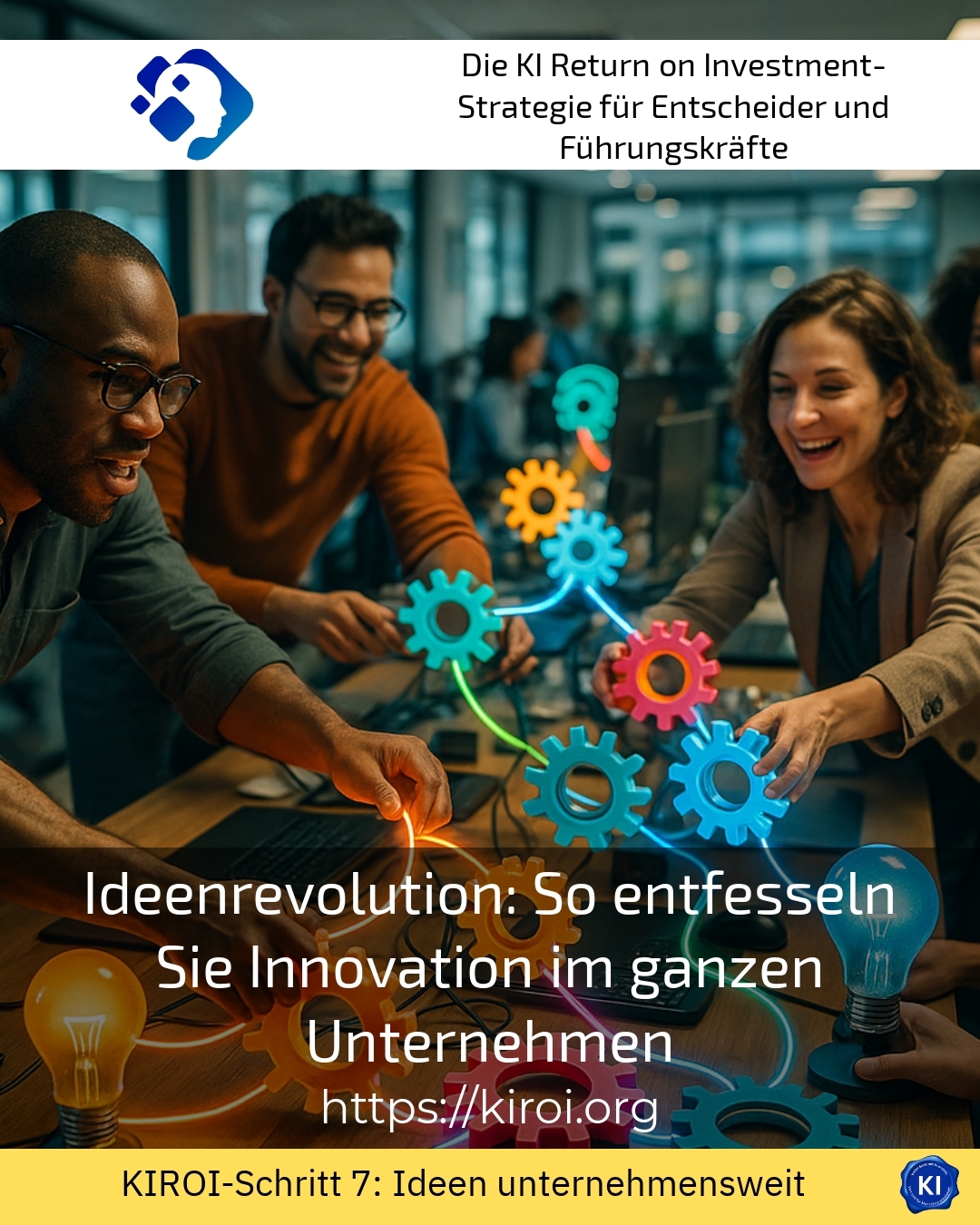
Imagine every single employee in your organisation suddenly transforms into a creative catalyst, developing new solution approaches daily and courageously sharing them with the entire team. The Idea revolution is spreading like wildfire through all departments. Companies today face the enormous challenge not only of keeping pace with technological change, but of actively shaping it. But how can leaders actually unlock these dormant potentials? This is precisely the question we address in the following sections. You will discover which concrete strategies have proven themselves in practice. We will show you paths that often lead to astonishing results.
Understanding the foundations of a sustainable revolution of ideas
Before organisations can even begin to establish creative processes, they must first understand what prerequisites are necessary for them. An open corporate culture forms the fundamental foundation upon which all further measures are built. Employees need psychological safety to be able to express unconventional ideas. This safety does not develop overnight, but rather emerges through consistent leadership behaviour. Leaders should therefore regularly demonstrate that they value dissenting opinions.
This connection is particularly evident in the manufacturing industry. A medium-sized mechanical engineering company introduced weekly idea rounds where production employees could submit suggestions for improvement. The result surprised even the most sceptical management. Within a few months, the error rate decreased by a significant percentage. A logistics company, in turn, established so-called innovation champions who act as a link between the workforce and senior management. These champions systematically collect ideas and guide their implementation. A retail company also experimented with anonymous suggestion boxes. Anonymity considerably lowered the inhibition threshold for critical suggestions.
Best practice with a KIROI customer
A family-run business with a long tradition in manufacturing turned to transruption coaching because its innovative strength had stagnated for years and employees were contributing hardly any new ideas. Together, we first analysed the existing communication structures and identified several barriers hindering creative exchange. Hierarchical structures prevented suggestions from the production floor from even reaching the decision-making level. As part of the support, we developed a multi-stage programme that involved both management and employees. First, we trained department heads in appreciative communication and active listening. Subsequently, we established monthly innovation workshops where mixed, cross-departmental teams worked on specific challenges. Participants often reported a completely new sense of appreciation. After about six months, the company recorded a significant increase in implemented improvement suggestions. Employee satisfaction increased measurably, and the working atmosphere improved noticeably.
Creating structures and processes for the ideas revolution
Creativity requires freedom, but it also thrives on clear structures. This apparent contradiction resolves as soon as companies understand that frameworks and freedom can complement each other. A well-thought-out idea management system forms the backbone for sustainable innovation processes. Such systems should be easily accessible and enable rapid feedback.
Let's consider some insightful examples from various sectors of the economy. A technology company introduced so-called hackathons, where employees were allowed to work on self-selected projects for two days. Several product improvements, which have now become standard offerings, emerged from these events. A service company, in turn, established a digital idea portal where suggestions can be submitted and rated by colleagues. The best ideas receive budget and personnel resources for implementation. An energy provider organised interdisciplinary exchange formats where employees met with experts from completely different fields. These shifts in perspective often sparked unexpected solutions.
Digital tools as catalysts for the revolutionisation of ideas
Digitalisation opens up completely new possibilities for creative exchange within organisations. Collaboration platforms enable teams to work together on concepts, even across geographical boundaries. Artificial intelligence can help to recognise patterns in large volumes of data and derive recommendations for action from them. However, these technical tools should never replace the human factor.
For example, an insurance company uses an AI-supported system that analyses incoming customer enquiries and identifies potential areas for improvement from them [1]. This insight is directly incorporated into product development. A construction company, in turn, relies on virtual reality to give employees the opportunity to test new construction methods in a simulated environment first. A pharmaceutical company established an internal knowledge platform where researchers can share and comment on their findings. The networking of expert knowledge led to several promising research approaches.
Leadership culture as the key to unlocking potential
Without a supportive leadership culture, even the best innovation programmes remain ineffective. Through their behaviour, leaders significantly influence whether employees dare to take creative risks. This starts with a culture of embracing mistakes and extends to recognising commitment. Supervisors who remain curious themselves and demonstrate a willingness to learn act as strong role models.
A car supplier introduced a reverse mentoring programme, where younger employees train experienced managers in digital topics [2]. This role reversal fundamentally changed the dynamics within the company. A media company established so-called "failure celebrations", where teams report on failed projects and learn from them together. The de-stigmatisation of mistakes led to significantly higher willingness to experiment. A financial service provider, in turn, explicitly incorporates innovation performance into managers' performance agreements. This structural integration ensures that the topic remains a permanent priority.
Best practice with a KIROI customer
An international consumer goods group sought guidance on transforming their leadership culture, as hardly any tangible results were being achieved despite extensive investment in innovation programmes. The disruption coaching began with a comprehensive analysis of existing leadership practices, identifying several hindering patterns. Although many leaders verbally expressed openness to new ideas, their actual behaviour sent different signals. Critical questions were often interpreted as rejection, and employees therefore shied away from taking risks. As part of our support, we developed an individual coaching programme for the leadership level, tailored to the organisation's specific challenges. Participants practiced new behaviours in protected spaces and regularly reflected on their impact on others. In parallel, we introduced feedback loops that allowed employees to anonymously share their perceptions of the leadership culture. After about a year, participants frequently reported a noticeably changed atmosphere that offered more scope for creative impulses.
The role of the ideas revolution in talent development
Innovative companies attract and retain talented individuals long-term. This realisation is becoming increasingly significant in the face of a growing shortage of skilled workers. Employees who can contribute their ideas develop a stronger connection to the organisation. They perceive their work as meaningful and remain motivated, even during challenging times.
A telecommunications company established an internal entrepreneurship programme, where employees can develop their own business ideas and implement them with the company's support. Several of these internal startups have since become independent business units. A healthcare provider offers employees, so-called, creative leave periods, during which they are allowed to dedicate themselves entirely to their own projects. The resulting innovations far exceeded expectations. A retail company, in turn, introduced rotation programmes, where employees work in other departments for a few months. These changes in perspective led to numerous cross-departmental improvements.
Recognising and systematically overcoming obstacles
The path to an innovative organisation is rarely straightforward. Resistance can occur at various levels and have different causes. Some employees fear that innovations will jeopardise their jobs. Others have had negative experiences with previous change projects. These concerns deserve serious consideration and should not be dismissed as mere obstruction.
A textile company overcame initial scepticism towards a new idea management system through intensive communication and early successes [3]. Small, quickly implementable improvements demonstrated to the workforce that their contributions actually had an impact. A chemical company trained so-called change agents, who acted as contact persons for uncertain colleagues. These multipliers mediated between management and the workforce. A tourism company, in turn, specifically involved critical voices in pilot projects, as their conviction had a particularly credible effect on others.
My KIROI Analysis
The observations from numerous accompanying projects clearly show that a successful Idea revolution requires far more than the mere introduction of new tools or programmes. Rather, it is a profound cultural shift that demands careful preparation and patient implementation. Organisations that successfully navigate this path are distinguished by several common characteristics, which I identified within my KIROI analysis.
First, they have leaders who understand innovation as a personal mission and embody this attitude on a daily basis. This role-modelling cannot be replaced by even the most sophisticated structure. Furthermore, successful companies create spaces for experimentation where failure is expressly permitted and even encouraged. Idea revolution thrives best where people feel safe enough to share even unfinished thoughts. Furthermore, my analysis shows that sustainable change takes time and cannot be forced through short-term campaigns. Companies should therefore have stamina and accept setbacks as part of the learning process. Finally, I recommend seeking external support, as an unbiased outside perspective often reveals blind spots. Transruption coaching can provide valuable impetus and professionally support the transformation process.
Further links from the text above:
[1] McKinsey Digital Insights on Technology Trends
[2] Harvard Business Review on the topic of Leadership
[3] Gartner Insights on Innovation and Transformation
For more information and if you have any questions, please contact Contact us or read more blog posts on the topic Artificial intelligence here.











 Deutsch
  English (UK)