
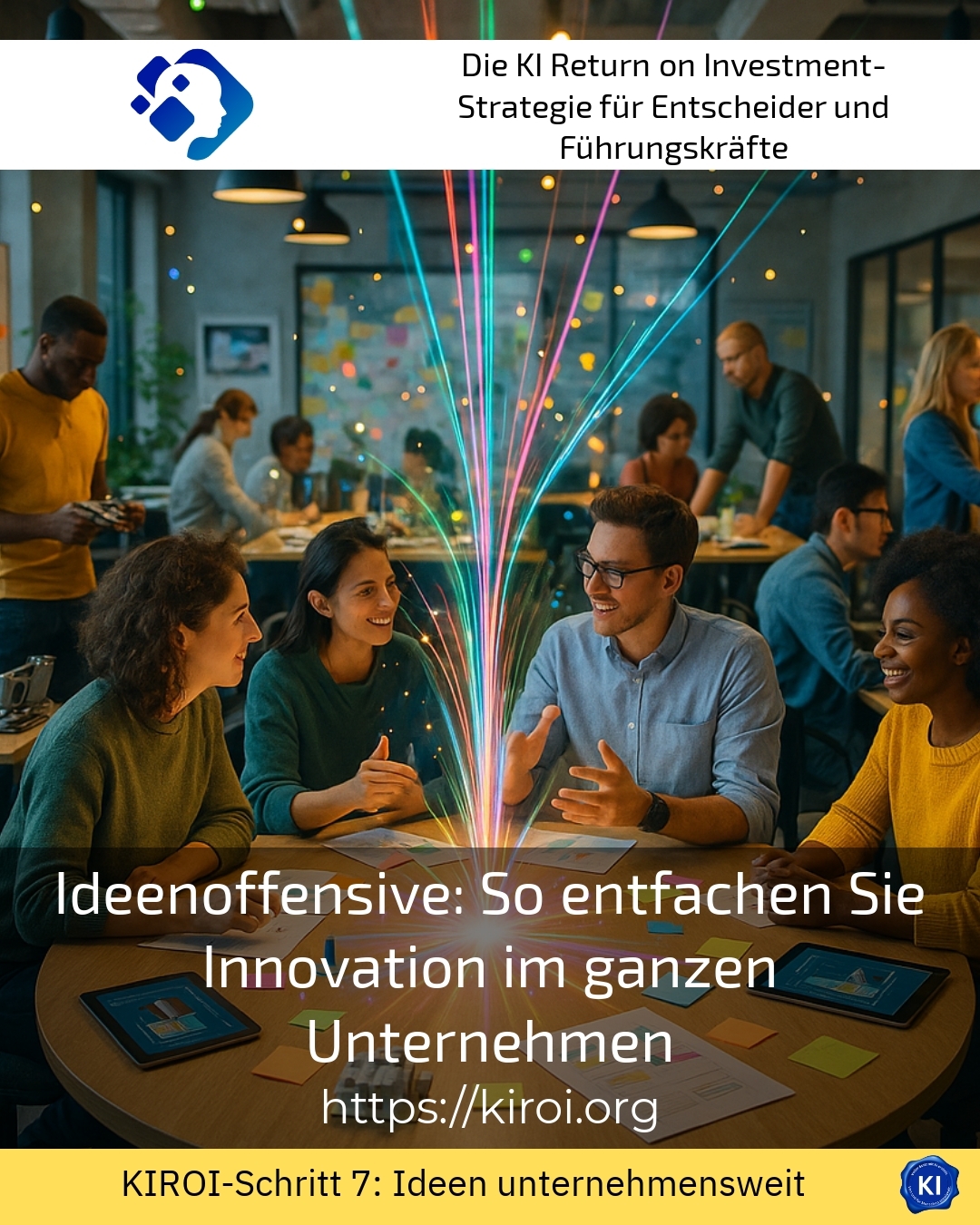
Imagine your employees bursting with creative suggestions and enthusiastically developing new solutions for everyday challenges. This vision appears to be an unattainable dream for many leaders, but with a well-thought-out Ideas offensive You can ignite innovation across the entire organisation. The reality is that untapped potential lies dormant in almost every organisation. Employees observe opportunities for improvement daily but keep them to themselves. Why? Because structures are missing, fears prevail, or simply no one asks for their opinion. This is precisely where a strategic innovation culture comes in, going far beyond sporadic brainstorming sessions and bringing about sustainable change.
Why classic innovation approaches fail
Many companies invest considerable sums in innovation departments and research centres. However, groundbreaking results often fail to materialise. The reason often lies in the isolation of these units from the rest of the business. When innovation is considered solely the task of a few specialists, organisations squander enormous potential. This phenomenon is particularly evident in consulting and coaching firms. While consultants develop innovative concepts for clients, they forget their own transformation. Training providers teach others creativity techniques but rarely apply them internally. This discrepancy undermines credibility and hinders actual growth.
Another obstacle is the so-called "idea trap". Companies enthusiastically collect suggestions but implement very few. Employees find this frustrating and withdraw. In management consulting, we observe this pattern particularly often with clients. They start innovation programmes with great enthusiasm but then lose focus. The consequence manifests as cynicism and resignation among the workforce. Transruption coaching helps companies to break through these patterns and build sustainable structures.
The cornerstones of a successful idea offensive
An effective Ideas offensive based on several pillars that interlock and reinforce each other. First, you need a culture of psychological safety where mistakes are viewed as learning opportunities. Furthermore, you need transparent processes that show what happens to submitted proposals. Finally, resources must be available to actually realise promising ideas. In coaching organisations, for example, this means that unconventional methodological suggestions are also welcome. Training companies benefit when trainers can propose new formats.
The combination of bottom-up and top-down approaches seems particularly important. Managers set the strategic framework and signal the importance of innovation. At the same time, the most valuable ideas often come from the grassroots. Consultants in direct customer contact recognise unmet needs first. Trainers notice which content is particularly well-received or where gaps exist. These valuable insights must be systematically recorded and evaluated.
Best practice with a KIROI customer
A medium-sized consulting firm with around two hundred employees approached us because the management observed a stagnation in the development of new consulting products. The experienced consultants had been working with tried-and-tested methods for years and showed little interest in change. At the same time, younger colleagues were pushing for digital innovations but felt unheard. As part of our Transruption support, we initially implemented a structured idea management system with clear evaluation criteria. Every submitted proposal received qualified feedback within fourteen days. Furthermore, we established monthly innovation circles where intergenerational teams developed concrete concepts. The introduction of so-called innovation budgets for individual departments proved particularly effective. These budgets allowed promising ideas to be tested without lengthy approval processes. After six months, the company had developed three new consulting formats and successfully positioned them in the market. Employee satisfaction increased measurably because the workforce felt taken seriously. This case exemplifies how a systematic approach enables sustainable results.
Psychological safety as a driver of innovation
People only bring their best ideas forward when they feel secure. This realisation comes from extensive studies on high-performing teams [1]. In coaching companies, this is particularly evident when developing new intervention methods. Coaches only experiment with unusual techniques when failures are not punished. Training providers benefit from this insight when designing innovative learning formats. Facilitators only venture into interactive elements when they feel supported.
Creating psychological safety requires consistent role-modelling by leaders. When managing directors openly address their own mistakes, trust is built. Department heads who welcome experiments encourage a willingness to take risks. In consulting firms, we recommend regular reflection sessions on failed projects. These sessions focus on learning experiences rather than assigning blame. Organisational development specialists should firmly embed such formats in the annual calendar.
Structures for systematic idea generation
Spontaneous creativity alone is not enough to foster continuous innovation. Companies need structures that systematically enable and channel idea generation. In the consulting industry, various formats have proven effective, each with different strengths. Hackathons bring together interdisciplinary teams to develop prototypes in a short period of time. Innovation labs offer protected spaces for long-term experimentation without the pressure of day-to-day business. Idea competitions mobilize the entire workforce and generate positive attention.
A particularly effective format is so-called learning journeys, where teams visit other companies. Consultants benefit enormously from observing innovation processes in organisations outside their own sector. Trainers expand their repertoire of methods by looking beyond their own horizons. Coaches gain new perspectives through exchanges with colleagues from different contexts. These external impulses can then be systematically integrated into internal processes.
Digital tools to support the ideas offensive
Modern technologies make it possible to design innovation processes more efficiently and inclusively. Digital idea management platforms allow employees to submit suggestions independent of time and location. Collaboration tools promote the joint further development of concepts across departmental boundaries. Artificial intelligence can support the categorisation of submitted ideas and the recognition of interdependencies [2]. Consulting firms are increasingly using such systems to better network the knowledge of their consultants.
At the same time, we warn against an over-digitalisation of the innovation process. Personal encounters and spontaneous exchange remain indispensable for genuine creativity. In training companies, we often observe that the best ideas arise at the coffee machine. Coaching organisations benefit from informal supervision rounds that cannot be replicated digitally. The art lies in the artful combination of analogue and digital elements.
Best practice with a KIROI customer
A leadership development academy with branches across the country was struggling with isolated innovation activities. Each branch developed its own seminars without benefiting from the insights of others. Management recognised the problem and commissioned us for a transruption support service to network innovation activities. We began by introducing a digital platform where all trainers could share their new concepts and experiences. We placed great emphasis on user-friendly operation and an attractive interface design. In addition, we organised quarterly in-person meetings where particularly promising ideas were tested live. This combination of digital documentation and personal exchange proved to be extremely effective. Within a year, twelve new seminar modules were created, which are now used across all branches. Trainers report increased motivation and a stronger sense of belonging to the overall organisation. It is particularly noteworthy that even reserved colleagues became more active through the digital platform. They were able to formulate ideas calmly without having to expose themselves in large meetings.
Leadership as a catalyst for innovation
The role of leaders in fostering innovation can hardly be overstated. Through their behaviour, they send signals that are carefully observed by employees. When leaders themselves contribute ideas and dare to experiment, this is inspiring. In consulting firms, this is particularly evident with partners who open up new business areas. CEOs of training providers who themselves test new formats motivate their teams enormously.
At the same time, leaders must learn to delegate control and allow for autonomy. Innovation rarely arises by command; instead, it requires room for exploration. In coaching organisations, this means coaches must be allowed to develop their own methodological approaches. Training managers should permit their instructors to deviate from standardised schedules. Consultants benefit from the opportunity to try out new approaches with clients.
Overcoming resistance and engaging sceptics
Every Ideas offensive encounters resistance that must be taken seriously. Skeptics often have valid objections that can provide valuable insights into weaknesses. In consulting firms, concerns often originate from experienced partners with established client relationships. They fear that innovations could jeopardise proven business models. Training providers often experience resistance from long-standing lecturers who consider their methods to be tried and tested.
Handling these resistances requires tact and strategic nous. We recommend actively involving sceptics in innovation processes rather than excluding them. Their critical questions can help to refine ideas and identify risks early on. In coaching organisations, we often ask experienced colleagues for feedback on new methods. This approach shows appreciation and utilises their expertise at the same time.
Measurement and continuous improvement
What is not measured cannot be systematically improved. Companies need key figures to evaluate the success of their innovation activities. This is not only about output measures such as the number of implemented ideas. Process indicators such as the participation rate or the average processing time are also relevant [3]. Consulting firms can additionally track the proportion of new services in total revenue.
Training providers, for example, measure how many new seminar formats are developed per year. Coaching organisations monitor which new methods are being implemented in practice. These key figures should be regularly reviewed and compared against targets. In the event of deviations, an analysis of the causes is required, leading to concrete improvement measures.
My KIROI Analysis
The development of a sustainable innovation culture represents one of the most demanding tasks for modern organisations. From my experience in guiding transruptions, I know that isolated measures rarely bring the desired success. Ideas offensive unfolds its full potential only when it is embedded in a comprehensive transformation strategy. This requires patience, consistency, and the willingness to accept uncomfortable truths.
Particularly in consulting firms, training organisations and coaching companies, I frequently observe a blind spot. These companies support others in innovation while neglecting their own development. The cobbler wears the worst shoes, as the saying so aptly puts it. This is precisely where our KIROI methodology comes in, by guiding companies to systematically break out of this pattern.
The presented approaches and examples show that sustainable innovation is possible. However, it requires the interplay of various factors that must be carefully coordinated. Psychological safety forms the foundation upon which all further measures are built. Structured processes ensure that ideas are not lost but are systematically processed. Leaders act as role models and enablers simultaneously. Digital tools support the process but do not replace personal interaction. The integration of sceptics prevents blind spots and strengthens acceptance. Finally, consistent measurement enables the continuous improvement of all activities. By intelligently combining these elements, you can ignite and sustainably embed innovation throughout the company.
Further links from the text above:
[1] Gallup: Psychological Safety at the Workplace
[2] Harvard Business Review: Innovation Management
[3] McKinsey: Measuring Innovation Success
For more information and if you have any questions, please contact Contact us or read more blog posts on the topic Artificial intelligence here.











 Deutsch
  English (UK)