
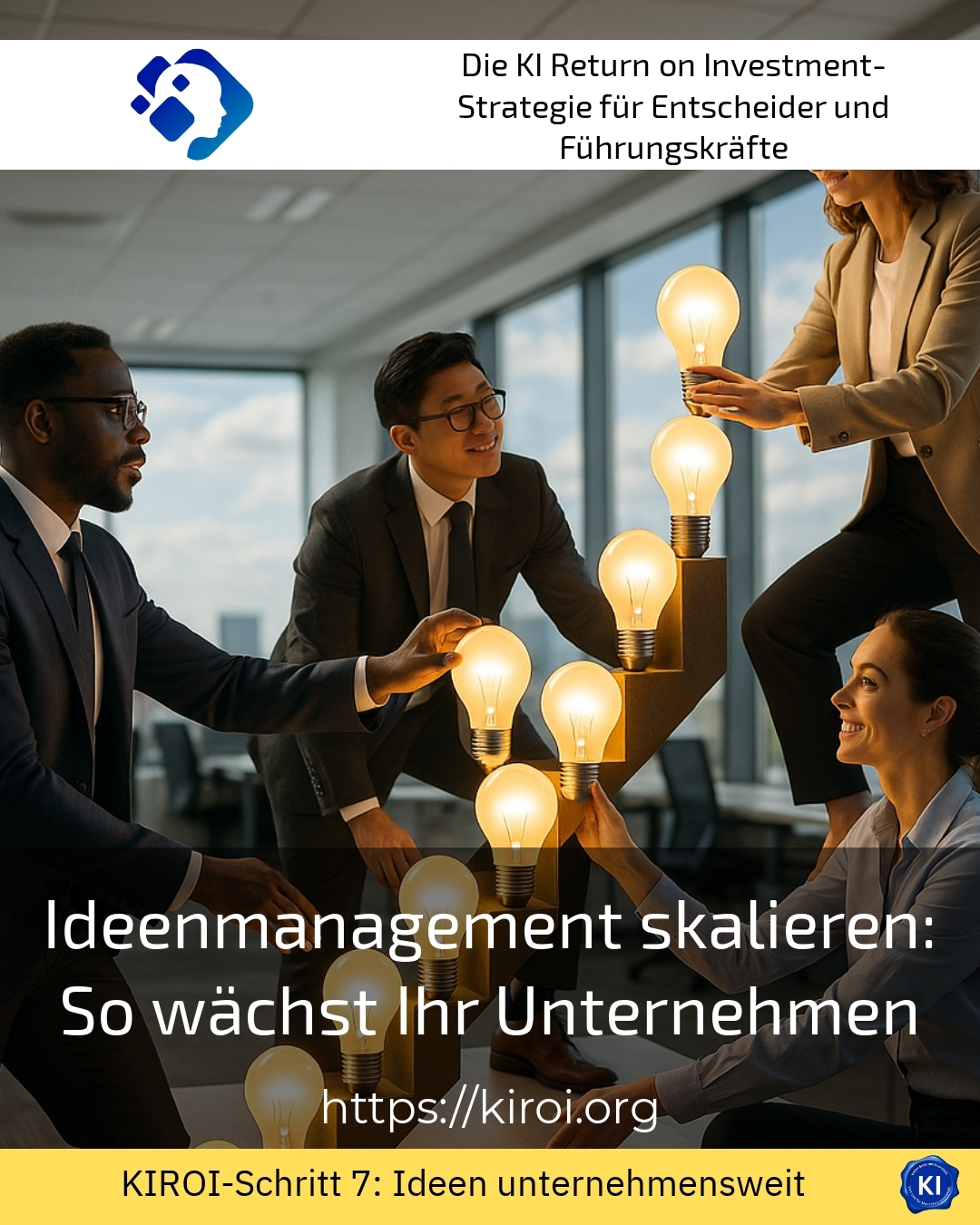
Imagine your company generating hundreds of brilliant suggestions from dedicated employees every day, yet no one can manage this flood of creativity anymore. This is precisely where the challenge lies when it comes to, Scaling ideas management to be able to and at the same time maintain the quality of innovation processes. Many organisations are facing this turning point where existing structures are reaching their limits. The good news, however, is that there are proven strategies to successfully navigate this transition. In this post, you will learn how growing companies can systematically scale their creative processes.
The foundations for sustainable growth through structured creative processes
As companies grow, the way innovations are created and implemented also changes. What worked informally in a small team of twenty people requires clear structures when there are two hundred or more employees. Clients often report that their existing systems are suddenly no longer sufficient. The volume of incoming suggestions significantly exceeds the capacities of the responsible departments. This leads to frustration among those submitting ideas and missed opportunities for the entire company.
A medium-sized mechanical engineering company from southern Germany found itself in precisely this situation [1]. The workforce had increased by fifty percent within a year. At the same time, the number of submitted suggestions for improvement almost tripled. The existing system, where a single person manually reviewed all submissions, collapsed under this load. The average processing time increased from two weeks to over three months. Employees lost faith in the process and stopped submitting their ideas.
Similar challenges are also seen in the logistics sector, where an expanding freight forwarding company could barely coordinate its decentralised locations. Each branch developed its own approaches to deal with local problems. However, there was a lack of an overarching system that unified these valuable insights and made them useful for everyone. The consequence was a multitude of siloed solutions that often existed in parallel without each other’s knowledge.
Best practice with a AIROI customer An international trading company with over three thousand employees at various locations across Europe was looking for ways to consolidate and systematically utilise its innovative capacity. The previous practice consisted of isolated emails to supervisors, which often got lost or forgotten in daily business. Transruptions coaching supported this company over an eighteen-month period in the introduction of a digital platform that centrally recorded all submissions and automatically forwarded them to the responsible specialist departments. The development of a transparent feedback culture, where every submitting person received initial feedback within seven days, was particularly important. Through this support, the company was able to increase employee participation from an original eight percent to an impressive thirty-two percent, and the number of actually implemented suggestions doubled within the first year of the new system's introduction.
Scaling ideas management through intelligent technologies
Modern technologies offer numerous possibilities to cope with the growing demands on creative processes. Artificial intelligence can assist by automatically categorising and prioritising incoming suggestions [2]. Intelligent systems can thus significantly relieve the responsible employees of repetitive tasks. The time gained can then be used for qualitative evaluation and strategic classification.
An example from the insurance industry illustrates this impressively. A large insurer implemented an AI-powered solution that recognised semantic similarities between various inputs. This enabled duplicates to be merged automatically, reducing manual effort by almost forty per cent. Additionally, the system suggested similar measures that had already been implemented, significantly improving the quality of assessments.
Promising approaches for technological support of creative processes are also emerging in the healthcare sector. A large clinic chain now uses a platform that collects and analyses input from all affiliated facilities. The software identifies overarching patterns and trends that would have remained hidden from individual sites. For example, if several hospitals suggest similar improvements for patient admission, the system automatically bundles these into a joint project.
In the automotive industry, a well-known supplier has fully digitised its processes, achieving remarkable results. Employees can now submit suggestions at any time and from anywhere via a mobile app. Images, videos, and voice messages complement the text-based descriptions, significantly improving understanding. The processing time has consequently been reduced from an average of six weeks to under ten days.
Scaling the Role of Corporate Culture in Idea Management
However, technology alone is not sufficient to successfully scale and permanently establish creative processes. Corporate culture plays an equally crucial role in scaling innovation activities. Employees must feel safe to express unconventional ideas and critically question existing processes. Leaders have a particular responsibility here as role models and encouragers of creative thinking.
An energy provider from the north German region has recognised this and adapted its management development accordingly [3]. In special workshops, managers learn how to create an open atmosphere for suggestions for improvement. They learn how important timely and appreciative feedback is for motivating employees. The results speak for themselves, as the participation rate rose by a remarkable twenty-five per cent after the introduction of these measures.
A large telecommunications company had similar experiences, fundamentally overhauling its internal incentive systems. Instead of just rewarding implemented suggestions, the quality of submissions and active participation in other projects are now also recognised. This change led to a significantly higher willingness to support each other and work together on solutions.
Best practice with a AIROI customer A leading consumer goods manufacturer with production sites on three continents faced the challenge of standardising its established innovation structures while also taking local specificities into account. Transruption coaching supported the company in introducing a global platform that considered cultural differences and yet enabled a unified process. Particularly important was the involvement of local champions, who acted as ambassadors for the new approach in their respective regions and motivated their colleagues. These champions received special training and had direct access to decision-makers at headquarters, which significantly strengthened their credibility locally. Within two years, the company was able to collect and evaluate over four thousand suggestions for improvement from all regions, with it being particularly noteworthy that around thirty percent of these submissions were relevant across locations and led to global process optimisations.
Structural adjustments for growing organisations
As companies grow, their organisational structures for creative processes must also adapt. What used to be a task for a single department now requires a network of responsible individuals across different levels. Decentralised structures enable faster on-the-spot decisions and increase employee buy-in. At the same time, central coordination is needed to leverage synergies and set strategic priorities.
An example from the banking sector impressively illustrates this challenge and shows possible solutions. A large regional bank introduced a three-tiered model that combines local autonomy with central control. At the first level, team leaders assess proposals from their immediate area of responsibility and implement simple measures directly. More complex issues are passed on to regional committees, which can decide on resources and priorities. Finally, strategically relevant input reaches a central innovation board, which coordinates company-wide development.
In the chemical industry, a medium-sized company has taken a different approach which is also showing considerable success. Here, so-called innovation patrons have been introduced, who, in addition to their regular duties, act as a point of contact for creative input. These patrons are specially trained and have a budget for smaller, immediate measures. Larger projects are presented and prioritised quarterly in an overarching forum.
The public sector also offers interesting examples of successful structural adjustments in the face of growing demands. A large city administration has merged its departments for citizen participation and internal improvement processes. This creates synergies between external and internal impulses that enrich the entire system. Employees benefit from experiences gained from citizen interaction, while internal expertise simultaneously feeds into external communication.
Scalability of measurability and continuous improvement in idea management
In order to assess the success of scaling measures, companies require meaningful key performance indicators and measurement tools. This goes beyond just quantitative aspects such as the number of submissions or implemented measures. Qualitative factors, such as strategic relevance or employee satisfaction, are equally important for a comprehensive assessment.
A pharmaceutical company has developed a comprehensive key performance indicator (KPI) system for this purpose, which takes various perspectives into account [4]. In addition to classic productivity KPIs, lead times, conversion rates, and financial impacts are also recorded. Regular employee surveys supplement this quantitative data with important qualitative assessments. The results are incorporated into a monthly report that is presented to the board of directors.
In the food industry, a major manufacturer demonstrates how continuous improvement of its own processes can be achieved. The company conducts semi-annual reviews where all stakeholders can provide feedback on the existing system. Concrete improvement measures are derived from this feedback and prioritised for implementation. In this way, the system continuously develops and adapts to changing requirements.
A trading group uses modern analytics tools to identify patterns in incoming suggestions and draw strategic conclusions from them. For example, if there is an increasing volume of input on a particular topic, this indicates a fundamental need for action. These findings are directly incorporated into strategic planning and have a lasting impact on investment decisions.
Best practice with a AIROI customer A long-established family business in metal processing, employing over a thousand people, wanted to modernise its evolved structures without jeopardising its proven corporate culture. Transruptions coaching accompanied this sensitive transformation process over a period of two years with regular workshops and individual consulting sessions. Together, a concept was developed that combined the strengths of existing informal communication channels with the advantages of a structured digital platform. The implementation was carried out step-by-step, starting with a pilot area in production that was particularly receptive to innovations. The positive experiences from this pilot were actively communicated and served as a role model for other areas of the company, with each area being given sufficient time to adapt to the new processes and make its own adjustments. At the end of the project, not only had the number of actionable suggestions tripled, but employee satisfaction had also measurably increased.
My AIROI Analysis
Successfully scaling creative processes presents companies with multifaceted challenges that go far beyond technical solutions. From my experience supporting numerous transformation projects, it repeatedly becomes clear that the human factor is crucial for success. Technology can offer support and make processes more efficient, but without a suitable culture and committed leaders, the potential remains untapped.
The realisation that there is no universal approach that works equally well for all organisations seems particularly important to me. Each company must find its own way that fits the existing culture and specific requirements. External stimuli and the experiences of other organisations can provide valuable inspiration, but must always be adapted to one's own context.
The examples shown from various industries demonstrate that success is possible when companies are willing to invest in their innovative capabilities. This investment includes not only financial resources for technology and training, but above all the time and attention of company leaders. Those who provide these resources can sustainably leverage the creativity and commitment of their employees, thereby securing long-term competitiveness. Transruption coaching supports companies on this path and provides impetus for successful transformation, with the individual situation of each organisation at the forefront.
Further links from the text above:
[1] VDMA – Innovation Management in Industry
[2] Bitkom – Artificial Intelligence in Corporate Use
[3] DGFP – Innovation Culture in Companies
[4] Haufe – Key Figures in Corporate Suggestion Schemes
For more information and if you have any questions, please contact Contact us or read more blog posts on the topic Artificial intelligence here.








 Deutsch
  English (UK)