
Creativity lies dormant in every company. But how do you bring these valuable impulses out of your employees' minds? This is precisely where modern idea management comes in. It offers a structured method for collecting, evaluating, and implementing ideas. KIROI Step 7 offers an innovative way to understand idea management not as a one-off action, but as a continuous accompanying process in your organisation.[1]
Ideas management: Far more than just collecting suggestions
Many companies confuse idea management with simple suggestion boxes. This is a misunderstanding. Real idea management is a comprehensive process. It ranges from the generation and collection to the implementation of improvements.[1]
The process begins with brainstorming. Employees are invited to contribute their ideas. This happens through various channels. Digital platforms play an important role. Brainstorming sessions are also valuable. Innovation challenges also motivate teams to participate.[1]
After collection comes evaluation. Not every idea is immediately implementable. Experts check feasibility. They analyse potential impacts. They verify alignment with strategic objectives. This is how the best candidates are identified.
Then comes the development phase. Selected ideas are refined. Teams often work collaboratively across functions. Prototypes are created. Tests show whether the concepts really work.[1]
Implementation is the crucial step. Resources are allocated. Action plans are created. Progress is monitored. Feedback is continuously fed back.
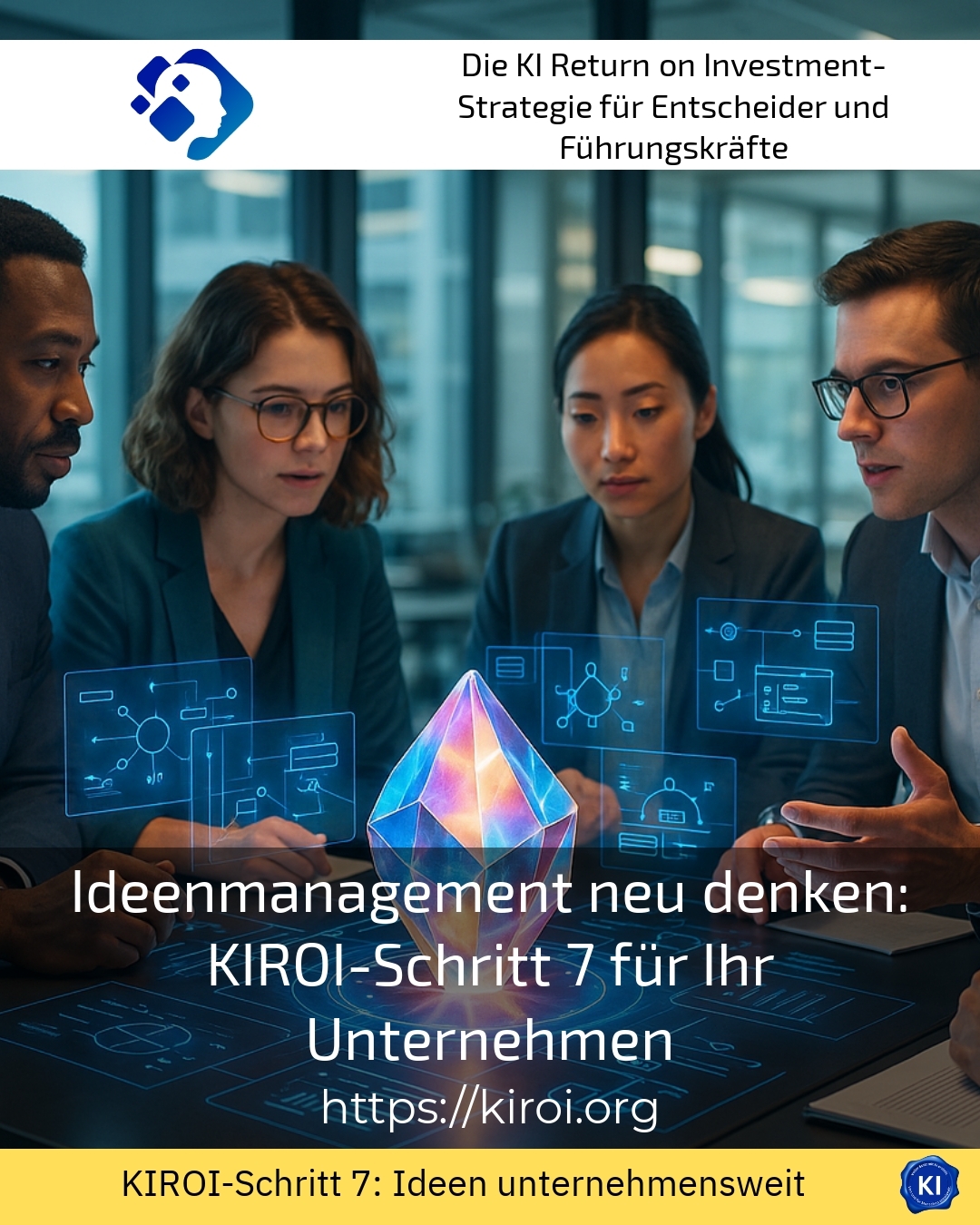
KIROI Step 7: Thinking about idea management company-wide
Classic idea management systems often have a problem. They operate in isolation. Departments aren't aware of suggestions from other areas. Synergies remain unexploited. KIROI step 7 solves this dilemma.
KIROI Step 7 focuses on networking. It actively connects different areas of the company. The step is called: „Ideas for other departments“. This already describes the philosophy. [2]
Strength lies in collaboration. Customer service, IT, and marketing work together. New perspectives emerge. Solutions become more holistic. The added value for the entire company grows.[2]
How KIROI Step 7 Removes Inhibitions
Many innovation projects fail due to practical obstacles. A good concept gets blocked. Resources are lacking. Responsibilities are unclear. Communication between teams is weak.
KIROI Step 7 specifically addresses these problems. Moderated workshops bring people together. Obstacles are openly identified. Solution approaches are developed collaboratively. This ensures every idea is taken seriously.[2]
This support brings a new quality to idea management. It becomes dynamic. It becomes concrete. It generates actual changes.[2]
BEST PRACTICE with a customer (name hidden due to NDA contract): A company in industrial manufacturing used KIROI Step 7. The aim was to systematically identify implementation obstacles. Moderated workshops promoted dialogue between departments. The obstacles were specifically removed. The result: innovation projects were realised faster. Knowledge exchange between specialist areas intensified significantly. The innovative strength of the entire organisation was sustainably strengthened.
Industry examples: Idea management in practice
Mechanical Engineering and Ideas Management
In the mechanical engineering industry, idea management is particularly valuable. Development cycles are often long and expensive. Small improvements save large sums. [2]
Targeted workshops significantly shorten development times. Designers, engineers, and manufacturing personnel exchange information. Problems are identified earlier. Solutions are found faster. Product innovations reach the market more quickly.[2]
Idea management helps to reduce misguided developments. Costs decrease. Quality increases. Competitiveness grows.
Software development and creative impulses
Software companies are reporting improved collaboration. Idea management actively involves development teams. Their proximity to the code and to customer problems is valuable.[2]
If programmers are allowed to contribute their ideas, better software is created. The quality of new features increases. Bugs decrease. User satisfaction grows.[2]
The idea management creates an environment where creativity thrives. Developers feel heard. This motivates and retains talent.
Handel: Managing ideas across branches
Retail chains benefit enormously from ideas management. Their employees work closely with customers. They know problems and wishes precisely.
Digital platforms enable branch suggestions to be shared with all others. A cashier in Hamburg has a good idea? It can be implemented immediately in Munich. Knowledge is shared. Learning takes place.[4]
The idea management makes large corporate networks agile. Every branch can learn from every other. Innovation comes from everywhere.
Practical Steps: Establishing Idea Management in a Business
Step 1: Build an idea management culture
Ideas management requires a conducive culture. Employees must know that their suggestions are welcome. They are allowed to take risks. Mistakes are permitted.
Leaders play a key role. They must embody creativity. They should ask questions. They must embrace and support ideas.
An open feedback culture is central. People want to know what is happening with their idea. Transparency builds trust.
Step 2: Create structured channels for idea management
Good infrastructure supports idea management. A digital platform is essential today. It should be easy to use. Employees must be able to submit ideas quickly.
Regular brainstorming sessions supplement the digital solution. Teams sit together. They build on each other. Synergies arise.[1]
Innovation challenges create additional incentives. A specific problem is posed. Teams work on it. The best solution wins.[1]
Step 3: Ideas Management with KIROI - Step 7 Think company-wide
The ideal scenario: Ideas from one department are made usable for other areas. This requires conscious thought. The KIROI step 7 structures this.[4]
Regular workshop series bring different departments together. People present their ideas. Others add to or adapt them. In this way, ideas grow across boundaries.
This makes idea management a real engine for company transformation.
Recognising and overcoming common obstacles in idea management
Many companies start with idea management, but experience stagnation. There are various reasons for this. Some collect ideas but don't implement them. This demotivates employees. [8]
Others have silos. Departments don't know each other. Knowledge transfer doesn't happen. Ideas remain locally limited.
Sometimes there is a lack of clear responsibilities. Who drives an idea forward? Who makes decisions? Unclear responsibilities lead to delays.
The transruption coaching approach addresses precisely these problems. Clients frequently report that classical idea management is insufficient. They do not achieve the peak performance necessary with traditional methods. KIROI Step 7 provides methods to bridge this gap.[8]
The role of feedback and recognition in idea management
Ideas management thrives on feedback. Employees need to know how their suggestions have been evaluated. Was the idea accepted? Why not? What happens next?[1]
Recognition is also central. People like their work to be seen. A simple thank you has a big impact. Small tokens of appreciation are also motivating.
Some companies offer financial incentives. Others choose different forms of recognition. What counts is consistency and authenticity.[1]
This makes idea management a culture of mutual appreciation. People feel part of something bigger.
Digital tools and technology in idea management
Modern idea management systems are digital. Web-based platforms allow for central administration. Employees can submit ideas from anywhere.
These systems also enable discussions. Others can leave comments. Ideas are further developed. Ideation management becomes more dialogical.
Voting functions are popular. Teams can rate ideas. The best suggestions receive visibly more support. This optimises resource allocation.
Analytics show which departments are active. How many ideas have been implemented? How long does implementation take? Such data informs continuous improvement. [6]
Ideas management as a strategic competitive advantage
Companies that take idea management seriously gain competitiveness. They innovate faster. They react more flexibly to market changes. They retain talent better.
The ideas management process thus becomes a strategic success factor. It is not just an HR issue; it is a leadership task. Top management must support and exemplify it. [7]
In the long term, organisations that harness the creative potential of all employees will be ahead of the game. Idea management is the key to achieving this.[7]
My analysis
Rethinking idea management means understanding it as a continuous process. The classic focus on collection is no longer sufficient. Companies need a holistic strategy that involves all levels. The KIROI Step 7 offers an innovative framework for this.
Practice shows: When idea management works across departments, genuine











 Deutsch
  English (UK)