
Why do so many brilliant minds fail to lead their teams to real innovation, even though they themselves are brimming with creative ideas?
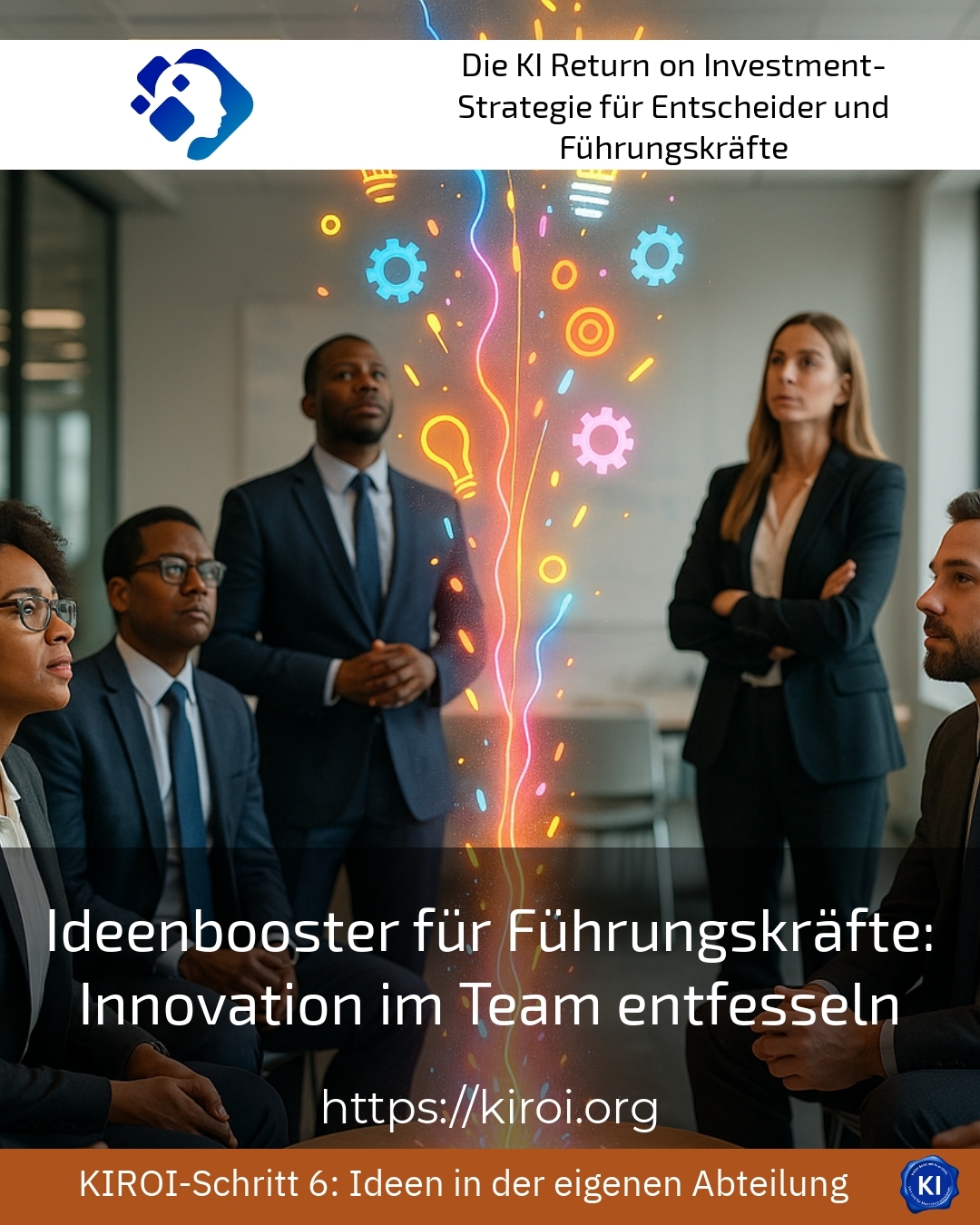
This question concerns decision-makers in almost all sectors of the economy. Ideas booster for leaders It represents a crucial lever in this process. It enables the unlocking of hidden potential. Innovation rarely occurs in isolation. It requires an environment that fosters creativity while providing structure. Many leaders significantly underestimate this balancing act. They focus on results but forget the process. This is precisely where the key to success lies. In this article, you will learn how you can become a catalyst for groundbreaking ideas as a leader.
The psychology behind creative breakthroughs in the corporate context
Creativity follows certain patterns that are scientifically well researched. The human brain requires certain prerequisites for innovative thinking. Stress and time pressure have a counterproductive effect in this regard. At the same time, a certain level of tension is also necessary. Understanding this paradox is enormously helpful for leaders. In the automotive industry, for example, many innovations emerged in relaxed thinking environments. Designers at large manufacturers often work in specially designed environments [1]. These spaces purposefully encourage the free flow of thought. Similarly, the pharmaceutical industry has gained similar insights. Research teams there deliberately allow employees free time for unconventional approaches. The technology industry goes one step further. Companies like well-known software houses explicitly grant employees time to experiment. This investment pays off in the long run.
The Ideas booster for leaders It begins with understanding these psychological foundations. Those who know the mechanisms can actively activate them. Transruptive coaching closely accompanies executives in this challenge. It helps them create the right framework conditions. Often, clients report amazing changes in their teams.
Best practice with a AIROI customer
A medium-sized company in the mechanical engineering sector faced a particular challenge, as the innovation power of the development team had noticeably decreased, despite the individual engineers possessing excellent qualifications. The management approached us with the request to break through this stagnation. During the analysis phase, we found that the meeting culture actively hindered innovation because every idea was immediately evaluated for feasibility. We implemented a new format called the Ideas Lab, in which no criticism was allowed at first. The management learned to consciously reframe their evaluative attitude. After only three months, several patent-worthy concepts had emerged in this protected space. The team developed a completely new drive technology that has now become the market leader. The management told us that the working environment had also significantly improved. Employees felt valued and contributed more actively. The sick leave rate decreased measurably, and the turnover rate dropped significantly.
The idea booster for managers in practical application
Theory alone is not enough; leaders need concrete tools for everyday life. The consumer goods industry provides inspiring examples. Major brands are implementing so-called consumer immersion programs. Managers spend time with real customers at home. They observe how products are actually used. These direct insights regularly lead to innovative improvements. The financial sector is now also using similar approaches. Banks send executives into branches to experience first-hand contact with customers. Insurance companies have managers work on claims. These experiences open up completely new perspectives.
In retail, the concept of reverse mentoring programs has taken hold [2]. Younger employees mentor experienced executives. They impart knowledge about digital trends and new customer expectations. This reversal of the traditional hierarchy fosters innovation on both sides. The logistics industry is experimenting with cross-functional teams for complex problems. Drivers, dispatchers, and IT experts work together to optimize processes. The different perspectives complement each other excellently.
Methods for activating the idea booster for executives
Certain techniques have proven particularly effective. The Design Thinking method originated in product development. However, it can be applied to almost all business areas. The core principle is to view problems from the perspective of the user. In medical technology, this approach led to revolutionary developments. Surgical instruments were completely redesigned. Usability became the central focus. The construction industry also benefits significantly from such methods. Architects and construction companies are increasingly listening to end users. Buildings are becoming more functional and pleasant as a result.
Transruptions coaching accompanies companies in the introduction of such innovation methods. It provides insights into how transformation can be achieved. The energy sector impressively demonstrates what results are possible. Utilities are working with customers to develop new tariff models. The telecommunications industry is testing products in early stages with real users. Even the traditional textile industry is opening up to participatory development processes.
Best practice with a AIROI customer
A leading company in the chemical industry was looking for ways to increase the speed of innovation because international competition was becoming increasingly intense and new market entrants were pushing forward with disruptive approaches. The senior management realized that the previous structures hindered creativity rather than encouraged it, because decision-making processes were long and hierarchical. We jointly developed a program to decentralize innovation decisions, giving individual teams more autonomy. Laboratory managers received their own budget for exploratory projects without the need for complex approval procedures. The change in the corporate culture took time and patience, but after about six months, initial positive effects were evident throughout the organization. Employees dared to take more initiative and brought unconventional ideas that would have been unheard of before. A team developed a completely new binder for the construction industry, which has now become a revenue generator. The leaders learned to delegate control and to trust, which was a real challenge for many.
Barriers on the path to an innovation culture
Not all attempts to promote innovation succeed immediately. Certain factors regularly block creative processes. Fear of failure is at the forefront of this. In the aviation industry, this insight was gained early on. A constructive culture of error was established there to protect human lives. Pilots report near-collisions without fear of sanctions. This openness has demonstrably prevented serious accidents. Other industries can learn from this. The food industry experiments with similar approaches in product development. Failures are viewed as learning opportunities. Automotive suppliers establish comparable systems for their innovation processes.
Another obstacle is the excessive bureaucracy. Ideas booster for leaders This problem often fails to be solved by long decision-making processes. In public administration, this problem is particularly pronounced [3]. But corporations also suffer from similar symptoms. The insurance industry has responded to this with agile units. Small teams work independently of the parent organization. They can make decisions faster and experiment. The pharmaceutical industry uses similar structures for its research departments. Spin-offs enable more flexible working there. Banks are also increasingly relying on innovation labs outside their headquarters.
The role of communication in the idea booster for leaders
Communication forms the foundation of any successful innovation culture. Leaders must be able to actively listen. The hospitality industry provides interesting examples. Major hotel chains systematically collect ideas from their front-line employees. Cleaning staff and receptionists often have the best insights. Their suggestions regularly lead to service improvements. The restaurant industry successfully uses similar feedback mechanisms. Kitchen staff introduces recipes. Service staff reports directly on customer requests.
Transruptions coaching supports leaders in improving their communication skills. It accompanies them on the path to a more open dialogue culture. The transport industry demonstrates how important this aspect is. Forwarding companies that listen to driver suggestions optimize their routes more efficiently. Airlines systematically collect crew feedback. The shipping industry implements digital platforms for improvement ideas.
Best practice with a AIROI customer
An internationally operating retail company with several hundred branches faced a serious problem: innovative ideas from the individual locations rarely reached the headquarters. The management knew that valuable knowledge remained unused, but they could not find a suitable solution. We analyzed the existing communication structures and identified several obstacles that hindered the flow of information. Together, we developed a digital platform on which every employee could submit ideas without having to go through superiors. The best suggestions were rewarded and implemented on a monthly basis, which significantly increased motivation. Branch managers received training to actively encourage and support idea generation on-site. Within a year, over two thousand suggestions were submitted, of which more than three hundred were actually implemented. The measurable benefits exceeded the investment costs manyfold, and the company won an innovation award in its industry. Particularly noteworthy was the increased employee satisfaction that became evident in the annual survey.
Sustainable anchoring of innovation processes
Unique initiatives often fail to have any impact. Sustainability requires systematic embedding in the corporate culture. The toy industry demonstrates how this can be achieved. Manufacturers integrate creative workshops into their regular work routines. Each employee has time reserved for their own projects. The sports apparel industry follows similar principles in product development. Designers test their own creations in real-life use. The furniture industry invites customers to design workshops. This integration generates valuable impulses continuously.
The media industry has institutionalized innovation cycles. Editorial teams regularly experiment with new formats. Broadcasting stations test programs on a small scale. Publishers establish digital units for forward-looking projects. The advertising industry thrives on constant renewal by definition. Agencies actively promote creative breaks for their employees. The entertainment industry systematically invests in innovation labs.
My AIROI Analysis
The ability to unleash innovation within a team increasingly determines entrepreneurial success in a rapidly changing business world. Leaders face the challenge of creating conditions that enable creativity while simultaneously delivering targeted results, which represents a true balancing act. The presented examples from various industries impressively demonstrate that there is no one-size-fits-all solution; each company must find its own path. The key success factor lies in the willingness to question conventional patterns and to venture new paths, even if it seems uncomfortable at first.
The AIROI-methodology provides a structured framework for this transformation by combining proven approaches with individual customization. What I find particularly important is the realization that technical tools alone are not enough; the human component remains crucial. Leaders must learn to trust and relinquish control, which many find difficult. Transruptive coaching accompanies this process precisely and provides valuable impulses. The described best practices demonstrate the results that are possible when companies consistently take this path. Innovation is not a coincidence; it is the result of conscious design. Those who internalize this insight have already taken the first step.
Further links from the text above:
[1] Harvard Business Review – Innovation Research and Insights
[2] McKinsey – Innovation Strategy Insights
[3] Forbes – Innovation and Technology
For more information and if you have any questions, please contact Contact us or read more blog posts on the topic Artificial intelligence here.






 Deutsch
 English (UK)