
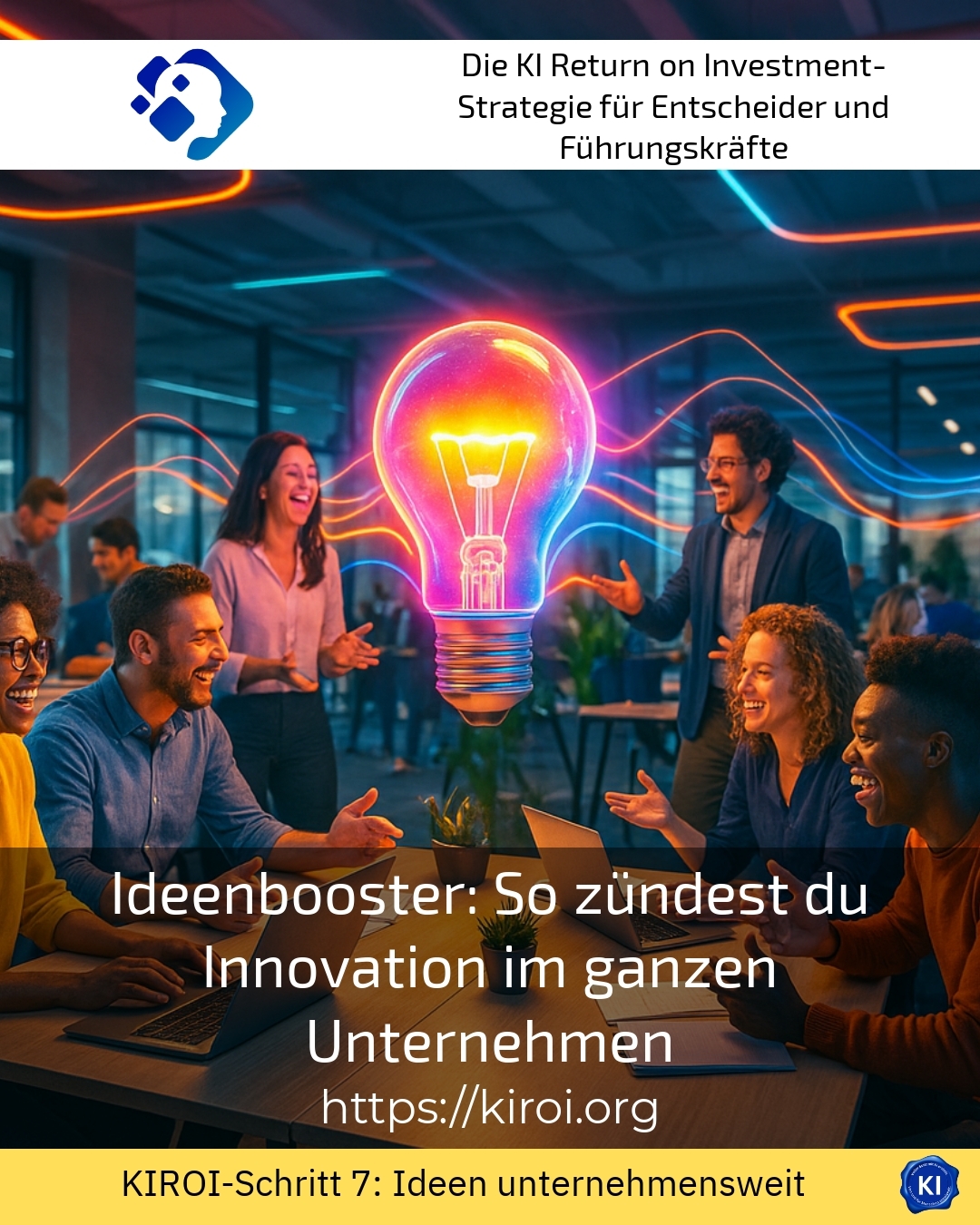
Imagine your employees coming to work in the morning with sparkling eyes. They can't wait to share their latest ideas. This state is not a pipe dream, but achievable. However, many companies struggle with rigid structures. The Idea booster: How to ignite innovation across the entire company often remains an unfulfilled promise. Yet, every organisation harbours immense creative potential. This potential is just waiting to be awakened. The following strategies will show you concrete ways to do this. You will learn how to systematically unleash creativity. And you will discover why real change always begins with the company culture.
Understanding the foundations of a creative corporate culture
Before companies their own Idea booster: How to ignite innovation across the entire company To implement it, they need to understand the basics. Creativity doesn't arise in a vacuum. It needs fertile ground and the right conditions. Many leaders believe that a table football table or colourful walls are sufficient. That is a widespread misconception that costs a lot of money. Real creative culture is rooted deeper and demands structural changes.
The first step is to create psychological safety. Employees must be allowed to make mistakes without fearing consequences. However, many organisations have a culture of fear. People prefer to remain silent rather than risk their ideas. Yet, the best breakthroughs often arise from supposed failures [1]. For example, a well-known technology company introduced so-called „Failure Parties.“ There, teams celebrate their failed projects and share their learnings. This practice has measurably increased the rate of innovation.
Furthermore, the communication structure plays a crucial role. Hierarchical barriers nip creative impulses in the bud. If every idea has to go through five approval levels, motivation dwindles. Progressive companies therefore rely on flat hierarchies and open doors. A medium-sized mechanical engineering firm introduced digital idea platforms. All employees can communicate directly with management there. The response was overwhelming and led to numerous improvements.
Best practice with a AIROI customer
A long-established family business in the manufacturing sector approached our transruption coaching with an urgent concern. For years, management had observed a gradual stagnation in new product ideas. Employees behaved passively, waiting for instructions from above. The leadership level increasingly felt left alone with the responsibility for innovation. As part of the support, we first analysed the existing communication channels within the company. This revealed that there were no established channels for suggestions for improvement. Together, we developed a multi-stage concept for activating the workforce. We introduced monthly innovation workshops where cross-departmental teams came together. Additionally, we implemented a digital suggestion system with a transparent feedback process. Managers received special coaching on appreciative idea evaluation. After six months, the company recorded a three-hundred percent increase in submitted suggestions. Particularly pleasing was the high implementation rate of around forty percent of all ideas. Employee satisfaction measurably increased, and staff turnover significantly decreased. This example impressively demonstrates how systematic support enables sustainable change.
Idea booster: How to ignite innovation across the entire company with structured methods
Paradoxically, creativity also needs structure to be able to unfold. Without clear frameworks, creative processes often come to nothing. This is why successful organisations rely on tried-and-tested methods and formats. These provide direction while simultaneously creating scope for unconventional thinking. The art lies in finding the right balance.
Design Thinking has established itself as a particularly effective approach. This method consistently places people at the centre. Teams go through various phases, from understanding to testing [2]. A financial service provider used Design Thinking to develop new customer portals. The result exceeded all expectations in terms of user-friendliness and acceptance. The process incorporates diverse perspectives and promotes empathy. This leads to solutions that address real needs.
Hackathons offer another powerful framework for concentrated creativity. At these intensive events, teams work on specific challenges under time pressure. The limited time acts as a catalyst for unusual ideas. A logistics company organises internal hackathons on sustainability topics quarterly. Several patented methods for resource conservation have already emerged from these. The participants' enthusiasm radiates far beyond the events.
The concept of twenty percent time also deserves attention. This allows employees to use a portion of their working hours for their own projects. This freedom often leads to surprising breakthroughs. A software company reports numerous product innovations through this model. The investment in free creative time pays off many times over in the long term. However, it requires trust and an appropriate corporate culture.
Spatial design as a catalyst for creativity
The physical working environment significantly influences creative potential. Cramped office cubicles and rigid seating arrangements hinder the flow of ideas. In contrast, modern office landscapes offer diverse zones for various activities. There are areas for concentrated work and others for spontaneous encounters. This variety supports different phases of the creative process.
Collaboration spaces with writable walls invite joint visualisation. Retreat spaces allow for undisturbed thinking and elaboration. Meeting zones encourage informal exchange between departments. A pharmaceutical company completely redesigned its research centre based on these principles. The number of cross-departmental projects tripled within a year. Employees report more inspiration and improved well-being.
Nature also plays an important role in creative thinking. Studies show that plants and natural materials increase concentration [3]. Views of greenery are proven to promote innovative thoughts. An architecture firm therefore integrated a roof garden as a meeting place. The meetings held there regularly bring forth fresh perspectives. The connection between indoor and outdoor spaces is invigorating.
Rethinking leadership for more creative energy
Leaders play a key role in unlocking creative potential. Their behaviour shapes culture more than any official statement. When managers prioritise control over trust, creativity withers. Modern leadership, therefore, means enabling, inspiring, and supporting. This attitude often requires a fundamental rethink.
Servant leadership has been shown to be particularly beneficial for creative cultures. In this approach, leaders see themselves as supporters of their teams. They remove obstacles and procure necessary resources. A consumer goods manufacturer trained its entire management level in this approach. As a result, employees showed significantly more initiative in making improvements. The leaders themselves report greater fulfilment in their roles.
Coaching competence is now part of the toolkit for good leadership. Instead of giving instructions, coaches ask the right questions. This enables employees to develop their own solutions and grow in their roles. An energy supplier integrated coaching elements into all its management training courses. Problem-solving skills at all levels increased noticeably. At the same time, talent retention within the company improved.
Best practice with a AIROI customer
A middle manager approached us for transruptions coaching with a specific concern. They felt they were no longer reaching their team and that ideas were stagnating. Meetings were sluggish, and no one was contributing new suggestions. In the coaching process, we initially worked on the manager's own mindset. Together, we identified unconscious behaviours that were blocking creativity. The manager tended to evaluate ideas immediately rather than letting them mature. They frequently interrupted and dominated discussions with their own ideas. Through practical exercises, they developed new communication techniques and reflection skills. They learned to tolerate silence and to use open-ended questions strategically. After just a few weeks, the team meeting dynamics noticeably changed. Employees dared to share even half-formed thoughts again. The number of actionable ideas increased steadily. The manager reported a completely new relationship with their team. They found their work meaningful and energising once more. This example illustrates how personal development enables organisational change.
With the Idea Booster: How to Sustainably Ignite Innovation Across the Entire Company
Sustainability here means two things: long-term impact and ecological responsibility. Both aspects are gaining importance for creative companies. One-off innovation offensives are usually ineffective. Instead, continuous nurturing of the creative culture is needed. This task requires patience and consistent action over many years.
Rituals help to anchor creative practices. Weekly brainstorming sessions can become a firm part of working life. Monthly innovation reports keep the focus on creative progress. Annual awards publicly recognise particularly innovative achievements. An insurance company has maintained an innovation calendar with such rituals for years. This keeps creative energy consistently high.
Measurement and feedback ensure continuous improvement. Figures like the number of submitted ideas provide initial indications. The implementation rate shows how seriously suggestions are taken. Employee surveys regularly capture the perceived innovation culture. A retail company uses a comprehensive dashboard to manage its creativity initiatives. The data enable targeted interventions where needed.
Using digital tools intelligently
Digitalisation offers a wide range of opportunities to support creative processes. Collaboration platforms enable teamwork across locations and time zones. Idea management systems systematically capture suggestions and make them transparent. Artificial intelligence can even serve as a sparring partner for new concepts [4].
Crucially, the tools must be adapted to people. Technology should support creativity rather than stifle it. Overly complicated systems are off-putting and remain unused. One media company deliberately chose a particularly low-threshold idea platform. The usage rate there is an impressive eighty percent of the workforce. Simplicity proved to be the decisive success factor.
Virtual whiteboards are revolutionising collaboration in distributed teams. Tools like Miro or Mural enable real-time visual brainstorming. A consulting firm uses them to conduct innovation workshops with international clients. The results are in no way inferior to those of in-person events. Sometimes they are even richer due to the easy documentation.
Harnessing diversity as a driver for creativity
Homogeneous teams often think along similar lines and overlook blind spots. Diversity in terms of background, experience, and perspective enriches creative processes. Different points of view lead to friction, but also to sparks. These sparks can ignite great fires of creativity.
An automotive supplier found that its development teams were too homogenous. Through targeted recruitment, it introduced more diversity into the organisation. New perspectives from other industries and cultures broadened horizons. The innovation rate increased measurably and new markets were opened up. Initial scepticism was quickly replaced by genuine enthusiasm.
The inclusion of external voices can also provide valuable impetus. Customers, suppliers, and even competitors offer fresh perspectives. Open innovation opens up the company's boundaries to ideas from the outside. A food manufacturer regularly invites consumers to product development workshops. The innovations that result meet the target group's taste particularly well.
My AIROI Analysis
Accompanying numerous companies on their journey towards greater creativity has provided me with important insights. True change always begins with people and their attitude. Structures and methods are important, but they are not enough on their own. A profound transformation of the corporate culture is needed. This transformation requires time, patience, and consistent role modelling by leadership.
Clients often report similar challenges on this path. The biggest hurdle is often the fear of failure on all levels. This fear is paralysing and prevents the undertaking of new paths. Our transruption coaching accompanies people and organisations through this difficult phase. We provide impetus and support in the development of new thought patterns. We respect the pace and specific characteristics of each organisation.
The AIROI methodology offers a proven framework for this transformation process. It combines strategic analysis with practical implementation support. The integration of various perspectives and disciplines is particularly effective. Idea booster: How to ignite innovation across the entire company It does not arise from individual measures. It results from the interplay of many factors that must be carefully coordinated. Those who take this path will be rewarded with a vibrant, future-proof organisation.
Further links from the text above:
[1] Harvard Business Review: Innovation and Failure Culture
[2] IDEO Design Thinking Resources
[3] Nature: Studies on Workplace Design and Creativity
[4] McKinsey: Digital Tools for Innovation Management
For more information and if you have any questions, please contact Contact us or read more blog posts on the topic Artificial intelligence here.








 Deutsch
  English (UK)