
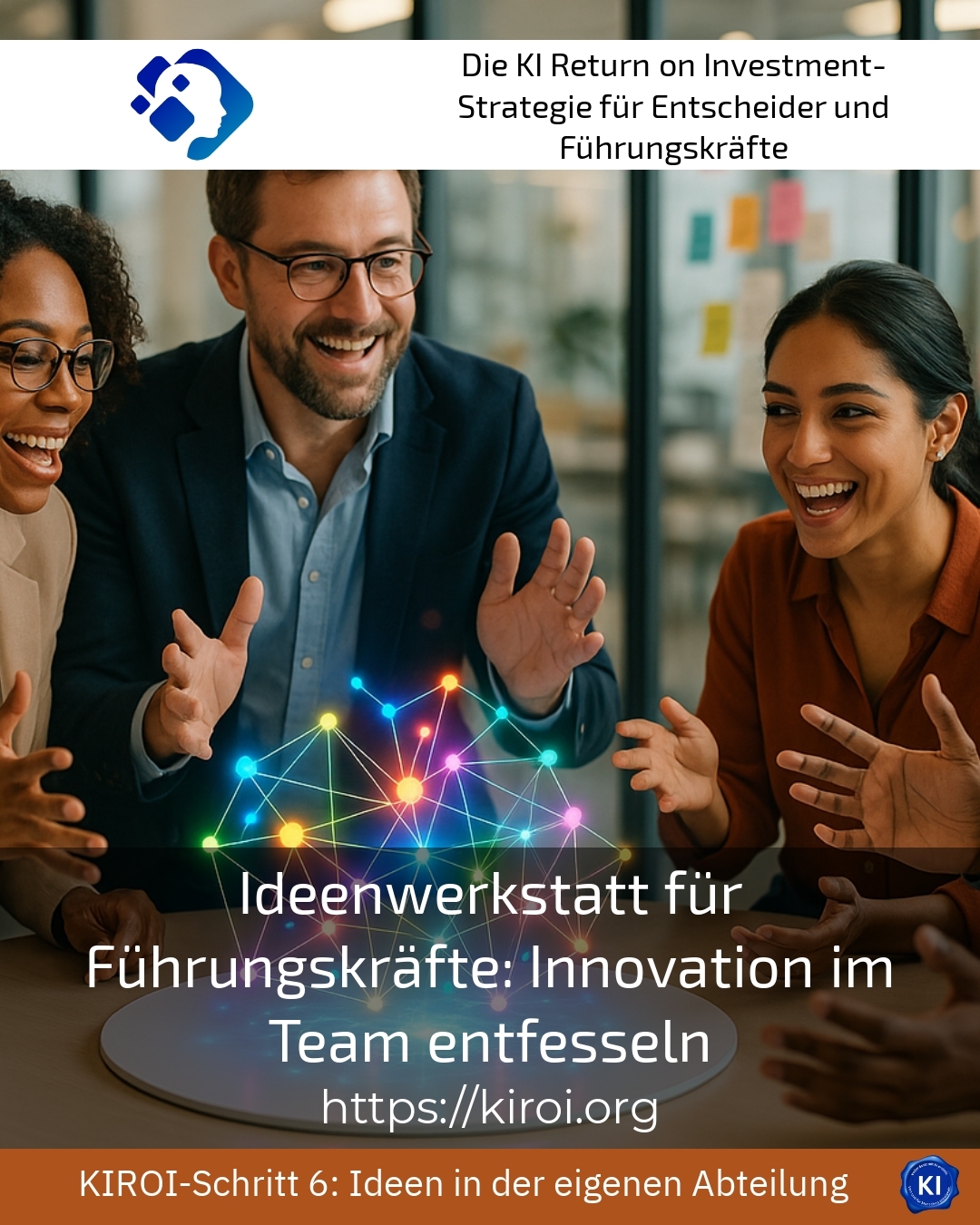
Imagine your leadership team enters a room and leaves a few hours later with groundbreaking concepts. The Ideation Workshop for Managers makes precisely this transformative experience possible. It creates a protected framework for creative thinking. This is where innovations emerge that can sustainably change companies. Many leaders report entirely new perspectives after such workshops. The structured exchange on an equal footing releases unimagined energies. This is not about quick fixes or superficial brainstormings. Rather, the focus is on in-depth engagement with future issues. This form of collective intelligence utilisation is gaining increasing importance in the modern working world.
The Power of Collective Creativity in Leadership Teams
Leaders today face complex challenges that they can hardly overcome alone. The speed of change regularly overwhelms traditional decision-making structures. Therefore, more and more companies are looking for new ways of collaboration. A technology group from Munich, for example, has completely realigned its product development. Management recognised that isolated departments could not produce marketable innovations. After a series of creative workshops, three completely new business areas emerged. A medium-sized mechanical engineering company from the Black Forest took a similar approach. For the first time, the owner family invited all divisional managers to a two-day creative process. The result was a service platform that today generates a significant portion of sales. A Hamburg-based logistics company also benefited considerably from this approach. The leaders jointly developed a sustainable packaging concept for their customers. These examples impressively show the potential that lies in structured collaboration.
The ideas workshop for leaders as a catalyst for change
The systematic promotion of creativity requires more than good intentions and a free afternoon. Successful companies consciously invest in the design of inspiring spaces and processes. A pharmaceutical group from Frankfurt has established its own innovation centre. There, executives regularly meet away from day-to-day operations. The spatial separation from everyday office life creates mental freedom for unconventional thoughts. An automotive supplier from Stuttgart, on the other hand, uses external creative spaces for its workshops. The deliberate distance from the company premises breaks down ingrained thought patterns. Participants frequently report a liberating atmosphere in such settings. An insurance company from Cologne is even experimenting with outdoor formats for its executives. Nature as an environment demonstrably promotes the cognitive flexibility of participants. These different approaches highlight the variety of possible design options.
Best practice with a KIROI customer
An internationally active consumer goods manufacturer faced the challenge of fundamentally renewing its leadership culture. The existing hierarchies significantly blocked the free exchange of ideas between departments. As part of the support provided by transruptions coaching, we developed a multi-stage workshop concept for the entire management team. The first step involved analysing existing communication patterns and hidden barriers. This revealed that many managers feared their proposals would fail. This insight led to the introduction of a failure-tolerant experimental format within the company. The managers subsequently met monthly in varying constellations for structured creative sessions. Within a year, this resulted in over fifty concrete suggestions for improving products and processes. Twelve of these suggestions were actually implemented and generated measurable savings for the company. Employee satisfaction in the departments involved increased by more than thirty percent. The improved collaboration between marketing and product development was particularly noteworthy. These two areas had previously barely communicated constructively with each other. The project impressively demonstrates how structured creative formats can initiate sustainable cultural changes.
Methods and tools for innovative teamwork
The selection of suitable methods is crucial for the success of creative workshops. Design Thinking has established itself as a valuable approach in many industries. A retail company from Düsseldorf is using this method to develop new store concepts. The executives systematically work through various phases, from observation to prototyping. In contrast, an energy supplier from Leipzig relies on the Walt Disney method for its strategy meetings [1]. This technique consciously separates the "dreamer", "realist", and "critic" within the group. This initially generates visionary ideas, which are then checked for feasibility. A medical technology manufacturer from Tuttlingen combines different creative methods depending on the question. For technical challenges, the company uses TRIZ methods from engineering. For marketing questions, it resorts to classic brainstorming variations. The methodological diversity significantly increases the probability of innovative breakthroughs.
The Role of Moderation in the Ideas Workshop for Executives
Professional moderation transforms a group of executives into a high-performing creative team. The facilitator creates a safe space for open communication without hierarchical barriers. A chemical company from Leverkusen regularly engages external facilitators for its innovation workshops. This neutrality also allows for critical discussions without regard to internal power dynamics. In contrast, a construction group from Berlin has trained and certified internal facilitators. These employees support teams from other business units in creative processes. The combination of industry knowledge and methodological competence proves to be particularly valuable. A telecommunications provider is even experimenting with digital moderation assistants for hybrid workshops. Artificial intelligence supports the structuring and documentation of results [2]. Executives frequently report higher efficiency through this technological support.
Psychological Foundations of Creative Leadership
Understanding psychological mechanisms significantly improves the quality of creative workshops. Psychological safety forms the foundation for open idea exchange within teams. A software company based in Karlsruhe has specifically focused on improving the culture of trust among its leadership. After a year of regular retrospectives, the number of improvement suggestions submitted rose considerably. A retail company from Nuremberg introduced anonymous idea channels alongside in-person workshops. This combination enables even reserved managers to participate in the innovation process. The diversity of perspectives expands considerably through such low-threshold approaches. A financial service provider from Frankfurt deliberately works with heterogeneous groups in its creative sessions. The mix of different age groups, genders, and professional backgrounds fosters innovative solutions. The most valuable ideas often emerge at the interfaces of different experience worlds.
Best practice with a KIROI customer
A long-established family business in the furniture sector was seeking ways to overcome strategic stagnation. The third generation of the owning family wanted to position the company for the future and open up new markets. As part of the transruption coaching, we guided an intensive transformation process over several months. Initially, we conducted a comprehensive analysis of the existing leadership culture and its strengths. In doing so, we recognised a high degree of implicit knowledge that had so far been barely systematically utilised. Ideation Workshop for Managers bot provided the perfect framework for activating these hidden resources. In six consecutive workshops, the managers developed a completely new product strategy for sustainable office furniture. The process included customer interviews, trend analyses, and intensive discussions about the company's values. The owner family was actively involved in the creative process from the very beginning and contributed valuable input. Particularly impressive was the energy that arose from the intergenerational collaboration, which spurred the process on. Younger managers brought digital expertise, while experienced colleagues contributed craft knowledge. The result was a modular furniture line that is now successfully positioned in the market and has received awards.
Overcoming resistance and unlocking potential
Not all managers greet creative workshop formats with open arms and enthusiasm. Skeptics often see them as a distraction from important operational tasks in day-to-day business. One industrial company from the Ruhr area countered such resistance with measurable proof of success. The management systematically documented all ideas from workshops and their subsequent implementation. After one year, the company was able to quantify the return on investment of the creative formats. A food manufacturer from Hamburg chose a different path to convince skeptics. Initially, the company started with small pilot groups of volunteer managers. The positive experiences and results of these groups then gradually convinced the doubters. A mechanical engineering company from Bielefeld firmly integrated creative sessions into the daily management routine of all departments. Weekly short innovation impulses replaced the purely status meetings that were customary before. This low-threshold integration significantly lowered the inhibition threshold for creative work and created acceptance.
Digital tools for collaborative creative processes
Digitalisation offers completely new possibilities for cross-location creative collaboration within companies. Virtual whiteboards enable synchronous work on shared idea collections in real-time [3]. A consultancy firm from Munich uses these tools for international client workshops with participants from different continents. Geographical distance becomes an asset rather than an obstacle in the creative process. An electronics manufacturer from Dresden combines virtual and physical creative spaces into hybrid formats with numerous advantages. Digital documentation automatically secures all results and makes them easily accessible later. A textile company from Mönchengladbach is experimenting with virtual reality environments for its design workshops. Managers can jointly develop and directly experience three-dimensional product concepts there. These immersive experiences significantly accelerate the prototyping process and sustainably reduce development costs.
Sustainable implementation of innovation processes
The full impact of individual creative workshops is only realised through systematic follow-up and implementation support. A cosmetics manufacturer from Hamburg has established its own innovation management system for this purpose, with clear responsibilities. Every idea from leadership workshops goes through a structured evaluation and development process with defined milestones. A steel company from Duisburg directly links its creative formats to the strategic planning cycle. The results of the idea workshop are thus immediately incorporated into corporate planning and prioritised. A logistics company from Bremen has formed an innovation committee from various management levels for evaluation. This committee decides monthly on the further development of promising concepts and provides resources. The institutional anchoring of creative processes sustainably ensures their long-term effectiveness within the company.
My KIROI Analysis
The systematic promotion of innovation within leadership teams is proving to be a crucial competitive factor for companies in all sectors. Ideation Workshop for Managers This provides a tried-and-tested framework for top-level creative collaboration. My analysis of numerous client projects reveals clear patterns of successful implementation and recurring success factors. Companies that regularly invest time in structured creative formats develop a higher speed of innovation in the market. Psychological safety within leadership teams forms the indispensable basis for open idea exchange. Without this trust, many valuable thoughts remain unspoken and are lost to the company.
Particularly noteworthy is the transformative effect on the entire company culture in the organisations being supported. When leaders themselves work creatively, this sustainably legitimises innovative approaches at all hierarchical levels. The role model function of management can hardly be overestimated in this regard for cultural change. Transruption coaching has proven to be valuable support for such change processes with many clients. The external perspective and methodological expertise significantly accelerate change and prevent common mistakes. Companies that embark on this path often report a new dynamic in their leadership teams and better collaboration.
The integration of digital tools significantly expands the possibilities for creative collaboration beyond geographical boundaries. Hybrid formats will become standard practice in the future, complementing and extending in-person workshops. Technological development is constantly opening up new options for immersive and collaborative creative experiences in teams. However, the human dimension of innovation and personal exchange between people remains crucial. Technology can support creativity, but never fully replace or automate it in its depth. The future belongs to companies that intelligently combine both dimensions and develop and promote their leaders accordingly.
Further links from the text above:
[1] Creativity Techniques: The Walt Disney Method in Detail
[2] AI-powered moderation tools for workshops
[3] Miro: Virtual whiteboards for collaborative work
For more information and if you have any questions, please contact Contact us or read more blog posts on the topic Artificial intelligence here.











 Deutsch
  English (UK)