
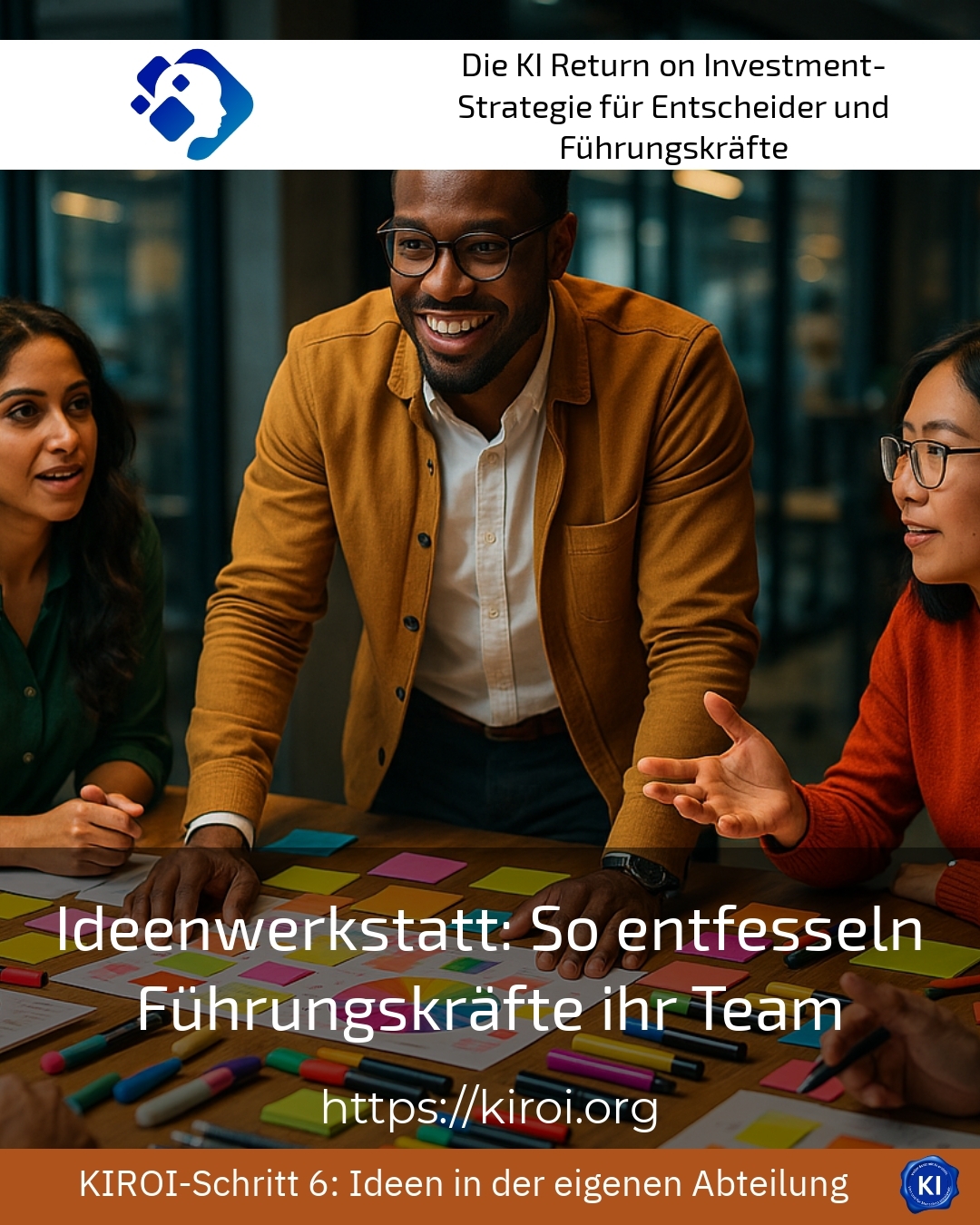
Imagine your employees coming into the office on Mondays full of energy, developing ground-breaking concepts off their own initiative. Ideas Workshop: How Leaders Unleash Their Team describes precisely this transformation process that makes the decisive difference in modern organisations. Many leaders desperately wonder why their teams, despite high qualifications, do not reach their full potential. The answer often lies hidden in entrenched structures and outdated leadership approaches. This article shows you practical ways to initiate and sustainably anchor creative processes.
Understanding the Fundamentals of Creative Collaboration
Creativity doesn't emerge in a vacuum, but requires fertile ground made of trust, psychological safety, and clear frameworks. Many companies invest significant sums in Design Thinking workshops or innovation labs without first establishing the fundamental prerequisites. According to a study by the Harvard Business School, over sixty percent of all innovation initiatives fail due to a lack of support from leadership [1]. This highlights that technical solutions alone are insufficient to unleash creative potential.
A medium-sized mechanical engineering company had spent years trying to modernise its development department. The engineers worked according to tried-and-tested methods and shied away from radical innovations. It wasn't until management began to communicate mistakes as learning opportunities that the atmosphere noticeably changed. A car parts supplier implemented weekly experimentation times, during which employees could work on their own projects without pressure to succeed. This initiative led to three patentable suggestions for improvement in the field of manufacturing technology within a few months. In turn, a software company established so-called "Failure Fridays," where failed projects were analysed and the lessons learned were shared.
The Idea Workshop: How Leaders Unleash Their Team Through a Culture of Trust
Trust forms the bedrock of any successful creative collaboration, because without this fundamental feeling of security, employees will never be willing to voice unconventional ideas or question established processes. In this context, science refers to psychological safety, a concept largely shaped by organisational researcher Amy Edmondson [2]. Teams with high psychological safety demonstrably show a forty percent higher innovation rate than comparable groups without this characteristic.
Best practice with a AIROI customer
A medium-sized family business from the metal industry approached our transruptions coaching team because the innovation rate was stagnating despite having a highly qualified workforce. Intensive discussions revealed that a pronounced error culture in the negative sense prevailed, in which every failure was associated with personal consequences. Together, we developed a multi-stage programme to transform the corporate culture. Firstly, we held workshops with the management level to raise awareness of the importance of psychological safety. We then established a mentoring system in which experienced employees supported younger colleagues in experimental projects. The transruption coaching helped managers to develop a new language for feedback that was constructive rather than judgemental. After nine months, over eighty per cent of those surveyed reported a significantly improved working atmosphere. The number of suggestions for improvement submitted increased threefold, and two of these suggestions have already been successfully implemented.
Creating structures that foster creativity
Paradoxically, creativity requires clear structures to flourish, as complete freedom often leads to a loss of direction and being overwhelmed. Successful organisations therefore establish fixed time slots for creative work, define clear processes for evaluating and implementing ideas, and provide dedicated resources for experimentation. For example, a logistics company reserves every Friday afternoon for cross-departmental project groups. A pharmaceutical company has set up an internal fund from which employees can apply for resources to develop their own concepts. A retail group uses regular hackathons to develop new solutions for operational challenges.
The physical working environment also plays an important role in fostering creative processes. Open meeting areas, flexible furnishings, and inspiring design elements can encourage collaboration. A technology company redesigned its office spaces based on the principle of random encounters and observed a significant increase in interdisciplinary projects [3]. A consultancy introduced mobile workstations, so that employees had new desk neighbours daily. An insurance group established so-called innovation hubs where teams could temporarily work on special projects.
Methods and tools for daily practice
The choice of suitable methods depends heavily on the specific company culture, team composition and particular challenges. Proven approaches include brainstorming variants such as brainwriting or the Walt Disney method, as well as more structured formats like Design Sprints or World Cafés. An energy supplier regularly uses Edward de Bono's Six Thinking Hats method to consider problems from different perspectives. A media company uses rapid prototyping to quickly visualise and test ideas. A construction company has had positive experiences with the Lego Serious Play method, where complex relationships are developed in a playful manner.
The Ideas Workshop: How Leaders Unleash Their Teams Through Modern Leadership
Leaders take on a completely different role in creative processes compared to traditional hierarchies, as they act less as decision-makers and controllers, but rather as enablers, coaches, and connectors. This transformation of leadership understanding presents a significant challenge for many managers, as they must abandon familiar behavioural patterns and develop new competencies. Studies, however, show that teams under enabling leadership exhibit a twenty-five percent higher level of satisfaction and a thirty percent increase in productivity [4].
A financial services provider trained its entire middle management in coaching techniques and subsequently recorded a significant decrease in staff turnover. An industrial company introduced the concept of servant leadership, where supervisors primarily have the task of removing obstacles for their employees. A retail company established a rotation principle, where the leadership of project teams changes regularly, allowing different leadership styles to be used and employees themselves to gain leadership experience.
Best practice with a AIROI customer
A managing director from the healthcare sector sought out transruptions coaching because she felt she could no longer reach her team. The employees seemed demotivated and hardly contributed any ideas of their own. During the coaching process, it became clear that the manager was unconsciously taking on a very controlling role that left little room for personal initiative. Together, we developed new communication strategies and practised specific discussion techniques. The manager learnt to ask open questions, listen actively and give employees more scope for decision-making. The introduction of regular retrospectives, in which the team identified potential for improvement together, proved to be particularly effective. The transruptions coaching accompanied this change process over several months with regular reflection meetings. The results were impressive: employee satisfaction increased measurably, the sickness rate fell and the team independently developed several process improvements that led to significant efficiency gains.
Identifying and constructively addressing resistance
Change processes almost inevitably encounter resistance, which can manifest in various forms, from open rejection and passive resistance to subtle sabotage. Leaders should not perceive this resistance as a personal attack, but rather as a natural reaction to perceived threats to security, status, or comfort zones. Research shows that early involvement, transparent communication, and the opportunity to co-create can significantly increase the acceptance of change [5].
A telecommunications company identified the most sceptical employees early on when introducing agile methods and made them project sponsors. A chemical company established an anonymous feedback system through which concerns could be voiced. A service company held regular town hall meetings where questions were openly answered and progress was communicated transparently.
Ensuring the sustainability of creative processes
The greatest challenge often lies not in initiating creative processes, but in sustaining them long-term and embedding them in the company culture. Many organisations experience a relapse into old patterns after initial euphoria once everyday life sets in again or external pressure situations arise. The Ideas Workshop: How Leaders Unleash Their Team therefore requires continuous attention and regular stimuli to remain vibrant and evolve.
A consumer goods company has introduced an internal innovation barometer that regularly measures the creative vitality of different departments. A mechanical engineering company awards innovation prizes in various categories annually and publicly celebrates successful projects. An IT company maintains a knowledge base in which all experiments conducted are documented, regardless of their outcome, so that subsequent teams can benefit from the accumulated experience.
My AIROI Analysis
Looking at numerous transformation projects clearly shows that the success of creative initiatives depends on several interdependent factors that must be carefully aligned. While technical solutions and methodological approaches form important building blocks, they can only unfold their potential if leadership culture and underlying values are addressed simultaneously. The experiences from transruption coaching impressively demonstrate that sustainable change always begins with people and can then only extend to structures and processes.
Particularly striking is the central significance of psychological safety, which was identified as a key factor in almost all successful projects. Leaders who create an atmosphere of trust and frame mistakes as learning opportunities enable their teams to think beyond their usual boundaries and generate real innovations. The Ideas Workshop: How Leaders Unleash Their Team thus becomes a holistic development process that goes far beyond the introduction of individual methods.
Organisations that wish to follow this path should prepare for a longer-term process that requires patience, perseverance, and continuous reflection. Experience shows that quick fixes and superficial measures do not lead to sustainable results. Transruption coaching can provide valuable impetus in this context and support leaders in redefining their own roles and developing the necessary competencies. Investing in creative potential pays off in the long term, as companies with high innovative capacity are demonstrably more resilient and successful in competition.
Further links from the text above:
[1] Harvard Business Review – Innovation
[2] Amy Edmondson – Psychological Safety
[3] McKinsey – People and Organisational Performance
[4] Gallup – Workplace Insights
[5] Prosci – Change Management Research
For more information and if you have any questions, please contact Contact us or read more blog posts on the topic Artificial intelligence here.









 Deutsch
  English (UK)