
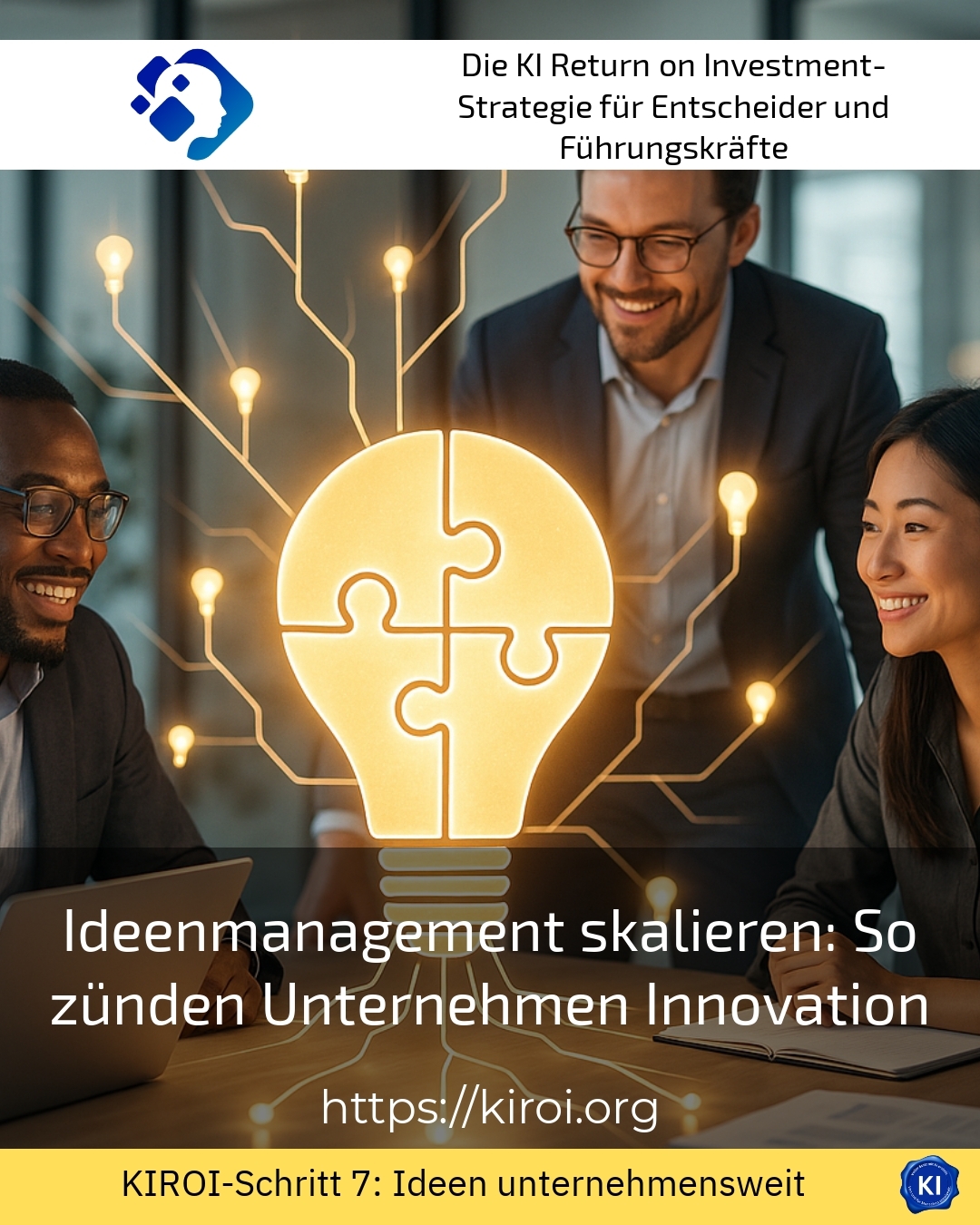
In a rapidly changing economic world, the ability to systematically develop creativity determines success or stagnation. Companies that Scaling ideas management wish to face a fascinating challenge. They must create structures that offer both freedom and direction. This is not about individual flashes of inspiration, but about sustainable processes. These processes transform spontaneous inspirations into measurable value creation. The following lines reveal how organisations can embark on this path of transformation. We will look at proven methods and inspiring practical examples from various industries.
The foundations for the systematic fostering of creativity in organisations
Before companies can expand their creative capacity, they must establish fundamental prerequisites. An open corporate culture forms the indispensable foundation for this. Employees need psychological safety to voice unconventional ideas. At the same time, they require clear channels through which their suggestions can be heard. For example, the automotive supplier Continental implemented a digital portal for suggestions for improvement. This system captures thousands of submissions from all areas of the company annually. Siemens AG, on the other hand, uses internal innovation competitions to unleash creative potential. At these events, teams present their concepts to an expert jury. The chemical company BASF relies on cross-functional workshops that bring together experts from various disciplines. These encounters often lead to unexpected connections between different fields of knowledge.
The technological infrastructure plays just as important a role as the cultural framework. Modern collaboration platforms enable cross-departmental exchange. They transparently document ideas and make evaluation processes understandable. Deutsche Telekom invested heavily in such digital tools, thereby connecting locations across multiple continents. The insurance group Allianz developed its own app for employee suggestions. This application considerably simplifies the submission and commenting on concepts. The energy provider E.ON is also experimenting with artificial intelligence for idea evaluation. Algorithms help to identify promising suggestions more quickly.
Best practice with a AIROI customerA medium-sized mechanical engineering company from Southern Germany faced the challenge of modernising its employee suggestion scheme. The existing system was based on paper forms and long processing times. Employees often lost interest because feedback was too slow. As part of transruption coaching, we supported the company in the digital transformation of this process. Together, we developed a multi-stage implementation strategy for a new platform. This took into account both technical requirements and cultural specificities. The involvement of sceptical managers, who initially feared a loss of control, was particularly important. Through targeted workshops, we were able to address these concerns and win over supporters. After six months, the number of submissions had quadrupled. The average processing time dropped from eight weeks to under two weeks. Employees have since reported higher motivation and a stronger sense of belonging. The company estimates that several implemented suggestions have enabled significant cost savings.
Develop structures to be able to scale ideas management
Scaling requires more than just larger budgets or additional staff. It is rather about intelligent structures that enable organic growth. The pharmaceutical company Bayer established dedicated innovation units in various business areas. These units operate autonomously but report to a central coordination point. This creates local freedom within an overarching framework. The consumer goods manufacturer Henkel follows a different approach. The company directly integrates creativity promotion into existing team structures. Each department has trained innovation managers who provide impetus. Robert Bosch GmbH combines both models. It operates both central research centres and decentralised idea labs.
Process design is crucial for the success of ambitious scaling initiatives. Overly complex processes stifle creativity at the outset. Conversely, overly simple structures lead to chaos and wasted resources. Logistics provider DHL developed a multi-stage funnel process. This systematically filters suggestions for feasibility and strategic relevance. Lufthansa Group uses a stage-gate model for larger innovation projects. Decisions on continuation or termination are made between clearly defined milestones. Retail group Metro relies on agile sprints for rapid prototype development. These iterative cycles allow for early failure without significant investment.
Scaling success factors in idea management across various industries
Different economic sectors require tailored approaches. The financial sector is subject to strict regulatory requirements that limit spaces for experimentation. Deutsche Bank therefore established a separate innovation hub. This consciously operates outside traditional compliance structures. Promising concepts later undergo orderly approval processes. Commerzbank cooperates intensively with fintech startups. Through these partnerships, it gains access to disruptive technologies. The Volksbanken Raiffeisenbanken use their cooperative network for decentralised idea competitions. Regional institutes exchange successful concepts among themselves.
In the manufacturing sector, efficiency gains and quality improvements are often the main focus. Tool manufacturer Hilti systematically involves its field service employees in product development. These employees gather customer feedback and pass on suggestions for improvement. Sports equipment manufacturer Adidas experiments with crowdsourcing platforms, where consumers can submit and rate their own design ideas. Household appliance manufacturer Miele traditionally maintains close relationships with trade businesses, whose practical experience is regularly incorporated into further development.
Best practice with a AIROI customerA leading financial services provider in Frankfurt wanted to fundamentally reform its internal creativity processes. The existing structure had grown organically over years and had become confusing. Various departments used different systems without central coordination. As a result, valuable synergies remained unexploited, and duplicate work was not uncommon. As part of our collaboration, we first analysed all existing channels and processes. We identified considerable friction losses and communication gaps. Together with the management team, we developed an integrated overall concept. This combined decentralised submission options with central evaluation and control. We paid special attention to the interface design between specialist departments and IT. We tested various options through targeted pilot projects before the company-wide rollout. Support from transruptions coaching helped to identify resistance early on. Critical voices were given space to constructively voice their concerns. After full implementation, employee satisfaction in surveys increased significantly. Managers reported higher quality and relevance of the submitted suggestions.
Technological tools and their role in scaling
Digital technologies open up entirely new possibilities for managing creative processes. Artificial intelligence can automatically categorise and prioritise large quantities of suggestions [1]. Software group SAP is integrating machine learning algorithms into its innovation platforms. These recognise patterns and suggest thematic clusters. Insurer Ergo is testing chatbots that support employees in formulating ideas. These digital assistants ask targeted questions, thereby improving submission quality. Technology group Infineon uses virtual reality for collaborative brainstorming sessions. Participants at different locations meet in digital spaces for these sessions.
Data analysis is becoming increasingly important for strategic decisions. Companies can identify trends earlier and allocate resources more effectively. Deutsche Post systematically analyses innovation data from various sources, generating insights into success factors and typical hurdles. Chemical distributor Brenntag links internal suggestion data with external market information, enabling more informed assessments of market potential. Automotive supplier ZF Friedrichshafen uses predictive analytics to forecast implementation success, with historical data helping to identify promising concepts at an early stage.
Empowering and motivating people
All technological tools remain ineffective without dedicated people. Qualification programmes therefore form an indispensable building block for successful scaling. The industrial group ThyssenKrupp offers special training in innovation methods. Employees learn techniques such as Design Thinking or Lean Startup there. The media group Bertelsmann maintains its own academy for creative thinking. This imparts both methodical knowledge and practical skills. The retail group Otto Group relies on peer-learning programmes. Experienced innovators pass on their knowledge to colleagues.
Incentive schemes significantly influence whether employees actively contribute ideas. Financial rewards often play a smaller role than assumed. Furniture manufacturer Ikea relies on recognition and visibility for successful idea generators [2]. These individuals are given the opportunity to present their concepts to management. The tourism group TUI awards annual innovation prizes in various categories. The accolades bring not only prestige but also additional development opportunities. Food manufacturer Nestlé is experimenting with sabbaticals for particularly successful innovators, allowing them to develop their ideas with full concentration.
Best practice with a AIROI customerAn internationally operating consumer goods manufacturer was struggling with declining engagement in its suggestion scheme. Despite attractive prizes, the number of submissions was continuously decreasing. An employee survey revealed surprising insights into the true causes. Many employees found the submission process bureaucratic and time-consuming. Others felt discouraged by previous rejections and saw no point anymore. In the coaching process, we jointly developed a communication campaign for revitalisation. This emphasised non-financial incentives, but rather the contribution to company development. At the same time, we simplified the submission process and introduced faster feedback. The introduction of idea sponsorships by managers was particularly effective. These actively supported promising suggestions through the evaluation process. Furthermore, we established regular innovation cafés for informal exchange. There, employees could share initial thoughts informally before making formal submissions. The measures showed a significant impact within a few months. The participation rate increased by over fifty percent compared to the same period last year.
Overcoming Challenges When Scaling Idea Management
Growth inevitably brings new complexities and potential stumbling blocks. A common challenge involves the balance between quantity and quality. More submissions do not automatically mean better results. Electronics manufacturer Siemens Healthineers therefore deliberately limits the number of parallel initiatives. Focusing is intended to prevent promising concepts from getting lost in the sheer volume. Automotive manufacturer BMW focuses on thematic priorities. These rotate regularly and guide creativity in strategically relevant directions. Software provider Datev uses gamification elements for quality assurance. Employees mutually assess the relevance and feasibility of suggestions [3].
Another critical hurdle lies in the ability to implement. Many organisations gather impressive amounts of ideas but fail during the realisation phase. Energy company RWE therefore established dedicated implementation teams. These teams exclusively handle the implementation of approved concepts. Telecommunications provider Vodafone makes budgets available for rapid pilot projects. Small tests are intended to show early on whether concepts work in practice. Construction company Hochtief directly links innovation management with its project business. New ideas are preferably tested within current projects.
My AIROI Analysis
The systematic development of creative potential is evolving into a core competency of future-proof organisations. Companies that successfully embark on this path combine several success factors. They create cultural conditions that foster openness and a joy for experimentation. At the same time, they establish structured processes that make ideas efficiently assessable and implementable. Technological tools support this, but can never replace human creativity. Empowering and motivating employees remains the crucial lever.
My experience from numerous support projects shows recurring patterns. Successful transformations mostly begin with small, manageable pilot projects. These generate quick successes and convince sceptical observers. Gradual expansions only follow after thorough evaluation of the experiences. At the same time, sustainable change requires patience and perseverance. Cultural habits cannot be reshaped overnight.
Transruption coaching offers tried-and-tested guidance for organisations on this development path. We provide impetus, ask critical questions, and bring in external perspectives. In doing so, we always respect the personal responsibility of our clients. Every company must find its own individual path. There are no miracle cures, but there are proven methods and helpful points of reference. The AIROI perspective combines strategic thinking with a pragmatic focus on implementation. It is precisely this combination that organisations wanting to grow need.
Further links from the text above:
[1] McKinsey: The Promise of Artificial Intelligence
[2] Harvard Business Review: Employee Motivation Insights
[3] Gartner: Innovation Management Research
For more information and if you have any questions, please contact Contact us or read more blog posts on the topic Artificial intelligence here.








 Deutsch
  English (UK)