
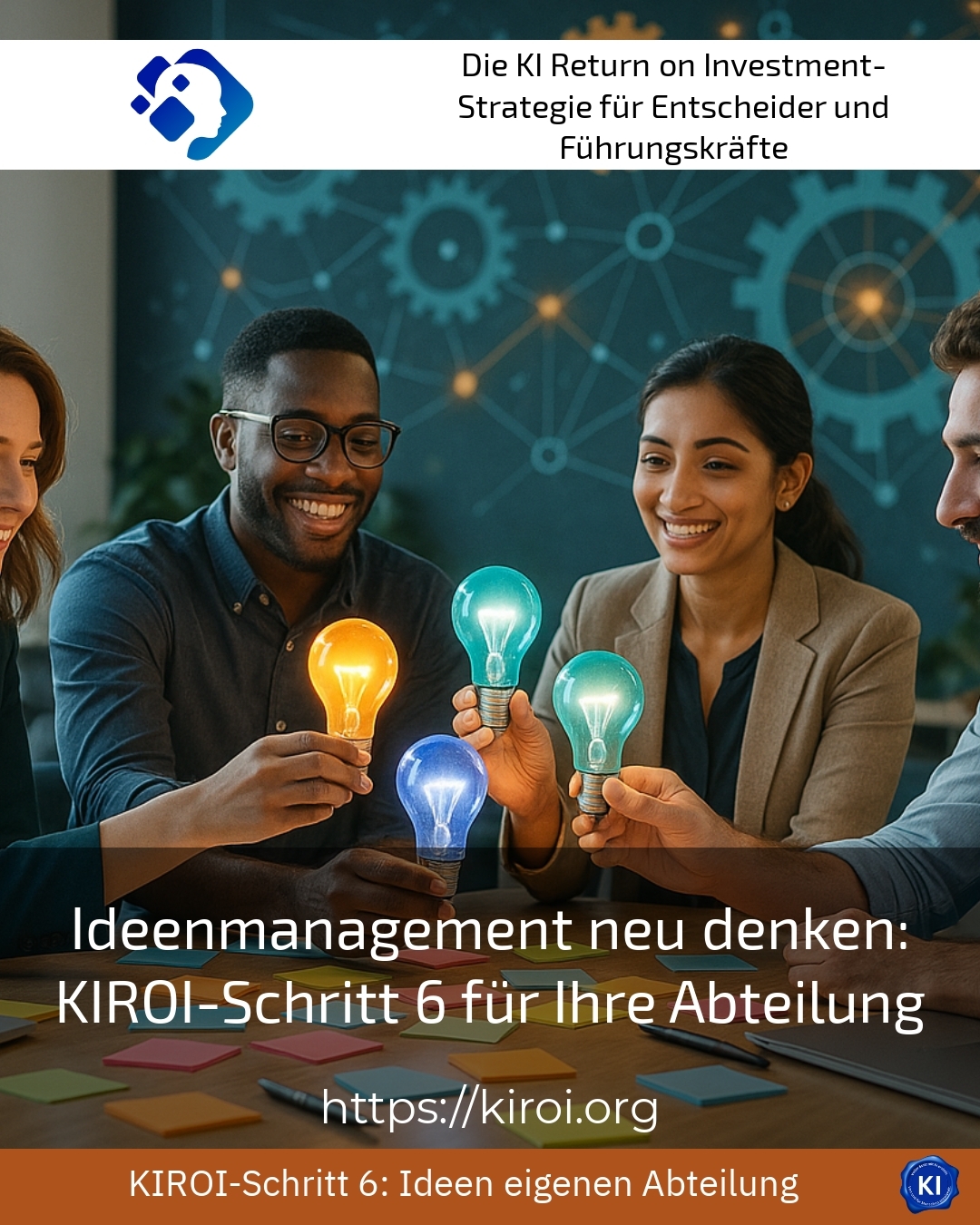
Ideas management is considered a central element for promoting innovation and efficiency within departments. The KIROI approach, with step 6, offers practical support to rethink and specifically shape this process. This step guides teams in systematically transforming creative impulses into concrete and actionable ideas that are effective directly on-site and have a lasting impact.
Rethinking idea management: The importance of KIROI Step 6
The core of the sixth KIROI step is the active promotion of idea development within the department. Clients frequently report that targeted stimulation and structured methods are crucial in unlocking employee potential and effectively realising creative suggestions. This not only strengthens the innovation culture but also fosters the implementation of improvements.
In practice, it is often found that production employees are encouraged by this step, for example, to identify concrete optimisations in the workflow and implement suggestions directly. In the service sector, teams can collaborate more effectively to develop innovative customer solutions. Process simplifications are also possible in administration, saving time and improving quality.
Real-world examples of successful idea management
A medium-sized industrial company established a regular idea workshop through Step 6, where employees from different departments can contribute suggestions and develop them together. This visibly increased participation and led to multiple process improvements in manufacturing.
A digital idea portal was introduced in a service company, allowing ideas to be captured, evaluated, and transparently tracked across locations. The combination of personal moderation and technical support significantly improved the implementation rate.
Another example is a technology company that, with the help of KIROI Step 6, facilitated the knowledge transfer of new technologies through a mentoring programme for young professionals. This ensured that innovative impulses were quickly and sustainably applied in operational business.
How the KIROI approach supports idea development
The coaching provided as part of Step 6 places particular emphasis on practical support within teams. This generates momentum that helps to structure workflows in idea management and to focus on feasible solutions. Among other things, this improves communication between hierarchical levels, which is essential for long-term success.
Implementation also involves examining ideas for feasibility and assigning clear responsibilities for prioritised projects. Employees appreciate it when suggestions are taken seriously and are followed up on transparently. This increases motivation and fosters a culture of co-creation.
This reveals a variety of application areas: In research and development, teams can pursue new product ideas in a more structured way. Production departments often identify optimisation potential that is frequently overlooked through standardised feedback loops. In sales too, customer benefits can be expanded and new market trends picked up through targeted idea management.
Practical tips for implementing idea management Step 6
- Create an open and appreciative atmosphere where employees can share their suggestions without hesitation.
- Organise regular, moderated workshops or creative meetings to encourage idea sharing and leverage synergies.
- Use digital tools to capture ideas, make them transparent, and visualise progress.
- Encourage employees to suggest even small improvements, as these often hold the greatest potential for efficiency.
- Anchor a reward system that not only honours mission-critical ideas but also values the process of participation.
Shaping sustainable idea management in the department
The sixth step of KIROI supports the rethinking and professionalisation of idea management. Conscious support of the processes helps to perceive ideas not just as occasional inputs, but as a driving force for continuous improvements and innovations. This creates an innovation culture within the department that involves all employees and fosters their creativity.
The integration of idea management often leads to higher employee motivation and increased identification with departmental goals. At the same time, the exchange of knowledge and experience is intensified. This allows the organisation to unleash its full potential and respond flexibly to market demands.
BEST PRACTICE with one customer (name hidden due to NDA contract) The customer reported that, through the targeted implementation of Step 6 in one production department, the number of improvement suggestions put into practice rose by 40% within six months. Employees felt more involved and contributed new ideas to optimise work processes. This led to measurable time savings and improved product quality.
BEST PRACTICE with one customer (name hidden due to NDA contract) In a service company, step 6 created a cross-functional team that organised innovation workshops. This allowed several suggestions from idea management to be translated into new, practically relevant service offerings, which sustainably increased customer satisfaction.
BEST PRACTICE with one customer (name hidden due to NDA contract) A technology group used Step 6 to improve knowledge transfer between departments via a mentoring programme. New employees were thus quickly integrated into existing idea projects, which noticeably increased the pace of innovation.
My analysis
Innovative and efficient idea management is essential today to future-proof departments. KIROI Step 6 addresses this very point, supporting teams in systematically developing and effectively implementing ideas. The practical examples show how different industries can benefit from this support – whether through fostering an open innovation culture, utilising digital tools, or improving knowledge transfer and collaboration.
With a clearly structured process, Step 6 supports the full realisation of employee potential and the maintenance of sustainable innovation dynamics. In this way, KIROI creates a valuable framework that understands idea management as a continuous and integrative process, thereby effectively strengthening the success of departments.
Further links from the text above:
Department optimisation: With KIROI step 6 to the think tank
Mastering Idea Development: KIROI Step 6 for Your Department
Ideation management with KIROI: Step 7 for company-wide success
Technological support in idea management
Idea management methods including free booklet
Idea Management: Definition, Processes & Benefits – HRworks
For more information and if you have any questions, please contact Contact us or read more blog posts on the topic Artificial intelligence here.











 Deutsch
  English (UK)